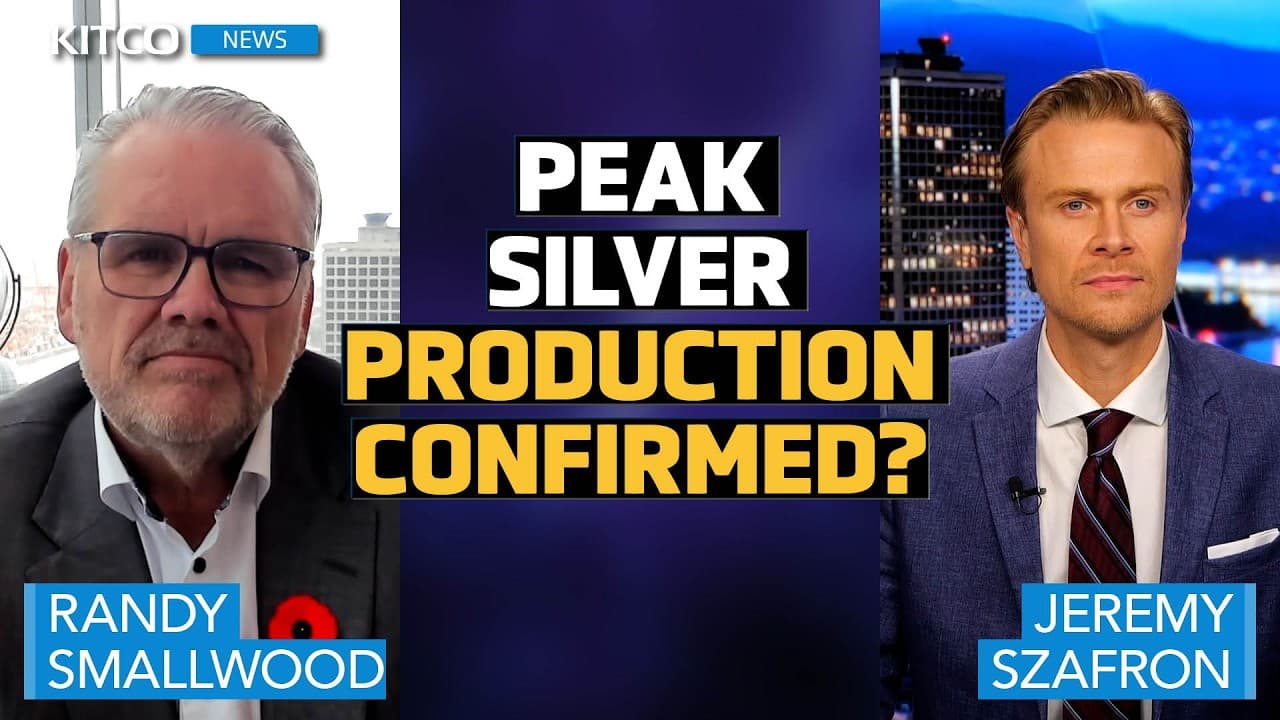
Why Are Gold and Silver Streamers Growing Now? U.S. Silver Critical Status, Wheaton CEO Randy Smallwood, and Peak Supply
TL;DR
Gold and silver streamers are growing because strong metal prices are advancing mining projects that need capital, while streams can fund development without miners issuing discounted shares. Wheaton Precious Metals expects close to $2 billion in annual free cash flow, has zero debt, and committed $670 million to Spring Valley. Read on for Randy Smallwood’s explanation of the financing model, production outlook, and expanding opportunity set.
Transcript
Welcome back. I'm Jeremy Saffron. Gold on the spot side, holding right around $4,000 an ounce. A critical psychological level, even as it consolidates off of its recent all-time highs. And this marks, of course, the strongest sustained rally in modern history. One of them at least. I mean, it's the kind of move we've only ever seen really three tim... Read More
Key Insights
- Uncertainty supports precious metals: Smallwood does not describe Wheaton as detached from wider market concerns. Instead, he argues that weak sentiment, equity-market pressure, and uncertainty support demand for precious metals. That strength benefits Wheaton twice, through the value of its metal exposure and through additional mining projects becoming attractive enough to advance.
- High prices unlock projects: Stronger gold and silver prices encourage miners to approve construction, expansions, optimizations, and other improvements. Each decision can create a need for outside capital. Because Wheaton supplies capital through streaming agreements, a wider set of economically viable projects expands the company’s potential transaction pipeline.
- Streams can prevent dilution: Mining shares may trade below the net asset value of the underlying operations. Raising money by issuing equity under those conditions adds shareholders and dilutes existing owners. Smallwood says a stream offers another route because it is priced according to the relevant metal’s value, potentially making it a more attractive funding source.
- Cash flow supports dual priorities: Wheaton expects close to $2 billion in free cash flow for the year as production grows. Management can reinvest this capital in accretive precious-metals agreements while continuing shareholder distributions. The reported 6.5% dividend increase, record earnings, and zero debt illustrate how the streaming model can combine investment capacity with returns to shareholders.
- Patience shaped Nevada entry: Wheaton had reviewed Nevada royalties and stream financings but considered them expensive. Rather than purchasing exposure at those valuations, it waited for an opportunity management viewed as accretive. Spring Valley became that opportunity, leading to a $670 million commitment in a jurisdiction Smallwood described as highly attractive for gold mining.
- Partnerships generate repeat business: The Spring Valley transaction came through Waterton Group, an existing Wheaton partner. Their earlier agreement covered Arizona’s Mineral Park mine, which was preparing to begin production. Smallwood linked this repeat relationship to Wheaton’s effort to be a partner of choice and to help counterparties make their projects successful.
- Processing affects expansion potential: Spring Valley is not expected to process all material in the same way. Approximately 30% to 40% is planned to be crushed and stacked on the heap-leach pad, while the balance is expected to be run-of-mine material. That configuration could allow additional material to enter the plan at stronger gold prices.
- Price assumptions leave upside: Spring Valley’s reserve was calculated using $1,800 gold, while its resource used approximately $2,200 gold. Smallwood contrasted those assumptions with higher spot prices and suggested more material could reach the heap. This supports his view that Wheaton’s deliveries may eventually exceed the current estimate of about 28,000 ounces annually.
- Thirty thousand ounces is plausible: Under the existing Spring Valley plan, Wheaton expects approximately 28,000 ounces per year. Smallwood said he would not be surprised to receive well over 30,000 ounces annually in the future. His view reflects the project’s price assumptions, processing design, and additional exploration potential.
- Guidance favors upper range: Wheaton’s annual production guidance runs from 600,000 to 670,000 ounces. After three quarters, management expected the result to fall in the upper half of that interval. This near-term expectation sits alongside a five-year growth profile exceeding 900,000 ounces and potential progress toward one million ounces.
- Partner improvements add optionality: Smallwood considers Wheaton’s longer-term production outlook conservative because operating partners continue proposing expansions, faster development schedules, and site optimizations. These changes can increase deliveries without requiring Wheaton to operate the mines directly. They therefore provide additional growth possibilities beyond the production already included in the stated profile.
- Streaming limits cost exposure: Traditional miners can face rising operating expenses during the same inflationary conditions that support gold prices. Higher prices may also convert material previously classified as high-grade waste into low-grade ore. Because mining costs are generally tied to tonnage, processing lower-grade material raises cost per ounce or pound, while streaming companies face that pressure less directly.
Install to Summarize YouTube Videos and Get Transcripts
Explore YouTube Video Summarizer or Get YouTube Transcript Extractor
Questions & Answers
Q: Why are gold and silver streamers growing now?
Strong gold and silver prices are encouraging mining companies to advance construction, expansions, and operating improvements. Those projects need capital, creating more opportunities for streaming companies such as Wheaton Precious Metals. A stream can also be more attractive than issuing mining shares when equities trade below net asset value because it avoids adding many new shareholders. Wheaton’s strong cash flow and zero debt give it capacity to finance these opportunities.
Q: How does precious-metals streaming finance a mining project?
A streaming company supplies capital that a miner can use to acquire, construct, expand, or optimize an asset. The agreement is valued using the metal connected to the stream. Smallwood says this approach can be more attractive when the mining company’s shares trade below net asset value. It funds development without relying on a large equity issuance that would dilute existing shareholders.
Q: Why did Wheaton invest $670 million in Spring Valley?
Wheaton wanted Nevada exposure but considered previously available royalties and stream financings expensive. Management waited until it found an opportunity it viewed as accretive. Spring Valley also extended Wheaton’s existing relationship with Waterton Group, its partner on Arizona’s Mineral Park mine. The project’s expected production, heap-leach design, price assumptions, and exploration potential strengthened its appeal.
Q: How much could Spring Valley deliver to Wheaton?
The current plan indicates approximately 28,000 ounces per year for Wheaton. Smallwood said he would not be surprised if deliveries eventually reached well above 30,000 ounces annually. The reserve used a gold price of $1,800, while the resource used approximately $2,200. Higher spot prices and exploration potential could allow more material to enter the production plan.
Q: How will Spring Valley process its material?
Spring Valley is planned as a conventional Nevada heap-leach operation. Approximately 30% to 40% of the material is expected to be crushed and stacked on a heap-leach pad. The remaining material is planned for run-of-mine heap-leach processing. This design matters because stronger gold prices could make additional material economic enough to place on the heap.
Q: What is Wheaton’s production growth outlook?
Wheaton’s annual production guidance is between 600,000 and 670,000 ounces. After three quarters, management expected production to finish in the upper half of that range. The company’s five-year growth profile rises above 900,000 ounces. Proposed partner expansions, accelerated projects, and optimizations could move annual output closer to one million ounces.
Q: How is Wheaton using its growing cash flow?
Wheaton expects close to $2 billion in free cash flow for the year. Management plans to reinvest that capital through carefully structured, accretive precious-metals streams. It is also returning capital to shareholders, including a 6.5% dividend increase. The company is pursuing these investments and distributions while reporting zero debt.
Q: Why is streaming less sensitive to mining inflation?
Traditional miners directly absorb operating costs that may rise during inflationary periods supporting gold prices. Higher metal prices can also convert material once treated as waste into lower-grade ore worth processing. Because costs are generally tied to the tonnage processed, lower grades increase the operating cost per ounce or pound. Streaming companies receive contractual metal exposure and therefore face these operating pressures less directly.
Summary & Key Takeaways
-
Precious metals gain support: Spot gold held near $4,000 an ounce while the S&P pulled back, U.S. consumer sentiment reached a new three-year low, and the government shutdown created a data drought. Randy Smallwood said concerns affecting the broader market were supporting precious metals. Strength in gold, followed more recently by silver, was also helping mining assets move toward construction decisions, creating additional opportunities for Wheaton Precious Metals to supply capital.
-
Streaming funds mining growth: Wheaton reported record earnings, increased its dividend by 6.5%, deployed close to $1 billion during the quarter, and carried zero debt. Smallwood said this combination demonstrates why streaming can support both growth and shareholder returns. When mining equities trade below net asset value, issuing shares can dilute existing owners. A stream may be more attractive because its price is based on the value of the underlying metal.
-
Multiple transactions deploy capital: Before Spring Valley, Wheaton completed a $300 million Hemlo stream that helped Hemlo Mining Corporation acquire the asset. Smallwood presented the Hemlo and Spring Valley agreements as examples of Wheaton putting its cash flow to work through carefully selected transactions. He also emphasized the company’s goal of becoming a partner of choice by helping counterparties succeed, rather than treating streams solely as financial arrangements.
-
Spring Valley adds Nevada exposure: Wheaton committed $670 million to Spring Valley after patiently waiting for an accretive Nevada opportunity. The agreement extends its relationship with Waterton Group, which also covers the Mineral Park mine in Arizona. Spring Valley is planned as a heap-leach operation, with approximately 30% to 40% of the material crushed and stacked. The remaining material is expected to enter the heap as run-of-mine material.
-
Production growth remains substantial: Spring Valley’s current plan is expected to deliver about 28,000 ounces annually to Wheaton, although Smallwood said production could rise well above 30,000 ounces. Wheaton’s annual guidance is 600,000 to 670,000 ounces, with management expecting the upper half of that range. Its five-year profile exceeds 900,000 ounces, while partner expansions, accelerated projects, and site optimizations could eventually move annual production toward one million ounces.
Read in Other Languages (beta)
Share This Summary 📚
Summarize YouTube Videos and Get Video Transcripts with 1-Click
Try YouTube Summary with ChatGPT & Claude or YouTube Transcript Generator
Explore More Summaries from Kitco NEWS 📚






Summarize YouTube Videos and Get Video Transcripts with 1-Click
Try YouTube Summary with ChatGPT & Claude or YouTube Transcript Generator