What role does gold play in Fed policy and markets?
TL;DR
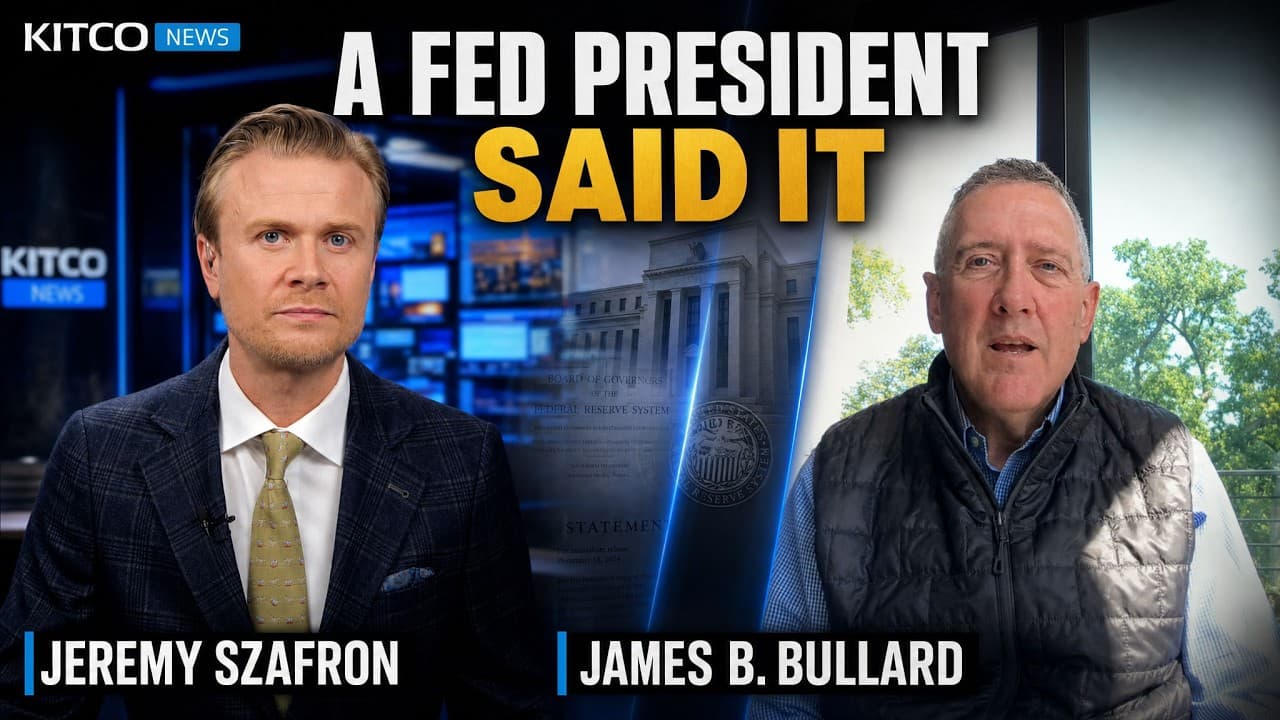
Warsh argues the central bank bears responsibility for long running inflation while markets priced in a September rate hike after his Jackson Hole speech. Bullard describes the Fed committee as split roughly 10 to 9 and discusses how a hold can still be hawkish. He also notes foreign central banks diversifying into gold.
Transcript
Welcome back. I'm Jeremy Schafer. Great show for you today. The chairman of the Federal Reserve stood up in Wyoming this morning and put five and a half years of inflation on his own institution. His words, [music] "The responsibility sits squarely with the central bank and that is where it belongs." Now, if you spent years arguing the central bank... Read More
Key Insights
- Gold and Treasuries have become part of a broader diversification trend among foreign central banks.
- Markets moved toward pricing in a September rate hike within an hour of the Jackson Hole speech.
- The FOMC is described as roughly split, with a central tendency around a hold or a limited number of hikes.
- The dot plot is expected to be a key tool for near term guidance on future policy paths.
- Inflation responsibility is attributed to the central bank, according to Warsh.
- The real economy is described as strong, with low unemployment and AI related growth.
- The discussion raises the possibility that a hold can still be hawkish depending on context.
- Debt concerns are raised, with refernce to deficits and rising debt to GDP ratios.
Install to Summarize YouTube Videos and Get Transcripts
Explore YouTube Video Summarizer or Get YouTube Transcript Extractor
Questions & Answers
Q: What is the main claim about inflation responsibility in the Jackson Hole speech?
The central bank bears responsibility for 65 months of sustained elevated inflation, and that accountability sits squarely with the central bank, according to Warsh. The statement signals that inflation is a policy outcome tied to central bank actions, which markets may interpret as justification for potential future policy adjustments.
Q: How did markets react to the speech in terms of rate expectations?
Markets moved the probability of a September rate hike from a long shot to the base case within about an hour after the speech. This shift reflects a reassessment of inflation dynamics and the likelihood of tighter monetary policy in the near term, aligning with a more hawkish stance among many policymakers.
Q: What does Bullard say about the FOMC split and its numerical representation?
Bullard estimates the committee is split roughly 10 to 9, indicating a near even division on policy direction. He frames the decision as a balance between holding and potentially tightening, with many participants being on the fence and capable of being convinced to move in either direction depending on incoming data.
Q: Why is the dot plot mentioned, and what is its potential impact?
The dot plot is mentioned as a source of near term forward guidance showing where policy might head by year end. It can influence market expectations because it signals the committee’s expectations for the funds rate, creating potential tensions if the actual moves diverge from the plotted path, particularly around September and beyond.
Q: What is the argument about forward guidance versus reaction functions?
Warsh argues against publishing a rigid reaction function because it can mislead markets and constrain the committee, but Bullard says explaining reasoning without rigid forward guidance can still be valuable. The debate centers on whether clear, calendar based forecasts help or hinder policy flexibility amid uncertain data.
Q: How does the discussion link gold to central bank credibility?
The speakers connect gold demand to eroding faith in the Fed, suggesting that central banks are diversifying away from Treasuries and toward gold as a hedge. This dynamic is framed as a signal of long run credibility concerns and potential policy pressures from outside traditional monetary instruments.
Q: What concerns are raised about fiscal policy and debt?
There is a warning about 6 percent deficits as a structural factor and debt heading toward 120 percent or 150 percent of GDP, implying long run sustainability concerns. Those fiscal dynamics can interact with monetary policy expectations, influencing the perceived need for tighter policy or alternative instruments.
Q: What scenario is described for September regarding policy action?
The discussion suggests September could serve as a test of institutional credibility, depending on whether the committee moves or holds. There is recognition that a single hold could still be hawkish if the underlying data imply persistent inflation pressures, and that action in October or December might follow if data justify it.
Summary & Key Takeaways
-
Warsh claims inflation responsibility lies with the central bank and markets reacted quickly to his Jackson Hole remarks, pushing probability of a September hike higher. The discussion frames a divided FOMC and how forward guidance could affect market expectations. Bullard emphasizes that the real economy looks strong while inflation remains stubborn.
-
The conversation explains the potential pathways for September policy moves, including how the dot plot and forward guidance interact with market pricing. It also contrasts views on gold versus Treasuries and suggests central banks are diversifying away from traditional assets.
-
The dialogue covers fiscal concerns and debt dynamics, cautioning about deficits and debt levels, while linking gold demand to eroding faith in central bank credibility and the signaling effect on monetary policy.
Read in Other Languages (beta)
Share This Summary 📚
Summarize YouTube Videos and Get Video Transcripts with 1-Click
Try YouTube Summary with ChatGPT & Claude or YouTube Transcript Generator
Explore More Summaries from Kitco NEWS 📚

Summarize YouTube Videos and Get Video Transcripts with 1-Click
Try YouTube Summary with ChatGPT & Claude or YouTube Transcript Generator