What Is Sample Space and Types of Events in Probability?
TL;DR
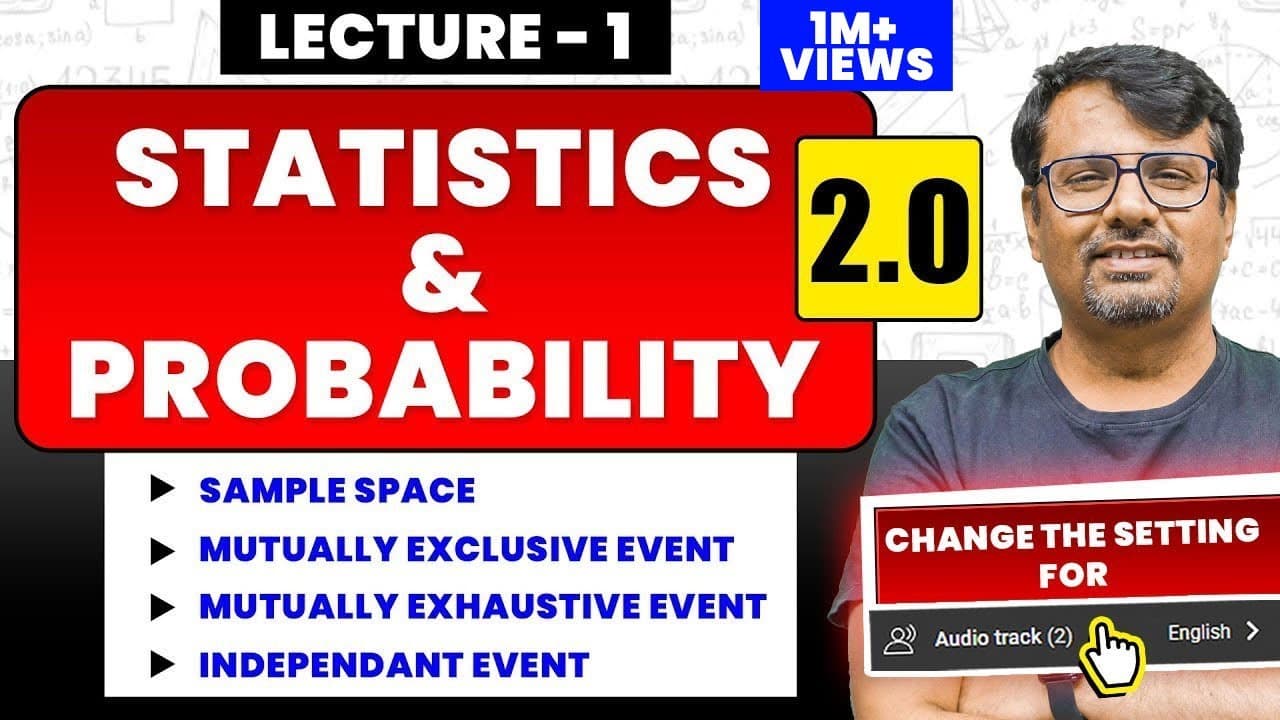
Sample space is the set of all possible outcomes of a random experiment, and without knowing it you cannot calculate any probability. Tossing a coin n times gives 2^n sample points, while throwing a die n times gives 6^n. A standard deck holds 52 cards: 26 black, 26 red, 12 face cards, and 16 owner cards.
Transcript
Hello students, my name is Dr. Gajendra Purohit and you are watching our YouTube channel. Today I am going to start a new topic that is probability and statistics where I will be discussing and covering everything in detail in my upcoming classes. And the old videos I uploaded, you can see the entire playlist here. There we started with random vari... Read More
Key Insights
- A random experiment is an experiment whose outcome cannot be planned or known beforehand. The instructor contrasts a leaked exam paper, where a hundred percent score is certain and probability does not apply, with an unseen paper, where an eighty percent score reflects genuine randomness.
- Sample space is the set of all possible outcomes of an experiment. Probability of any event cannot be determined without first knowing the sample space, because the denominator of the probability comes directly from counting those possible outcomes.
- The number of sample points when a coin is tossed n times is two to the power n. One toss gives two outcomes, two tosses give two to the power two, and three tosses give two to the power three, which is the eight sequences from HHH through TTT.
- Dice sample points follow six to the power n. A single die thrown once has six outcomes, one through six, and two dice thrown together produce six to the power two ordered pairs running from one comma one up to six comma six.
- Tossing a single coin twice and tossing two coins once produce the same sample points. The same equivalence holds for dice: one die thrown two times gives the same sample space as two dice thrown together, so this common exam confusion has no effect on the answer.
- Writing the two-dice sample space in a fixed systematic order is the technique that removes difficulty from these questions. Pairing one with each of one through six, then two with each, and so on, guarantees no outcome is missed when counting a specific event.
- A standard deck contains fifty two cards, twenty six black and twenty six red. The black cards split into thirteen spades and thirteen clubs, called chidi in Hindi, while the red cards split into thirteen hearts, called lal paan, and thirteen diamonds.
- Face cards are the Jack, Queen and King of each suit, giving three per suit and twelve in total, six black and six red. Adding the ace to each suit's J, Q and K produces sixteen owner cards, four in every suit.
Install to Summarize YouTube Videos and Get Transcripts
Explore YouTube Video Summarizer or Get YouTube Transcript Extractor
Questions & Answers
Q: What is a sample space in probability?
Sample space is the set of all possible outcomes of an experiment. The instructor stresses that without proper knowledge of the sample space you cannot determine the probability of anything. The lottery example makes this concrete: if you draw a ticket and win, that fact alone tells you nothing numerically, but once you know the box holds one hundred tickets and one prize, the probability of winning with a single ticket is one by hundred. When a coin is tossed, the possible outcomes head or tail form the sample space, and whichever one actually occurs is the event.
Q: What is a random experiment and why does randomness matter in probability?
A random experiment is one carried out without planning, so the outcome is unknown in advance. The instructor states that if anything is done with planning, the concept of probability is never applied. His example is an exam: if the paper has been leaked you already know you will get full marks, so there is no probability involved, whereas scoring eighty percent on an unseen paper reflects real uncertainty. Similarly, if you know which lottery ticket holds the prize, your chance of winning is a hundred percent. Throwing dice, tossing a coin, drawing a card from a deck and taking a ball from a box of differently colored balls are all random experiments.
Q: How to calculate the number of sample points when a coin is tossed multiple times?
The number of sample points is two raised to the number of tosses. One toss gives two to the power one, that is head or tail. Two tosses give two to the power two, which lists as head head, head tail, tail head and tail tail. Three tosses give two to the power three, which the instructor lists as HHH, HHT, HTH, THH, HTT, THT, TTH and TTT. To write the list without missing anything, take each outcome of the first toss and multiply it through every outcome of the remaining tosses, working systematically until the complete sample space is obtained.
Q: How many sample points are there when two dice are thrown?
Two dice thrown together produce six to the power two sample points. The instructor writes them in a fixed systematic order: one comma one, one comma two, on through one comma six; then two comma one through two comma six; then three, four, five and six paired the same way, ending at six comma six. Following this order is what keeps the enumeration complete. For a single die the count is six to the power one, since the outcome can be one, two, three, four, five or six.
Q: Is tossing one coin twice the same as tossing two coins once?
Yes. The instructor addresses this directly because it is a frequent source of confusion in exam questions. If a single coin is tossed twice, or two coins are tossed one time, the sample points are the same. The identical rule applies to dice: two dice thrown once and one die thrown two times give the same sample space. His advice is not to get confused by how the question is worded, since the phrasing does not change the set of possible outcomes or the count of sample points.
Q: How to find the probability that the sum of two dice is eleven or more?
Start by writing out the full sample space of two dice, which is the six to the power two ordered pairs running from one comma one to six comma six. Then identify which of those pairs give a sum of eleven or more, meaning a total of either eleven or twelve. The instructor points out those specific outcomes on the enumerated grid and notes that once the sample space is in front of you, the probability of any event like this can be calculated easily. This is his general argument for why writing the sample space first is worth the effort.
Q: How many face cards and owner cards are in a deck of 52 cards?
There are twelve face cards in a deck of fifty two. Face cards are the Jack, Queen and King, and since each of the four suits has one of each, the count is three plus three plus three plus three, which equals twelve. Of those, six are black face cards and six are red face cards. Owner cards are the ace together with the Jack, Queen and King, which gives four cards in each suit and sixteen owner cards in the full deck. The instructor also refers to Jack, Queen and King as Gulam, Begum and Badshah.
Q: What are the four suits in a deck of cards and how are they divided?
A deck has fifty two cards, of which twenty six are black and twenty six are red. The black cards divide into thirteen spades, which the instructor calls kala paan, and thirteen clubs, called chidi in Hindi. The red cards divide into thirteen hearts, called red heart or lal paan, and thirteen diamonds. Within every one of the four suits the sequence is the same: one ace, then the number cards from two up to ten, then Jack, Queen and King. Knowing this breakdown is what makes card-based sample space questions straightforward.
Summary & Key Takeaways
-
This lecture opens a new Statistics and Probability 2.0 series by Dr. Gajendra Purohit, built as a from-the-basics rebuild of an earlier playlist that had already covered random variables, PDF, PMF, probability distributions, joint PDF, joint PMF, MGF and CGF. The planned sequence starts with terminology and types of events.
-
A random experiment is one whose outcome is not planned or known in advance. If an exam paper is leaked, the student knows full marks are coming, so probability does not apply. If the paper is unseen and the student scores eighty percent, that reflects genuine uncertainty. Throwing dice, tossing coins, drawing cards and picking colored balls are all random experiments.
-
Sample space is the set of all possible outcomes of an experiment, and probability cannot be determined without it. A lottery win means nothing numerically until you know the box holds one hundred tickets, at which point the chance of winning with one ticket is one by hundred.
-
Coin sample points follow powers of two: one toss gives two to the power one, two tosses give two to the power two (HH, HT, TH, TT), and three tosses give two to the power three, listed as HHH, HHT, HTH, THH, HTT, THT, TTH, TTT. The full listing is built by systematically multiplying each first-position outcome with the rest.
-
Dice follow powers of six. One die gives six to the power one outcomes, one through six. Two dice give six to the power two, written systematically as (1,1) through (6,6). Tossing one coin twice and tossing two coins once yield the same sample points, as do one die thrown twice and two dice thrown together.
-
Once the sample space is written out, event probabilities follow directly. For a sum of eleven or more with two dice, only the outcomes summing to eleven or twelve qualify, and those can be read straight off the enumerated grid of thirty six pairs.
-
A deck has fifty two cards split into twenty six black and twenty six red. The black half divides into thirteen spades and thirteen clubs (called chidi in Hindi), and the red half into thirteen hearts (lal paan) and thirteen diamonds.
-
Each of the four suits runs ace, then two through ten, then Jack, Queen and King. J, Q and K are face cards, giving three per suit and twelve in total, six black and six red. Adding the ace to J, Q and K in each suit gives sixteen owner cards, four per suit.
Read in Other Languages (beta)
Share This Summary 📚
Summarize YouTube Videos and Get Video Transcripts with 1-Click
Try YouTube Summary with ChatGPT & Claude or YouTube Transcript Generator
Explore More Summaries from Dr.Gajendra Purohit 📚




Summarize YouTube Videos and Get Video Transcripts with 1-Click
Try YouTube Summary with ChatGPT & Claude or YouTube Transcript Generator