What Is the Continuum of AI Capabilities and Risks?
TL;DR
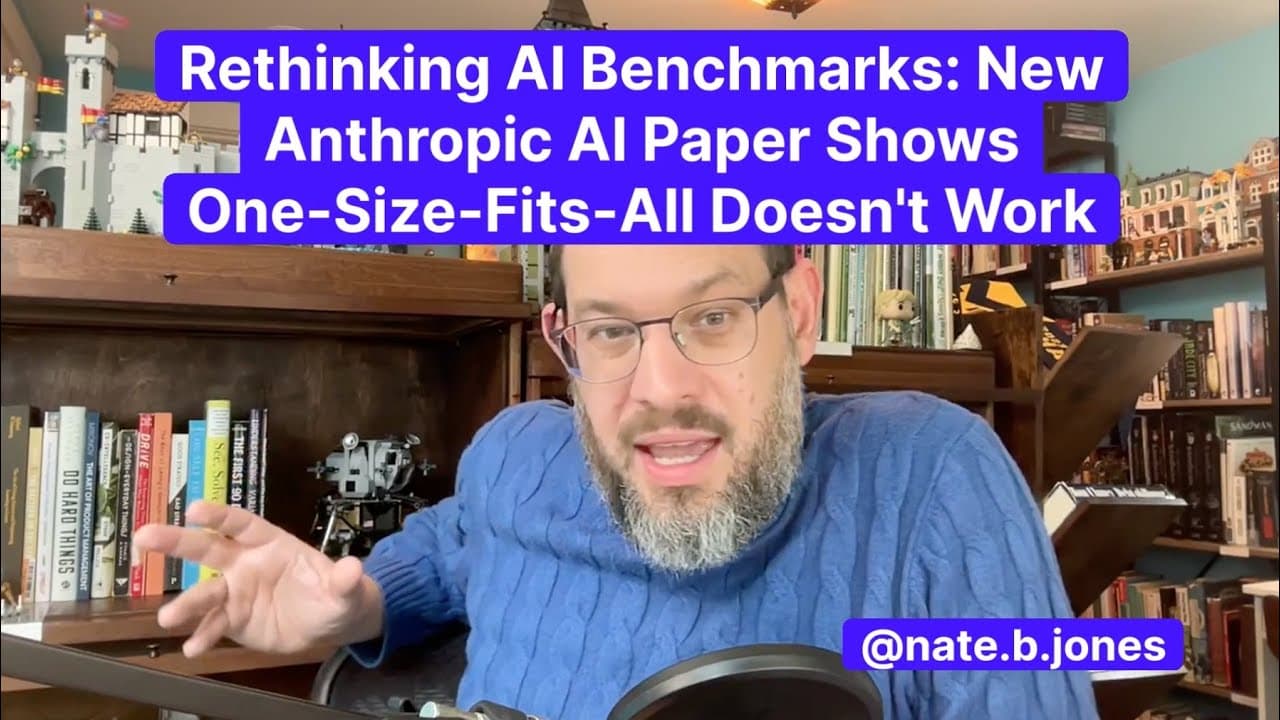
AI outputs lie on a spectrum from truth to hallucination, and their behavior is highly context dependent. The key point is to test models across multiple architectures, understand how they reason and pattern match, and evaluate agency and autonomy rather than rely on simple benchmarks. Practical evaluation requires detailed continuums that reveal model strengths and limits for useful work.
Transcript
so I think this kind of needs the Star Trek next Generation Vibe because we're going to be talking about some really abstract stuff it just feels like we should be soaring through space so so put on that hat fundamentally what I want to talk about today is the idea that we are developing AI systems so quickly that we're having trouble understanding... Read More
Key Insights
- AI outputs are not simply true or false; they exist on a continuum of truth and hallucination depending on model, prompt, and context.
- Reasoning in AI is multi-faceted, combining pattern matching and multi-step thought, with different models emphasizing different inference pathways.
- Tokens and inference can involve multi-threading, Monte Carlo tree search, and models of experts, leading to varied reasoning styles across models.
- A continuum of agency is debated, distinguishing between autonomous-like behavior and simulated goals shaped by the RL environment and prompts.
- Understanding model capabilities requires model-specific testing and cross-model comparisons rather than relying on a single benchmark or score.
- Prompts can influence apparent multi-step thought, potentially blurring the line between surface pattern matching and genuine reasoning.
- Reliance on traditional benchmarks may be misleading because scores are overfitted to particular tasks and models.
- A common language for continuums, including truth versus hallucination, pattern matching versus reasoning, and autonomy versus simulation, can improve benchmarking and decision making.
- More videos from this channel:
- More from this channel: AI News & Strategy Daily | Nate B Jones
Install to Summarize YouTube Videos and Get Transcripts
Explore YouTube Video Summarizer or Get YouTube Transcript Extractor
Questions & Answers
Q: How can we define AI capability without relying on binary truth or falsehood?
AI capability can be understood as existing along a continuum where outputs can be more or less truthful depending on context, model, and prompt. The approach is to test across multiple models, analyze where each stands on this spectrum, and use that information to inform safe deployment, expectations, and alignment assessment.
Q: Why is the distinction between pattern matching and multi-step thought important?
The distinction matters because some AI systems appear to reason when they are effectively performing advanced pattern matching guided by prompts, while others genuinely engage in multi-step reasoning. Recognizing this helps set realistic expectations, design better prompts, and choose models that fit the required level of deliberation for a task.
Q: What does the Continuum of agency imply for AI deployment?
The continuum implies we should assess whether a model exhibits genuine autonomous-like planning or merely simulates goals through conditioning and prompts. This informs how much autonomy we grant, what safety controls are necessary, and how we evaluate alignment and responsibility in practical applications.
Q: How should benchmarking evolve according to the video?
Benchmarking should evolve to include durable continuums that compare models across multiple dimensions, such as hallucination versus truth, reasoning versus pattern matching, and autonomy versus simulation. This approach reduces overfitting to a single metric and provides a richer understanding of model capabilities for real-world use.
Q: What role does testing play in understanding AI models?
Testing plays a central role by revealing performance differences and prompt adherence across models. Regular, structured tests with careful prompts expose how models handle diverse scenarios, enabling more accurate assessments of capability, reliability, and alignment beyond generic scores.
Q: How can prompts affect perceived AI reasoning?
Prompts can guide models toward producing more coherent, multi-step outputs, making it seem like the model is reasoning deeply. This phenomenon can blur the line between true reasoning and sophisticated pattern completion, underscoring the need for careful analysis of prompt design and its impact on observed capabilities.
Q: Why are traditional tests considered insufficient according to the video?
Traditional tests are viewed as overfitted to specific tasks and models, failing to capture the full range of capabilities and limitations. A broader framework of continuums allows for more robust comparisons and better understanding of where a model excels or struggles in practical scenarios.
Q: What is the practical goal of mapping AI continuums?
The practical goal is to provide a durable, shared framework for evaluating models that helps researchers and practitioners place models on relevant dimensions, understand where they fit in terms of capability and risk, and guide responsible, value-driven use of AI systems.
Summary & Key Takeaways
-
The video argues that AI capabilities are not binary but exist along continuums such as truth versus hallucination, pattern matching versus deep reasoning, and genuine autonomy versus simulated goals, requiring nuanced evaluation across models.
-
Testing is essential to reveal differences between models, with careful, structured prompts and cross-model comparisons to understand performance and adherence.
-
A practical path forward is creating durable continuums and benchmarks that measure capability in working actions rather than relying on traditional test scores.
Read in Other Languages (beta)
Share This Summary 📚
Summarize YouTube Videos and Get Video Transcripts with 1-Click
Try YouTube Summary with ChatGPT & Claude or YouTube Transcript Generator
Explore More Summaries from AI News & Strategy Daily | Nate B Jones 📚






Summarize YouTube Videos and Get Video Transcripts with 1-Click
Try YouTube Summary with ChatGPT & Claude or YouTube Transcript Generator