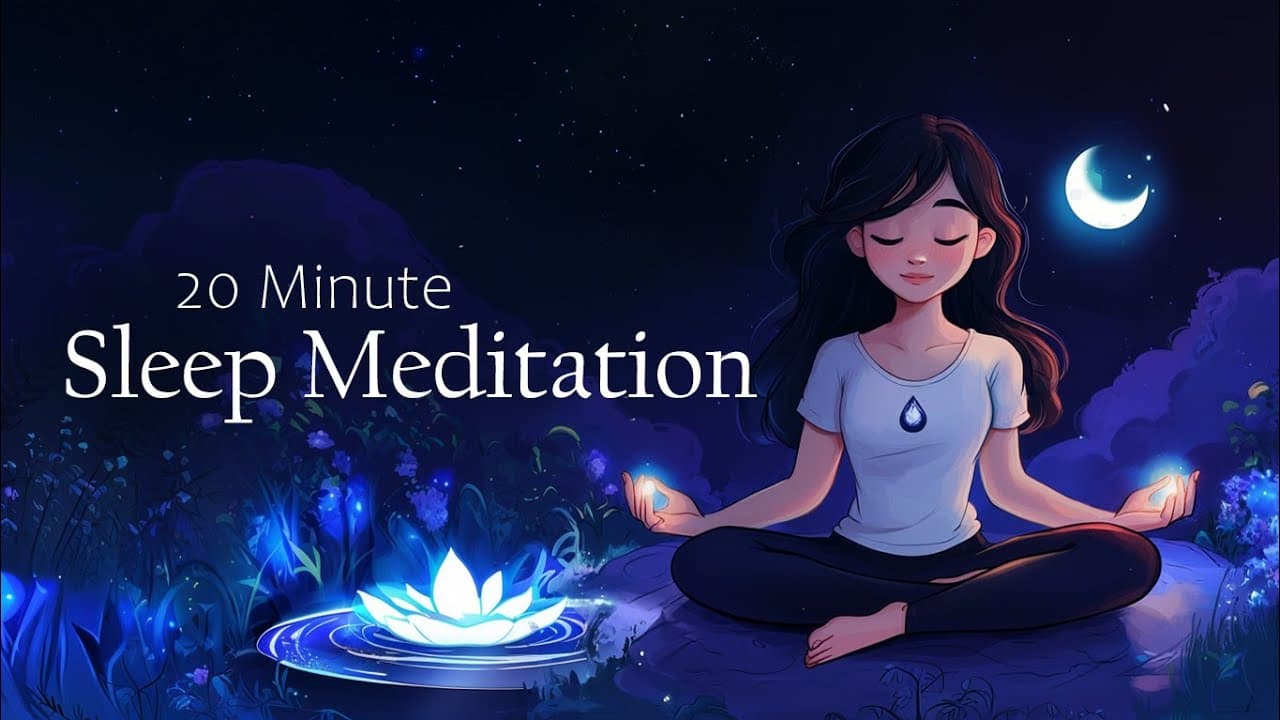
How to Fall Asleep With a Guided Meditation
TL;DR
Relax by observing your breath, lengthening an exhale, and gradually softening areas such as your forehead, jaw, and shoulders. Then imagine standing in a flowing river whose changing currents represent a natural, valid path through life, allowing self-kindness, gratitude, and trust to replace tension as you move toward sleep.
Transcript
Begin by inviting all of your awareness to enter into this time and space with your beautiful breath and body. inviting both of which to be as calm and relaxed as they'd like to be at this time as if you're greeting the breath in the body saying hello breath hello body. Thank you for letting me be here, present with you right now. And in doing so, ... Read More
Key Insights
- Present-moment awareness begins by greeting the breath and body with appreciation, then inviting both to become as calm and relaxed as they would like. This approach treats relaxation as permission rather than a demand and establishes a gentle relationship with the current moment.
- A longer, slower exhale is used after a deep inhalation to help the listener settle into the meditation. The guidance encourages experimentation with making the exhale longer than the inhale while emphasizing trust in the listener’s own breathing rhythm and natural flow.
- The observer perspective involves experiencing the air as though it is breathing the listener. Instead of trying to control every sensation, the listener watches the breath, body, thoughts, and emotions with curiosity, allowing whatever arises to be present as an act of kindness.
- Physical relaxation focuses on making the eyebrows, forehead, jaw, and shoulders soft and heavy. The listener is also invited to notice other areas that could relax more deeply and to reassure the body that it has done enough for the day.
- Self-appreciation is presented as a reciprocal relationship between the listener and the body. The meditation encourages gratitude for the physical form and imagines the body returning that appreciation, creating a loving feeling in which nothing further is required except rest.
- The river visualization is shaped by the listener’s imagination, including its plants, width, depth, bends, rocks, and current. This flexible imagery allows the natural landscape to feel either familiar or entirely new while drawing awareness away from daily tension.
- The river’s changing movement represents the many ways life can unfold. Some water pools temporarily, some sections move quickly, and some currents pass over rocks, yet none of these patterns is described as incorrect or deserving of judgment.
- The central affirmation is that the listener’s way of moving through life is correct for them. Like a drop of water traveling through a river, the listener is portrayed as a natural part of life who is free and deserving to follow an individual path.
Install to Summarize YouTube Videos and Get Transcripts
Explore YouTube Video Summarizer or Get YouTube Transcript Extractor
Questions & Answers
Q: How can guided meditation help you relax before sleep?
Guided meditation can support relaxation by directing attention toward the breath, physical sensations, and calming imagery. In this practice, the listener takes a deep inhalation, lengthens the exhale, softens areas such as the forehead, jaw, and shoulders, and gives the body permission to stop working. A peaceful river visualization then encourages trust, self-kindness, and gratitude while the listener settles toward sleep.
Q: How should you breathe during this sleep meditation?
Begin with an extra-long, deep inhalation that draws awareness into the present moment. Let the following exhalation become extra long and slow, perhaps extending it beyond the length of the inhale if that feels comfortable. At the end of the exhale, allow breathing to return to its natural pace. The practice emphasizes curiosity and trust in your own flow rather than forcing a fixed breathing pattern.
Q: What parts of the body should you relax first?
The meditation specifically invites the eyebrows and forehead to become soft and heavy, followed by the jaw and shoulders. After relaxing these areas, notice where else the body could release tension more deeply. The broader intention is to thank the body for everything it has already done, ask nothing more of it for the day, and let it choose whatever feels most restful.
Q: What should you do when your mind wanders during meditation?
Allow wandering thoughts or emotions to arise without fighting, correcting, or judging them. Adopt the role of an observer who gently notices what is happening and permits it to exist. The meditation frames this acceptance as an act of kindness toward yourself. After noticing the experience, remain present with your breath and body rather than demanding that the mind stay completely still.
Q: How do you visualize the river in this sleep meditation?
Imagine arriving at a beautiful riverbank and allow your mind to create the details. Notice the plants along the bank, the river’s width and depth, its bends, any visible rocks, and the speed of the water. Decide naturally whether the place feels familiar or new. Then picture stepping barefoot into the cool edge of the water and entering more deeply only if that feels right.
Q: What does the flowing river represent in the meditation?
The river represents the natural ways a person can move through life. Its water may pool and become temporarily stagnant, move quickly through another section, or travel over rocks. None of these movements makes the water incorrect. By observing those variations, the listener is encouraged to view personal changes, pauses, and difficulties with the same acceptance and to trust their individual path.
Q: How is the river’s energy imagined moving through the body?
The meditation imagines the river’s energy entering through the soles of the feet after the listener steps into the cool water. It then rises through the ankles and legs, continues through the knees and thighs, and reaches the hips and torso. From there, it moves through the chest, back, shoulders, arms, neck, and head, creating a whole-body sense of natural flow.
Q: What affirmations conclude the guided sleep meditation?
The concluding ideas affirm that the listener flows naturally with life, just as water moves through a river. The listener is encouraged to stop judging their path and recognize that their way of moving through life is correct for them. They are described as a brilliant and perfect part of nature who is free to flow as they wish and deserves that freedom, while gratitude surrounds them like a warm hug.
Summary & Key Takeaways
-
The meditation begins by bringing full awareness to the breath and body. It invites a long, deep inhalation followed by a slow exhalation that may extend beyond the inhale. As breathing returns to its natural rhythm, the listener observes the experience with curiosity and appreciates the body without asking it to do anything more.
-
Physical relaxation centers on softening the eyebrows, forehead, jaw, and shoulders while noticing where else tension can be released. The body is thanked for everything it has done and given permission to rest. Wandering thoughts and emerging emotions are allowed to exist while the listener maintains a gentle, kind, and nonjudgmental awareness.
-
The visualization transports the listener to a riverbank, where plants, rocks, bends, depth, and moving water are imagined personally. Entering the cool water connects the body with the river’s energy. Different currents symbolize individual life paths, reinforcing that every way of flowing can be natural, correct, free, and worthy of gratitude.
Read in Other Languages (beta)
Share This Summary 📚
Summarize YouTube Videos and Get Video Transcripts with 1-Click
Try YouTube Summary with ChatGPT & Claude or YouTube Transcript Generator
Explore More Summaries from Great Meditation 📚



Summarize YouTube Videos and Get Video Transcripts with 1-Click
Try YouTube Summary with ChatGPT & Claude or YouTube Transcript Generator