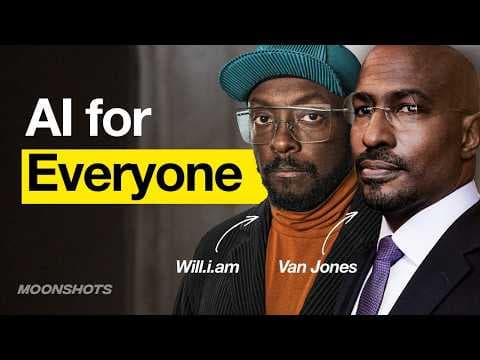
How Will AI Reset Advertising and Gaming in 50 Years?

TL;DR
AI will reshape how we find products, learn, and govern by enabling personalized agents and faster policy making. Education will integrate interactive AI to accelerate learning, while advertising shifts toward trusted AI recommendations. Regulation will need to keep pace with rapid AI innovation and its use across sectors.
Transcript
What's the world going to look like in 50 years? There's no way. There's just absolutely no way to make that prediction. I think AI is going to be listening to my conversations when I say, "Seem, I really love that shirt." And it knows I need a shirt. So, it just asks your AI where you got that shirt. And then it just delivers to me magically the n... Read More
Key Insights
- AI is accelerating the pace of change in technology and applications across multiple sectors.
- The key to effective AI adoption is trusted agents that can suggest and facilitate actions for users.
- Education systems are adapting to AI integration, with expectations of faster learning and more project based AI aided work.
- AI driven lawmaking and policy writing could reduce costs and speed up regulatory processes.
- Governments are experimenting with AI to write laws and formulate policies, signaling a shift in public administration.
- There is a debate about how schools should regulate or encourage AI use in learning environments.
- Industry leaders see AI as essential for future competitiveness and economic efficiency.
- The conversation highlights a need for proactive regulatory frameworks to manage AI growth and impact.
- More videos from this channel:
- More from this channel: Peter H. Diamandis
Install to Summarize YouTube Videos and Get Transcripts
Explore YouTube Video Summarizer or Get YouTube Transcript Extractor
Questions & Answers
Q: A real search query question about the video (e.g. 'How to...', 'What is...', 'Why does...', 'When should...'). Question 1
AI is rapidly transforming advertising and gaming by enabling personalized, agent driven experiences that predict user needs and suggest next steps. This shift could redefine how brands reach customers and how players interact with games, moving from passive content to proactive, AI guided experiences. The result is more efficient engagement and new monetization models.
Q: Question 2
Education will change as AI allows faster learning and more project based, AI aided work. Schools may incorporate AI to tailor instruction, provide real time feedback, and help students complete ambitious projects that were previously impractical. This could shorten learning timelines and change how teachers support student growth.
Q: Question 3
Policy making and law writing may be accelerated by AI as governments explore AI generated drafts and policy optimization. This could reduce costs and speed up regulatory processes, but it also raises questions about oversight, accountability, and ensuring alignment with public interests and ethical standards.
Q: Question 4
The episode discusses a future where trusted AI agents suggest purchases or signups, potentially disrupting traditional advertising and e commerce. Consumers could rely on AI to curate options, compare alternatives, and execute purchases, shifting the market toward AI mediated decision making.
Q: Question 5
There is a growing emphasis on integrating AI into K through 12 education and higher learning, with leaders arguing for AI literacy as a core skill. This highlights the need to balance innovation with safeguards, ensuring students develop critical thinking while leveraging AI to accelerate learning.
Q: Question 6
Global governments are experimenting with AI enabled governance, including drafting laws and evaluating regulatory impact. If scaled, this approach could dramatically shorten policy cycles and enable more responsive governance, though it mandates strong governance frameworks to monitor AI behavior and prevent misuses.
Q: Question 7
Industry leaders point to AI as essential for future competitiveness, with innovations appearing weekly. The trajectory implies a competitive race to deploy AI responsibly across sectors, requiring robust infrastructure, talent, and policy to maximize benefits while mitigating risks.
Q: Question 8
The conversation underlines the need for a regulatory framework that can keep pace with AI innovation. This includes standards for safety, ethics, transparency, and accountability, as well as mechanisms to ensure that AI benefits are broadly shared and risks are managed responsibly.
Summary & Key Takeaways
-
AI changes advertising and gaming through personalized, AI driven interactions that predict needs and facilitate purchases.
-
AI will influence education by accelerating learning and enabling AI assisted classrooms and curricula.
-
Regulatory frameworks will be required to keep up with AI driven policy making and governance across nations.
Read in Other Languages (beta)
Share This Summary 📚
Summarize YouTube Videos and Get Video Transcripts with 1-Click
Try YouTube Summary with ChatGPT & Claude or YouTube Transcript Generator
Explore More Summaries from Peter H. Diamandis 📚





Summarize YouTube Videos and Get Video Transcripts with 1-Click
Try YouTube Summary with ChatGPT & Claude or YouTube Transcript Generator