How AI compute markets could reshape GPUs as assets
TL;DR
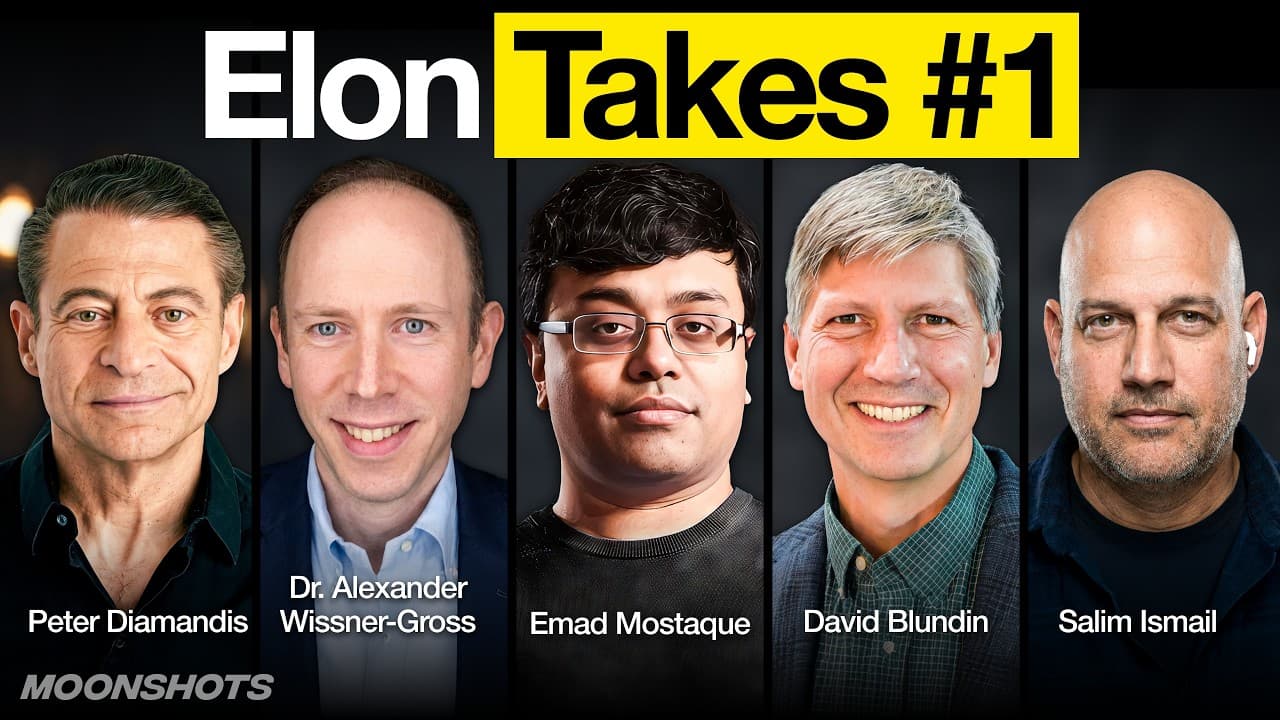
GPUs are increasingly being discussed as financial assets due to partnerships and demand in AI compute. The hosts debate pause scenarios for AI development, longevity prize funding, and the growing crossover between tech progress and finance. The conversation covers Grok releases, Hollywood AI impact, and the trajectory toward advanced AI systems.
Transcript
Bernie Sanders sent a formal letter to the CEOs of Anthropic, Meta, and Open Eye. >> AI capabilities have reached a critical threshold. Pause AI development. >> The cat's out the bag. It's too late, right? >> Nvidia just [music] announced a partnership that redefineses what GPU compute means as a financial asset. >> This is like the very first pitc... Read More
Key Insights
- GPUs are discussed as potential financial assets due to new partnerships and market demand for AI compute.
- The speakers compare the evolution of AI compute markets to historical financial instruments and asset securitization.
- There is a focus on the idea that exponential technologies may not have predictable depreciation, complicating traditional asset modeling.
- The panel sees Grok 4.7 as part of a rapid sequence of AI model iterations with improving capabilities.
- The longevity prize is presented as a model to accelerate practical healthspan improvements and related biomedical research.
- There is an emphasis on the convergence of multiple exponential technologies to accelerate any given domain when they align.
- NVIDIA and Wall Street are described as shaping the financialization of compute through market mechanisms and investment.
- The group discusses ethical and governance questions around pausing AI development and the implications for policy and society.
- More videos from this channel:
- More from this channel: Peter H. Diamandis
Install to Summarize YouTube Videos and Get Transcripts
Explore YouTube Video Summarizer or Get YouTube Transcript Extractor
Questions & Answers
Q: What is the new role of GPUs in the AI economy according to the talk?
GPUs are described as financial assets due to partnerships and the demand they satisfy in AI compute markets. The discussion suggests that compute capacity can be deconstructed into tradable or investable instruments, influencing how capital flows into AI infrastructure. This re framing could affect pricing, depreciation expectations, and investment strategies in tech hardware.
Q: How does the panel view the idea of pausing AI development?
The panel references a call to pause AI development and notes the need to consider governance alongside technical progress. They discuss the tension between immediate competitive advantages and long term safety, highlighting that policy actions interact with how rapidly compute and models evolve, potentially altering incentives for continued acceleration.
Q: What is Grok 4.7 and why is it significant in the discussion?
Grok 4.7 is mentioned as a rapidly upcoming AI model, part of a sequence that includes Grok 4.5 and 4.6. Its significance lies in its potential to train on SpaceX physics and engineering knowledge, illustrating how faster iterations and domain specialized data could push capabilities, adding momentum to the broader AI frontier.
Q: What role does longevity research play in the conversation?
Longevity research is framed as a major future market and a societal objective, with a prize program awarding significant funding and encouraging human trials. The discussion links healthspan improvement to economic and government outcomes, such as retirement timing and reduced sick care expenses, showing how biomedical progress intersects with policy and finance.
Q: How is AI impacting Hollywood and filmmaking according to the talk?
The panel notes that AI is transforming Hollywood and filmmaking, suggesting new workflows, synthetic media capabilities, and potential shifts in content creation. This reflects the broader trend of AI tools permeating media industries, enabling new creative methods while raising questions about authorship and ethical use.
Q: What is the overall tone about the pace of AI progress?
The speakers express optimism about accelerating progress, describing a path toward a faster pace of AI development. They compare this period to past industrial milestones and emphasize how multiple exponential technologies converging on a single domain can yield rapid, tangible outcomes, reinforcing a forward looking mindset.
Q: How do the guests relate AI progress to energy and financial markets?
The guests draw parallels between AI progress and finance by discussing compute as an asset class influenced by market dynamics, investor interest, and depreciation characteristics. They also consider the energy and cost structures of training large models, framing these as key factors in determining the sustainability and scalability of AI investments.
Q: What governance questions are raised about AI and society?
The discussion raises governance concerns about the balance between innovation and safety, including how policy, law, and personhood concepts evolve as AI capabilities expand. The group contemplates how new architectures and non transformer models may change risk profiles and regulatory needs, emphasizing the importance of governance alongside technical breakthroughs.
Summary & Key Takeaways
-
The discussion frames GPU compute as a financial asset through partnerships and market dynamics, highlighting the conceptual shift in how compute is valued.
-
The panel links acceleration of AI capabilities to funding mechanisms like prizes and the potential for a broader economic model around AI infrastructure.
-
The conversation connects aging research, longevity prizes, and AI development pace to illustrate an ecosystem where exponential technologies push rapid change.
Read in Other Languages (beta)
Share This Summary 📚
Summarize YouTube Videos and Get Video Transcripts with 1-Click
Try YouTube Summary with ChatGPT & Claude or YouTube Transcript Generator
Explore More Summaries from Peter H. Diamandis 📚



Summarize YouTube Videos and Get Video Transcripts with 1-Click
Try YouTube Summary with ChatGPT & Claude or YouTube Transcript Generator