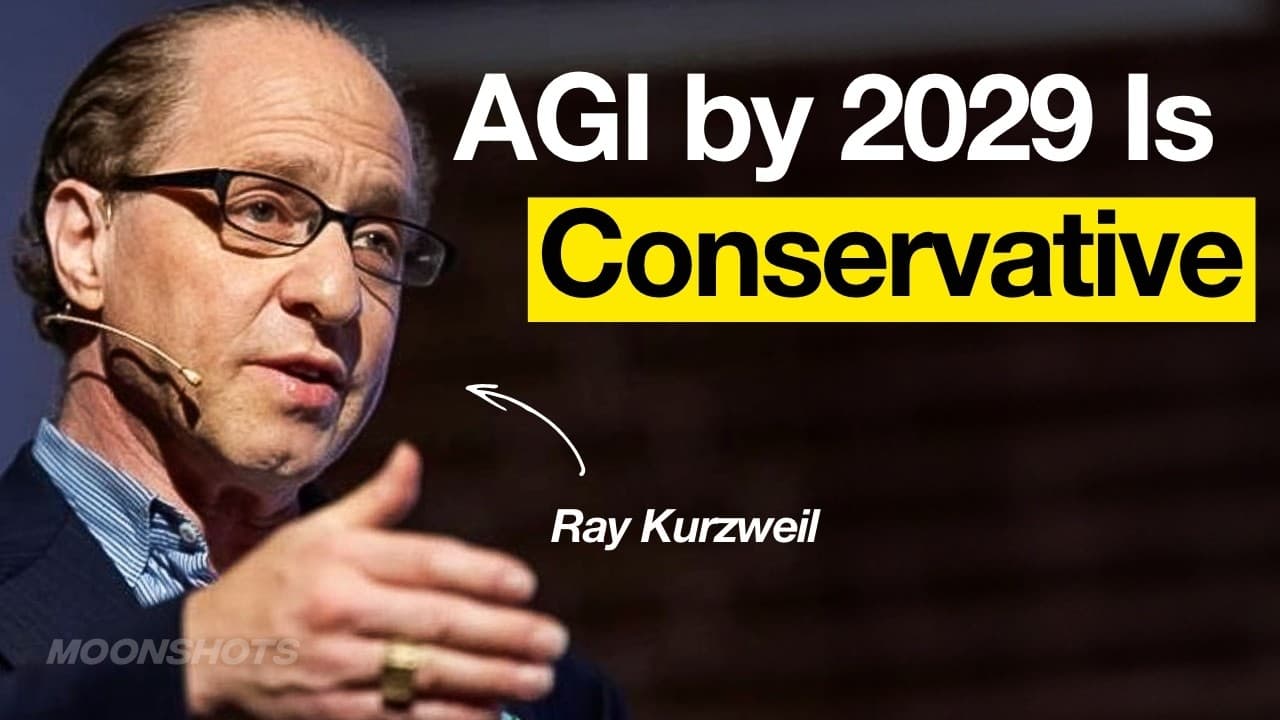
How Did Ray Kurzweil Predict AGI Years Ahead?
TL;DR
Ray Kurzweil and Peter Diamandis discuss AGI timelines, predicting human level AI by 2029 and the singularity by 2045, plus implications for jobs, longevity, and digital intelligence. The conversation covers exponential tech, potential nanotech advances, and merging human and machine intelligence, with insights for 2025 and beyond.
Transcript
2029 for AGI is conservative people present PRS that a will present and they assume that all we have is the things that we can do today to to to modify it without realizing that that's also going to expand do you see uh significant job loss in 2025 26 27 80% of people uh worked in food production uh 200 years ago today there 2% so we've lost all th... Read More
Key Insights
- AI timelines are debated but Kurzweil emphasizes a 2029 milestone for human level AI alongside a broader 2045 Singularity metaphor.
- The Singularity is described as a merging of human and machine intelligence, not a separate, external agent, with future neural interfaces enabling faster access to information.
- Exponential growth in AI can lead to rapid transformations in capabilities, collaboration with humans, and new hybrid forms of cognition.
- Nanotech and brain-computer interfaces are envisioned to expand human capabilities, potentially allowing instant access to information and enhanced problem solving.
- Job impact is a recurring theme, with historical context of shifting labor and predictions of future disruption in the short to mid term.
- Kurzweil avoids deterministic certainty, framing predictions as high-probability trajectories rather than fixed outcomes.
- The discussion situates AI progress within a broader ecosystem of technologies and human adaptability, stressing the importance of preparation and responsible development.
- The speakers acknowledge the role of influential figures and programs in shaping the trajectory of AI research and its societal adoption.
- More videos from this channel:
- More from this channel: Peter H. Diamandis
Install to Summarize YouTube Videos and Get Transcripts
Explore YouTube Video Summarizer or Get YouTube Transcript Extractor
Questions & Answers
Q: What is the core idea behind the Singularity as discussed in the episode?
The Singularity is described as a merging of human and machine intelligence rather than a standalone external event. It represents a point where human cognitive abilities are amplified by AI and future neural interfaces, allowing us to access and process information in ways that feel instantaneous. This fusion marks a qualitative shift in how we think and solve problems.
Q: When does Kurzweil predict human level AI will be achieved, according to the conversation?
Kurzweil asserts a timeline around 2029 for achieving human level AI, meaning AI that can perform tasks at human competence across domains. He frames this as a milestone within a broader progression toward the Singularity, which he characterizes as an exponential growth trajectory that culminates in radical enhancements to intelligence.
Q: What role do neural interfaces play in Kurzweil’s vision of AI a merged future?
Neural interfaces like future versions of brain computer interfaces are central to enabling direct access to one’s own mind and faster information processing. In the discussion, these interfaces are seen as a means to reduce the latency between intention and action, effectively speeding up learning, decision making, and interaction with digital systems as part of the human-AI merge.
Q: How does the conversation describe exponential tech growth and its effects?
The episode explains that exponential growth in AI compounds capabilities rapidly, creating trajectories that accelerate as they unfold. This speed means that what seems plausible today can evolve into transformative capabilities in a relatively short timeframe, influencing work, health, and daily life through increasingly sophisticated AI systems and hybrid intelligence.
Q: What potential job impacts are discussed in relation to AI progress?
The discussion notes historical shifts in labor, such as the decline of certain jobs in food production over centuries, and anticipates further disruption from AI and automation. The key point is that while some roles may disappear, others will emerge, and society will need to adapt through new skills and opportunities created by advancing technologies.
Q: How does Kurzweil address the possibility of an intelligence explosion or hard takeoff?
Kurzweil differentiates his view from a guaranteed hard takeoff by emphasizing that progress will be exponential and accelerating, yet not necessarily a sudden, instantaneous explosion. He argues that once the foundation is established, interactions between humans and AI will rapidly push capabilities forward, creating swift but not necessarily abrupt leaps.
Q: What is the relationship between AI progress and longevity or health tech in the dialogue?
The conversation connects AI progress with health technologies by suggesting that future enhancements in cognition could pair with advances in longevity science and monitoring, such as continuous data collection and personalized interventions. This integration hints at a future where AI helps optimize health outcomes and extend healthy lifespans.
Q: What role do thought leaders and programs play in shaping AI progress according to the episode?
The speakers acknowledge that influential figures, think tanks, and programs like abundance 360 contribute to guiding AI research and its adoption. By convening leading experts and sharing insights, these platforms help anticipate trends, align investment with responsible development, and prepare society for the transformative effects of AI and related technologies.
Summary & Key Takeaways
-
The episode highlights Ray Kurzweil’s predictions for AGI and the singularity, including timelines around 2029 and 2045, and discusses how these advances could transform work, health, and intelligence integration.
-
The conversation explores how humans might merge with AI through future neural interfaces and nanotech, potentially accelerating cognitive capabilities and redefining what counts as intelligence.
-
The hosts emphasize a pragmatic view on exponential technologies, predicting shifts in employment and safety while emphasizing optimistic, proactive approaches to future tech landscapes.
Read in Other Languages (beta)
Share This Summary 📚
Summarize YouTube Videos and Get Video Transcripts with 1-Click
Try YouTube Summary with ChatGPT & Claude or YouTube Transcript Generator
Explore More Summaries from Peter H. Diamandis 📚




Summarize YouTube Videos and Get Video Transcripts with 1-Click
Try YouTube Summary with ChatGPT & Claude or YouTube Transcript Generator