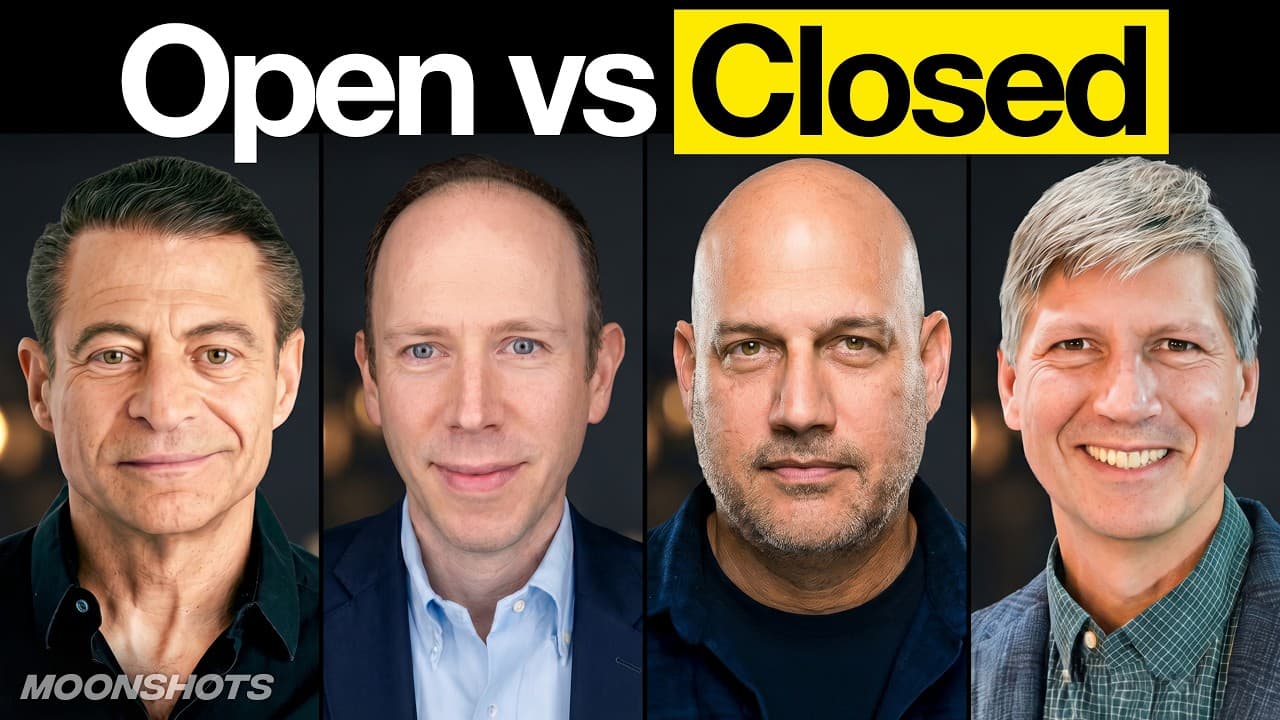
What is the open vs closed AI debate among OpenAI and Anthropic
TL;DR
OpenAI and Anthropic are discussed as rivals with differing safety focuses, yet both explore governance and the balance between open and closed models. The panel considers how open models could defend against threats, while concerns about state actors, bio risk, and AI diplomacy frame the conversation. Lobbing in DC and global south dynamics are also highlighted.
Transcript
A couple of days ago, Jensen Wong, CEO of Nvidia, he says the world needs both Frontier closed models and Frontier open models. Enthropic was silent for three days and there was a lot of conversation. Where is Enthropic in this conversation? >> All Daario has to say is >> OpenAI and Enthropic who have been two rivals for the longest time. They've b... Read More
Key Insights
- Open models are argued to strengthen safety and cybersecurity.
- Jensen argues for both frontier open models and frontier closed models to cover security and innovation needs.
- Anthropic’s stance is framed around safety and governance rather than a blanket ban on open models.
- Dario emphasizes that the central issue is whether authoritarian states can reach the AI frontier, focusing on risks from state actors.
- Blocking advanced chips and chipmaking equipment from reaching risky regions is proposed as a safety measure.
- OpenAI and Anthropic are described as potentially coordinating lobbying efforts in Washington, signaling policy influence beyond product development.
- AI diplomacy is highlighted as a tool of statecraft, with Xi Jinping and the global south cited in discussions of global AI leverage.
- The panel references specific model names like Claude 5 and Kim K3 to illustrate the evolving model landscape.
- More videos from this channel:
- More from this channel: Peter H. Diamandis
Install to Summarize YouTube Videos and Get Transcripts
Explore YouTube Video Summarizer or Get YouTube Transcript Extractor
Questions & Answers
Q: What is the core argument for keeping some AI models open and some closed?
The core argument is that open models can strengthen safety, cybersecurity, and innovation by allowing broader scrutiny, collaboration, and rapid iteration, while closed models can offer controlled governance and protection of sensitive capabilities. The balance aims to harness the benefits of openness without exposing critical systems to misuse. This framework contends that safety benefits come from diversified access rather than a single monopoly, and that both approaches can coexist to address different threat models and policy objectives.
Q: Why do some leaders think state actors could threaten AI safety if models are too open?
The concern is that if frontier AI capabilities become easily accessible, authoritarian states could attempt to harness them for strategic advantage, potentially accelerating illicit weapons development, surveillance, or disruption campaigns. Proponents argue that governance mechanisms, export controls, and targeted safety tests are needed to prevent such misuse while maintaining beneficial research. The debate centers on balancing innovation with security implications in a geopolitically tense environment.
Q: What role does AI diplomacy play in this discussion?
AI diplomacy is presented as a strategic tool to shape global norms, safety standards, and technology sharing practices across countries. It encompasses negotiations on open versus closed models, cross border data governance, and cooperative safety research. By framing AI as a diplomatic issue, leaders aim to build coalitions, coordinate policy, and manage competitive dynamics among major AI powers and the global south.
Q: How might lobbying in Washington affect open and closed AI policies?
Lobbying in Washington could influence funding, regulatory timing, safety standards, and export controls that shape how open and closed AI models are developed and deployed. If major players align on common safety frameworks, policymakers might implement clearer guidelines that encourage responsible openness while reducing risks. The result could be a more predictable policy environment that supports innovation with guardrails.
Q: What are Claude 5 and Kim K3, and why do they matter in this talk?
Claude 5 and Kim K3 are model developments cited to illustrate ongoing progress and competition in the frontier AI space. Claude 5 represents a safety focused model from Anthropic, while Kim K3 from Hugging Face signals advances in model capability. Their mention signals the rapid evolution of model architectures and the ongoing industry push to balance performance with safety and governance requirements.
Q: How does the discussion connect open AI to global south dynamics?
The dialogue links AI openness and governance to global south diplomacy, suggesting that AI capabilities and policy choices will influence international leverage and development outcomes. By discussing how AI can be used as a tool of statecraft, the conversation highlights the need for inclusive dialogue and equitable access to safe AI technologies across regions.
Q: What is the strategic concern around hardware and frontier access?
A strategic concern is that controlling hardware, supply chains, and distillation pathways could limit who can reach the frontier, thereby shaping competitive advantage and national security implications. The argument is that restricting access to advanced chips and related equipment could slow potential adversaries while we pursue robust safety testing and governance across both open and closed models.
Q: What does the panel say about the potential future of AI in policy and industry?
The panel portrays a trajectory where AI policy, industry competition, and safety governance evolve together, with ongoing debates about openness, sovereignty, and safety practices. They suggest that the next era will involve regulated openness, coordinated safety standards, and collaborative international frameworks designed to manage risks while sustaining rapid innovation and industry growth.
Summary & Key Takeaways
-
A broad debate centers on open versus closed AI and how safety, governance, and innovation interact across firms and governments, with Nvidia, OpenAI, and Anthropic at the center.
-
The discussion frames open models as a defense against cyber and AI threats, while acknowledging risks from authoritarian access and biothreats that could influence frontier capabilities.
-
Global diplomacy and regulatory strategies are threaded through the dialogue, including lobbying efforts in Washington and the role of AI in statecraft and cross border influence.
Read in Other Languages (beta)
Share This Summary 📚
Summarize YouTube Videos and Get Video Transcripts with 1-Click
Try YouTube Summary with ChatGPT & Claude or YouTube Transcript Generator
Explore More Summaries from Peter H. Diamandis 📚


Summarize YouTube Videos and Get Video Transcripts with 1-Click
Try YouTube Summary with ChatGPT & Claude or YouTube Transcript Generator