How Does Deliberate Cold Exposure Improve Health and Performance?
TL;DR
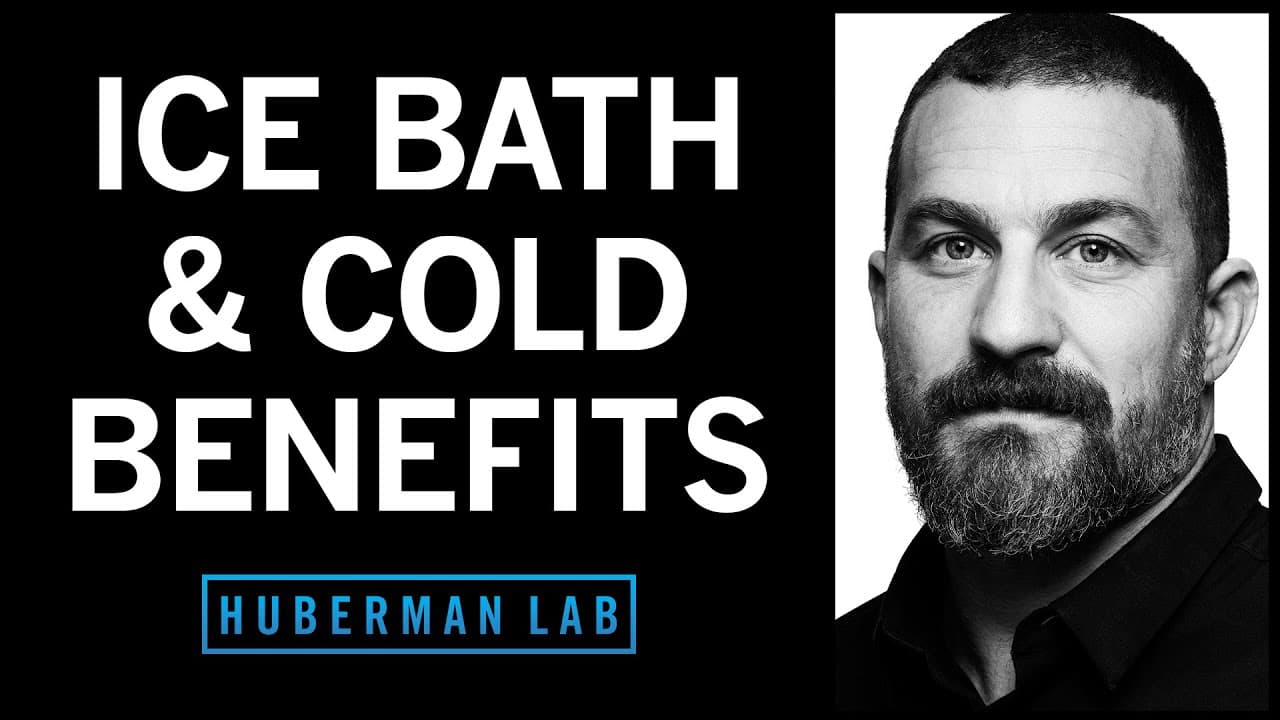
Deliberate cold exposure enhances mental health, physical health, and performance by triggering the release of norepinephrine and epinephrine. Methods include cold showers and cold water immersion, with immersion being more effective. Engaging with discomfort builds resilience and can improve cognitive function during exposure.
Transcript
- Welcome to the Huberman Lab Podcast, where we discuss science and science based tools for everyday life. I'm Andrew Huberman, and I'm a professor of neurobiology and ophthalmology at Stanford School of Medicine. Today, we are going to discuss the use of deliberate cold exposure for health and performance. Temperature is a powerful stimulus on our... Read More
Key Insights
- 🧑⚕️ Deliberate cold exposure is a powerful tool for enhancing mental health, physical health, and performance.
- 🥶 Cold showers and cold water immersion are effective methods, with cold water immersion being more efficient in reducing core body temperature.
- 🥶 Developing mental resilience and toughness can be achieved by intentionally facing and overcoming resistance during cold exposure.
- 🤯 Engaging in cognitive tasks and maintaining clarity of mind during exposure can optimize mental performance.
Install to Summarize YouTube Videos and Get Transcripts
Explore YouTube Video Summarizer or Get YouTube Transcript Extractor
Questions & Answers
Q: How cold should the water be for effective cold exposure?
The water should be uncomfortably cold, but at a temperature that is safe to stay in. It is subjective and can vary according to individual cold tolerance.
Q: Are cold showers as effective as cold water immersion?
Cold water immersion, where the body is submerged up to the neck, is the most effective form of cold exposure. Cold showers are a second option, and going outside in cold weather with minimal clothing can also be beneficial.
Q: What is the best mental state during deliberate cold exposure?
There are two options: calming oneself or leaning into the challenge. Cognitive exercises or engaging in mental tasks can help maintain clarity of mind during exposure.
Q: How can deliberate cold exposure build mental resilience?
Counting "walls" or resistance experienced during cold exposure can gradually increase mental resilience. This involves setting goals to overcome specific challenges during each exposure.
Q: Does movement during cold exposure affect the experience?
Staying still generates a thermal layer that keeps the body warmer. Movement can increase the feeling of coldness, but it varies from person to person. Experimentation is encouraged to find what works best.
Summary & Key Takeaways
-
Deliberate cold exposure can improve mental health, physical health, and performance by leveraging the powerful stimulus of temperature on the body and brain.
-
Cold exposure protocols can be achieved through cold showers, cold water immersion, or purposefully exposing oneself to cold environments.
-
Building mental toughness and resilience can be achieved through systematic exposure to uncomfortable cold temperatures and increasing the number of "walls" one can overcome.
-
Engaging in cognitive activities and maintaining clarity of mind during cold exposure can further enhance mental performance.
-
Movement during cold exposure can affect the body's generation of heat and the overall experience of cold.
Read in Other Languages (beta)
Share This Summary 📚
Summarize YouTube Videos and Get Video Transcripts with 1-Click
Try YouTube Summary with ChatGPT & Claude or YouTube Transcript Generator
Explore More Summaries from Andrew Huberman 📚

Summarize YouTube Videos and Get Video Transcripts with 1-Click
Try YouTube Summary with ChatGPT & Claude or YouTube Transcript Generator