How Does a Bainbridge Mass Spectrometer Work?
TL;DR
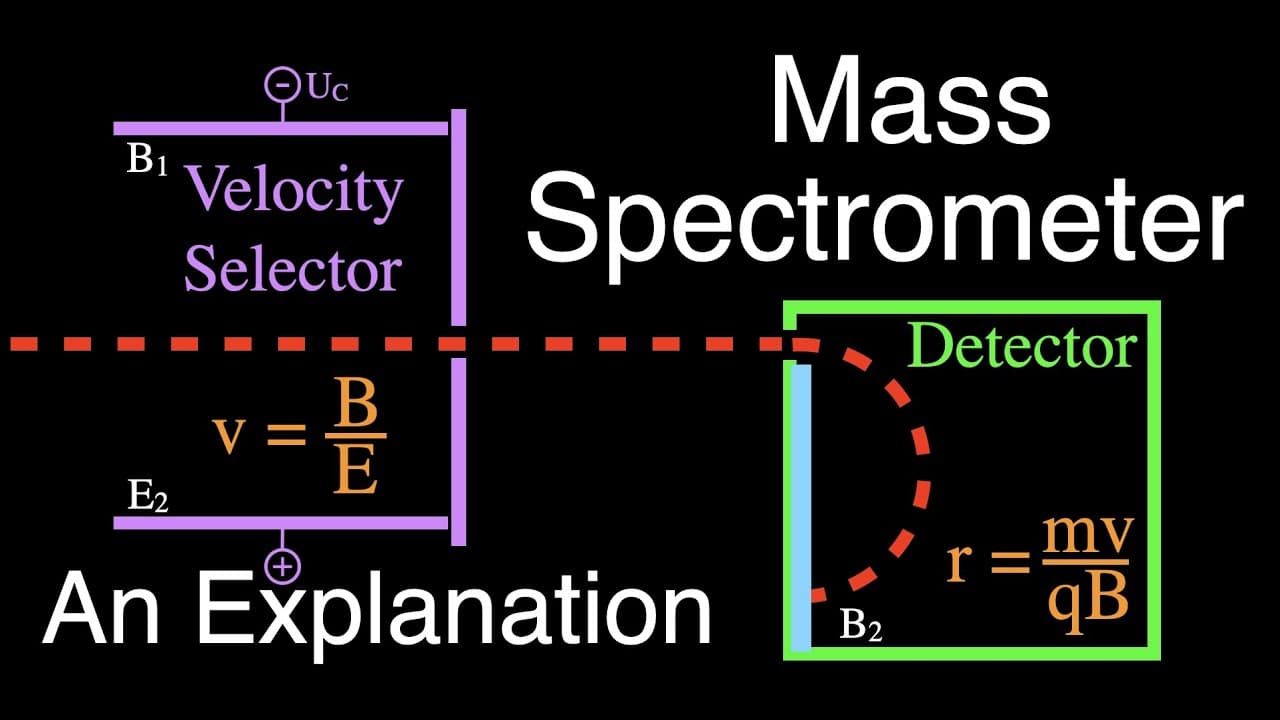
A Bainbridge mass spectrometer determines atomic mass by accelerating ions, selecting ions with a specified velocity, and separating them along curved paths at the detector according to mass. In the worked example, a singly charged lead-208 ion accelerated through 350 volts reaches 18,000 m/s. Read on for the governing energy and force relationships behind each stage.
Transcript
in today's video we are going to go over a detailed step-by-step explanation of how a bain bridge mass spectrometer works now before we get started please don't forget to subscribe to my channel step by step science get all my excellent physics chemistry and math videos again when i look at my analytics i see that a lot of people who watch my video... Read More
Key Insights
- 💆 Bainbridge mass spectrometers are crucial for determining atomic mass through ion acceleration.
- ℹ️ Ion source and accelerator play a role in preparing charged particles for separation.
- ❓ Velocity selector ensures only particles with specified velocity continue to the next stage.
- 🦮 Magnetic field strength is calculated to guide particles through the velocity selector.
- 🥺 Coordination of electric and magnetic fields in the spectrometer leads to accurate mass separation.
- 💆 Calculations involving charge, mass, velocity, and field strengths enable precise results.
- 💆 Bainbridge mass spectrometers rely on the principles of electromagnetism for operation.
Install to Summarize YouTube Videos and Get Transcripts
Explore YouTube Video Summarizer or Get YouTube Transcript Extractor
Questions & Answers
Q: How does a Bainbridge mass spectrometer work?
A Bainbridge mass spectrometer uses an ion source and accelerator, a velocity selector, and a detector. The ions are accelerated, filtered so that only ions with the desired velocity continue, and then separated at the detector based on their mass.
Q: What is a Bainbridge mass spectrometer used to determine?
A Bainbridge mass spectrometer is typically used to determine the atomic mass of different atoms. It separates and detects accelerated ions according to their mass.
Q: How does the ion source and accelerator work?
A positively charged ion moves between positively and negatively charged plates through an electric field directed from the positive plate to the negative plate. The electric force accelerates the ion as its electric potential energy is converted into kinetic energy.
Q: How is an ion’s exit velocity calculated?
The calculation sets the electric potential energy, qV, equal to the kinetic energy, 1/2 mv^2. Solving for velocity gives v equal to the square root of 2qV divided by m.
Q: What velocity does a singly charged lead-208 ion reach after acceleration through 350 volts?
The lead-208 ion reaches 18,000 m/s, which is also expressed as 18 km/s. The calculation uses a positive charge of 1.60 × 10^-19 C and a lead-ion mass of 3.45 × 10^-25 kg.
Q: How is the mass of the lead-208 ion calculated?
Lead-208 has a mass number of 208, representing the number of protons and neutrons in its nucleus. Multiplying 208 by 1.66 × 10^-27 kg gives an ion mass of 3.45 × 10^-25 kg.
Q: What is the role of the velocity selector?
The velocity selector allows only ions with the desired velocity to pass straight through. In the example, it is configured for lead ions traveling at 18,000 m/s.
Q: What fields are used in the velocity selector?
The velocity selector contains positively and negatively charged plates that create an electric field, along with a magnetic field. In the example, the voltage across the plates is 110 volts and their separation is 12 cm, while the required magnetic-field strength is the quantity to be calculated.
Summary & Key Takeaways
-
Detailed explanation of Bainbridge mass spectrometer components.
-
Ion source and accelerator function to determine atomic mass.
-
Explanation of velocity selector and detector operations.
Read in Other Languages (beta)
Share This Summary 📚
Summarize YouTube Videos and Get Video Transcripts with 1-Click
Try YouTube Summary with ChatGPT & Claude or YouTube Transcript Generator
Explore More Summaries from Step by Step Science 📚
Summarize YouTube Videos and Get Video Transcripts with 1-Click
Try YouTube Summary with ChatGPT & Claude or YouTube Transcript Generator