How to Build an Agentic OS with Claude Code
TL;DR
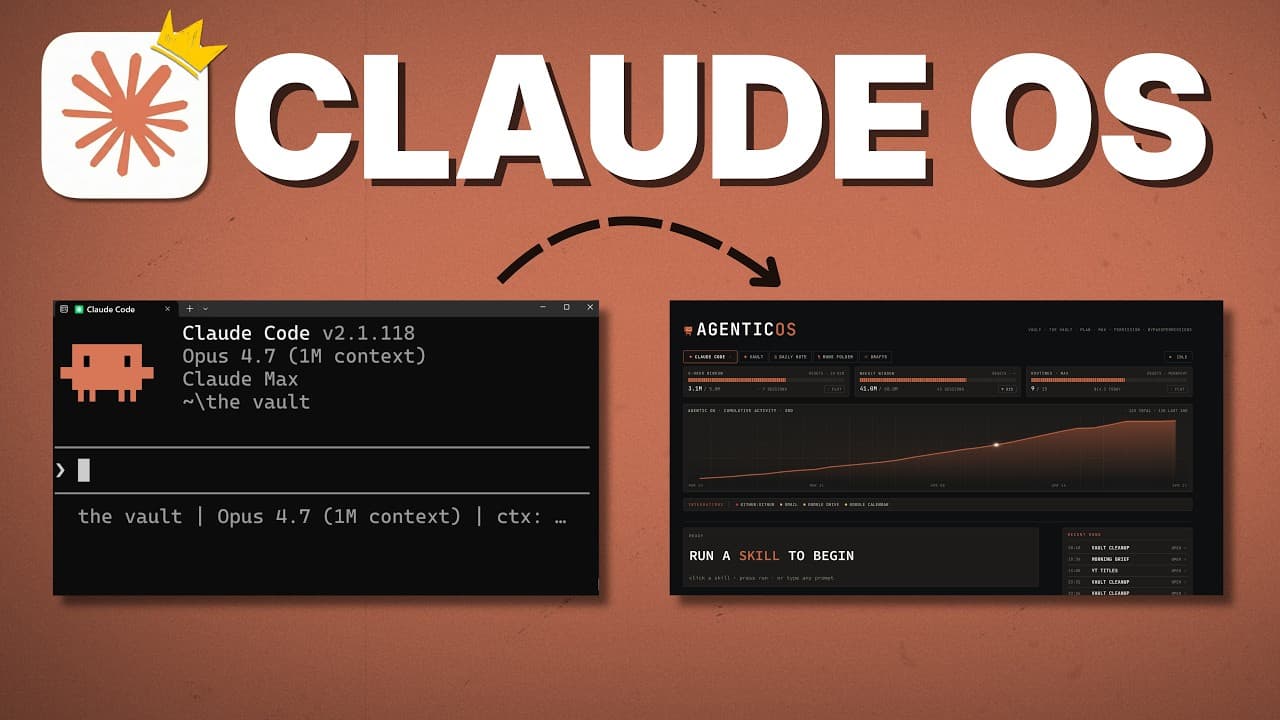
An agentic OS powered by Claude Code addresses memory, consistency, and accessibility challenges. By integrating tools like Obsidian for memory and customizable skills for consistency, users can create a system that is accessible even to non-technical team members. This setup allows for efficient task automation and a user-friendly interface that eliminates the need for terminal use.
Transcript
Do you need a cla powered a gentic OS? As a gentic coding tools like claude code only get more powerful, the gap between what they can do and what the average user can pull out of them only gets bigger. And to close that gap, we need a holistic architecture that solves the big three problems almost every user faces. And that's memory, consistency, ... Read More
Key Insights
- Claude Code can enhance productivity by addressing memory, consistency, and accessibility gaps.
- Memory is managed using tools like Obsidian, which stores past interactions and data.
- Consistency is achieved through customized skills and automations tailored to specific tasks.
- Accessibility is improved by using dashboards that allow non-technical users to execute tasks easily.
- An agentic OS can be customized for different business domains like sales, marketing, and research.
- Tasks can be automated locally or remotely, depending on their nature and requirements.
- Remote tasks run independently of the user's computer, offering flexibility in execution.
- A dashboard centralizes task execution, making it accessible and understandable for all team members.
Install to Summarize YouTube Videos and Get Transcripts
Explore YouTube Video Summarizer or Get YouTube Transcript Extractor
Questions & Answers
Q: How to manage memory in an agentic OS?
Memory in an agentic OS is managed using tools like Obsidian, which store past interactions and data. This allows Claude Code to recall previous conversations and actions, making it easier to maintain consistency across tasks. By using a simple folder structure, users can organize their data efficiently without needing complex systems.
Q: What is the role of skills in an agentic OS?
Skills in an agentic OS are customized actions that automate specific tasks. They are designed to reflect day-to-day activities, allowing users to execute tasks consistently and efficiently. Skills can be tailored to different business domains, such as sales or research, and are integral to maintaining consistency in the system.
Q: Why use a dashboard in an agentic OS?
A dashboard in an agentic OS provides a user-friendly interface that allows non-technical users to execute tasks without needing to use the terminal. It centralizes task execution, making it accessible and understandable for all team members. This setup democratizes access to Claude Code's capabilities, enabling broader team participation.
Q: How do automations work in an agentic OS?
Automations in an agentic OS can be set up to run tasks either locally or remotely. Local automations interact with the user's computer and its resources, while remote automations run independently in the cloud. This flexibility allows users to execute tasks without being physically present, enhancing productivity and efficiency.
Q: What is the accessibility gap in coding tools?
The accessibility gap in coding tools refers to the difficulty non-technical users face when trying to harness powerful coding capabilities. An agentic OS addresses this by providing a dashboard interface that simplifies task execution, allowing users to benefit from advanced features without needing to understand complex terminal commands.
Q: How can an agentic OS be customized for business needs?
An agentic OS can be customized by creating specific skills and automations tailored to different business domains, such as sales, marketing, or research. This customization allows the system to align with the unique workflows and tasks of a business, ensuring that it meets the specific needs and objectives of the organization.
Q: What are the benefits of using Claude Code in an agentic OS?
Claude Code enhances an agentic OS by providing powerful coding capabilities that improve productivity and efficiency. It allows for the creation of customized skills and automations, addressing memory and consistency issues. The system's accessibility is improved through dashboards, making it usable by non-technical team members and broadening its applicability.
Q: Why is a mental model important in setting up an agentic OS?
A mental model is important in setting up an agentic OS because it helps users understand and organize their tasks and workflows. By visualizing the system as an organizational chart, users can better identify the skills and automations needed for their specific tasks, ensuring that the system is set up effectively and efficiently.
Summary & Key Takeaways
-
An agentic OS powered by Claude Code bridges the gap between powerful coding tools and average users by focusing on memory, consistency, and accessibility. Memory is managed through tools like Obsidian, while consistency is achieved via customized skills and automations. The system's accessibility is enhanced through dashboards, enabling non-technical users to harness Claude Code's power without using the terminal.
-
The video emphasizes the importance of customizing an agentic OS to fit specific business needs, such as sales, marketing, and research. It explains how tasks can be automated both locally and remotely, depending on their nature, and highlights the role of a dashboard in making these tasks accessible to non-technical team members.
-
By setting up a Claude Code-powered agentic OS, users can automate routine tasks and improve productivity. This system allows for the creation of tailored skills and automations, which are then executed through a user-friendly dashboard. This approach democratizes access to advanced coding capabilities, making them usable by non-technical team members.
Read in Other Languages (beta)
Share This Summary 📚
Summarize YouTube Videos and Get Video Transcripts with 1-Click
Try YouTube Summary with ChatGPT & Claude or YouTube Transcript Generator
Explore More Summaries from Chase AI 📚

Summarize YouTube Videos and Get Video Transcripts with 1-Click
Try YouTube Summary with ChatGPT & Claude or YouTube Transcript Generator