How to Avoid Costly Business and Career Mistakes
TL;DR
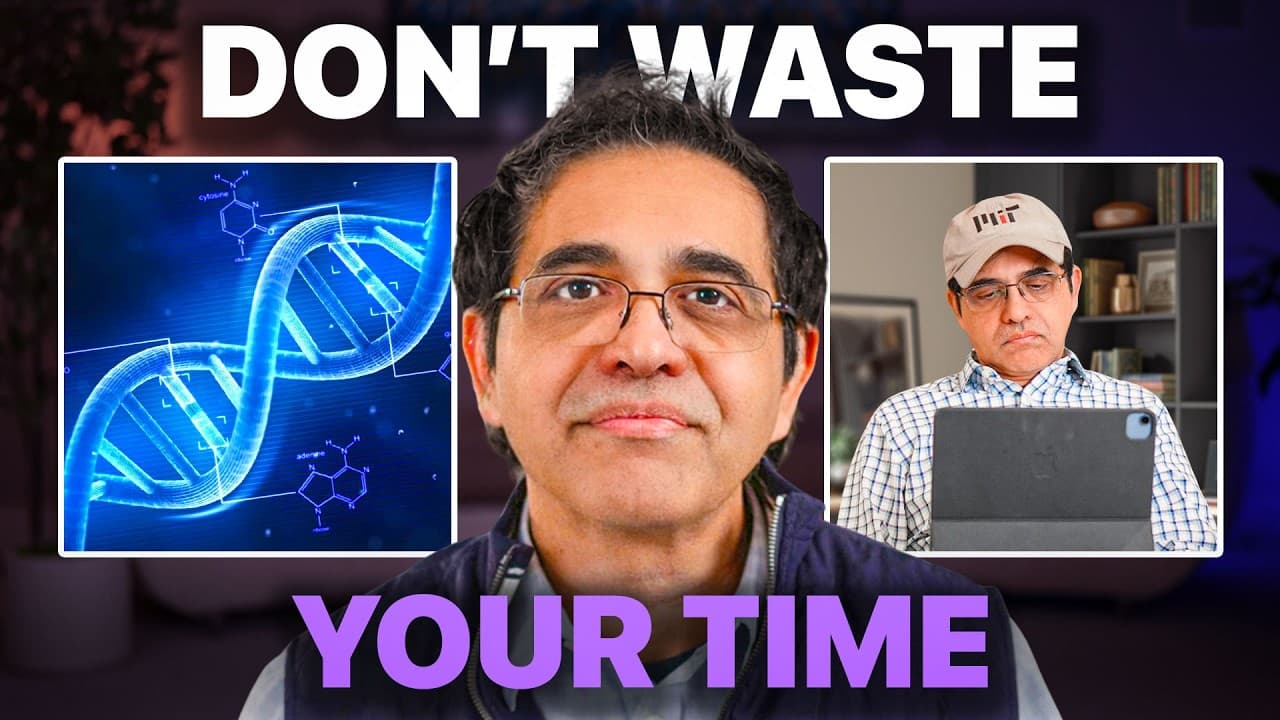
Validate that a meaningful market need exists before investing heavily in a business or career path. Qualify opportunities through leverage, insight, or timing, then operate according to the venture’s underlying business DNA. Durable success comes from choosing worthwhile problems, testing demand early, and using strategies suited to how the business creates value.
Transcript
I went from sleeping on the streets of Mumbai to becoming an MIT grad and then building billion-dollar companies as a CEO, investor and board member. And what I learned was that the biggest advantage isn't talent or techniques. It's avoiding critical mistakes before they cost you years and [music] your fortune. So, here are four principles behind e... Read More
Key Insights
- Market need is more important than the sophistication of a solution. The speaker describes spending months developing a premium consulting service only to discover that a cheaper Google product had emptied the market, turning strong execution and talented staffing into effort spent building in a ghost town.
- Wisdom is knowing whether a problem deserves to be solved. Education often rewards convergence toward a predetermined answer, while business and career decisions require divergent thinking, questioning assumptions, and deciding whether the original question is useful before investing time in solving it.
- Nearly half of the failed venture-backed startups cited in the transcript lacked market need. The referenced study found that 75% of thousands of venture-backed startups never returned money to investors, while 48% failed because customers did not need their proposed solution.
- The value of an opportunity can be tested with three questions. Ask why you are pursuing it, whose life will actually change if you succeed, and what will break if you do not proceed. These questions expose work that appears important but produces no meaningful consequence.
- Passion is useful as fuel but unreliable as a compass. Industries built around music, film, fashion, and Broadway contain abundant passionate talent but limited demand, creating what the speaker calls a glamour tax, the cost of waiting and competing for scarce opportunities.
- The LIT framework qualifies opportunities through leverage, insight, and timing. Leverage is an advantage competitors cannot easily copy, insight is a market truth others have missed, and timing explains why the idea is especially suited to the present moment.
- Business DNA determines both recurring traps and appropriate strategies. A company cannot win by copying the operating habits of a fundamentally different model, just as an elephant cannot become a cheetah by adopting the cheetah’s diet. Understanding the model prevents effort from being directed toward incompatible goals.
- Burnout often results from working on the wrong thing rather than simply working too hard. A mismatch between personal expectations and business DNA can create persistent frustration, because each model has structural constraints involving time, inventory, development costs, liquidity, attention, investment risk, or debt.
Install to Summarize YouTube Videos and Get Transcripts
Explore YouTube Video Summarizer or Get YouTube Transcript Extractor
Questions & Answers
Q: How can entrepreneurs avoid building a product nobody needs?
Entrepreneurs can reduce this risk by validating the problem before optimizing the solution. They should ask why the product must exist, whose life will change if it works, and what will break if it is never created. They should also test whether customers are willing to pay before committing major development costs, staffing, or months of execution.
Q: What does building in a ghost town mean in business?
Building in a ghost town means investing talent, time, and money in a solution after its meaningful market has disappeared or when no genuine market need existed. The transcript illustrates this with a premium consulting service developed by highly qualified people while Google quietly released a cheaper software alternative. Strong execution could not compensate for an empty market.
Q: Why is passion a poor guide for choosing a career or business?
Passion can provide the energy required for sustained effort, but it does not establish customer demand or economic opportunity. Passion industries often have an enormous supply of talented people competing for limited openings. The transcript therefore treats passion as fuel rather than a compass and recommends checking market conditions and personal advantages before turning an interest into a career.
Q: What is the LIT framework for evaluating business ideas?
The LIT framework evaluates an idea through leverage, insight, and timing. Leverage asks what unfair advantage you possess that competitors cannot readily copy. Insight asks what important market truth you understand that others are missing. Timing asks why the idea works specifically now. The speaker argues that a sustainable business needs at least one of these three advantages.
Q: What are the seven types of business DNA?
The seven business DNA signatures described are service, physical product, digital product, marketplace, media, capital, and assets. Each represents a different way of creating and selling value, from human time and physical goods to software, matchmaking, attention, financial risk, or access to scarce assets. Each also carries different structural traps and scaling requirements.
Q: How can a service business overcome the time wall?
A service business can overcome dependence on the founder’s time by productizing its expertise. This means converting customized work into a repeatable playbook, process, or delivery system that can operate without the founder performing every task. Other people can then execute the method, allowing revenue capacity to expand beyond the number of hours one person can personally sell.
Q: How should digital products validate demand before scaling?
Digital product businesses should build the smallest product capable of testing whether the market wants the solution. They can then gather evidence, change the offering when it does not fit, and continue testing before accepting massive upfront research and development costs. The essential goal is to confirm that customers exist and are willing to pay before making a large commitment.
Q: How do marketplace, media, capital, and asset businesses win?
Marketplace businesses should dominate a narrow niche first so buyers and sellers can create liquidity. Media businesses should move audiences from rented social platforms toward direct relationships such as newsletters. Capital businesses should diversify and syndicate risk rather than concentrate everything in one investment. Asset businesses can benefit from high entry costs because those barriers may limit competition after construction.
Summary & Key Takeaways
-
The first principle is to identify ghost towns before building in them. A polished solution is worthless when its market has disappeared or never existed. Before optimizing execution, ask why the work matters, whose life changes if it succeeds, what breaks without it, and whether the proposed product or activity should exist at all.
-
Passion supplies energy, but market demand should guide direction. Passion-heavy industries attract abundant talent while offering limited opportunities, which can reduce an individual’s market value. The LIT framework qualifies an idea by testing for leverage competitors cannot copy, a distinctive market insight, or timing that makes the opportunity particularly viable right now.
-
Every business has an operating DNA that shapes its economics, risks, and winning strategy. Services must overcome dependence on human time, physical products must manage inventory and cash, digital products must validate demand before major development, marketplaces need niche liquidity, media needs direct audience relationships, capital businesses need diversified risk, and asset businesses face debt-intensive entry.
Read in Other Languages (beta)
Share This Summary 📚
Summarize YouTube Videos and Get Video Transcripts with 1-Click
Try YouTube Summary with ChatGPT & Claude or YouTube Transcript Generator
Explore More Summaries from Sandeep Swadia 📚


Summarize YouTube Videos and Get Video Transcripts with 1-Click
Try YouTube Summary with ChatGPT & Claude or YouTube Transcript Generator