How to Build and Optimize AI Agents in 2024
TL;DR
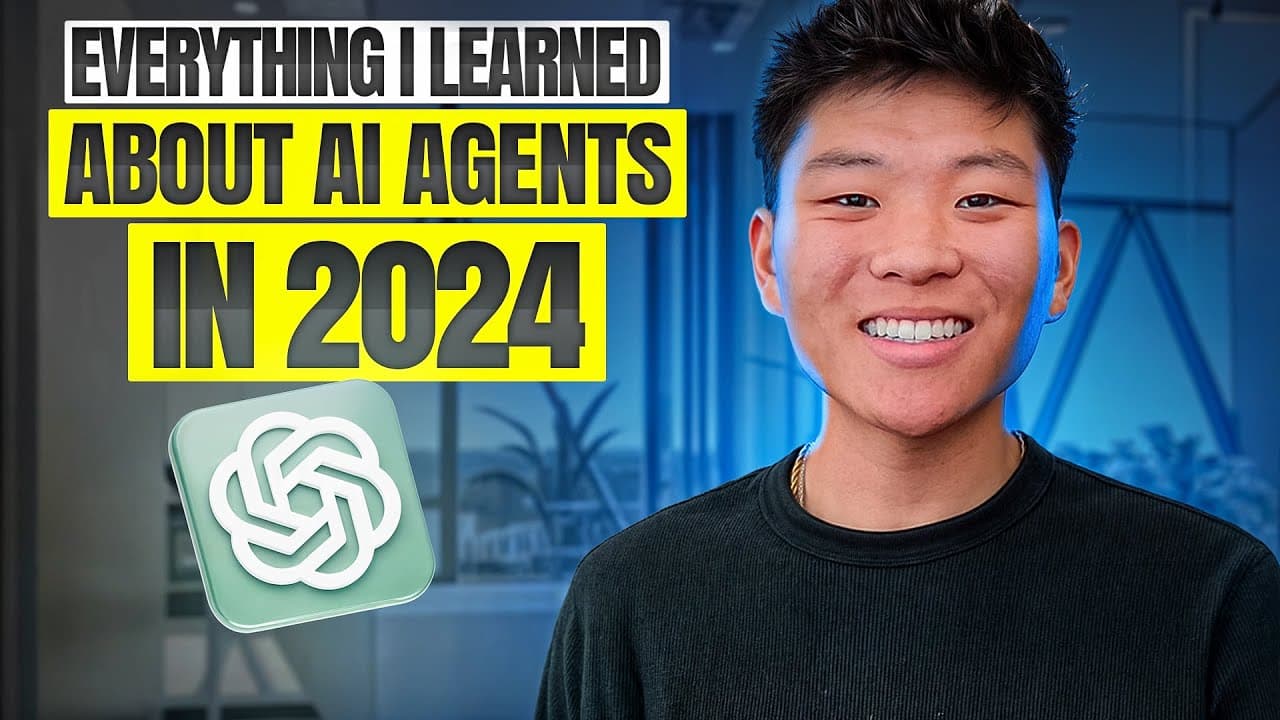
AI agents can autonomously handle complex tasks, transforming workflows and reducing costs. Key components include a core agent, memory, tools, and prompts. Successful AI agents require a strong data foundation, modular architecture, and effective prompt engineering. By starting early in AI agent development, you can position yourself as a leader in this evolving field.
Transcript
imagine having a team of workers that never sleeps handles repetitive tasks with precision and costs a fraction of hiring a human welcome to the world of AI agents this year I discovered their potential and it changed everything for me if you guys don't know me my name is Nate I've been working in automation for a while now but when I started learn... Read More
Key Insights
- AI agents operate autonomously, handling multi-step processes and making decisions without constant input.
- The core agent acts as the central processing unit, integrating all functionalities for decision-making.
- Memory allows AI agents to maintain context and continuity, storing and retrieving information as needed.
- Tools provide the external resources or APIs necessary for AI agents to perform specific tasks.
- Prompts help AI agents analyze problems, devise strategies, and determine steps to complete tasks proactively.
- Advanced problem-solving capabilities enable AI agents to analyze situations, plan tasks, and execute plans efficiently.
- Data quality and context are crucial for AI agents, with vector databases enhancing data retrieval and contextual understanding.
- Modular architecture and prompt engineering are key to building scalable and efficient AI agent systems.
Install to Summarize YouTube Videos and Get Transcripts
Explore YouTube Video Summarizer or Get YouTube Transcript Extractor
Questions & Answers
Q: How do AI agents differ from AI assistants?
AI agents differ from AI assistants in their autonomy and complexity. While AI assistants are reactive and perform tasks through direct user interaction, AI agents operate autonomously, managing complex multi-step processes and making decisions without constant input. This autonomy allows AI agents to proactively tackle tasks and strategize independently.
Q: What are the core components of AI agents?
The core components of AI agents include the core agent, memory, tools, and prompts. The core agent acts as the central processing unit, integrating all functionalities. Memory allows the agent to store and retrieve information, maintaining context. Tools provide the external resources or APIs for specific tasks, and prompts help the agent analyze problems and devise strategies.
Q: Why is data quality important for AI agents?
Data quality is crucial for AI agents because it directly impacts their decision-making and performance. High-quality, up-to-date data ensures that AI agents can make accurate decisions and provide reliable results. Without quality data, agents may make poor decisions, leading to inaccurate outcomes. Contextual understanding of data is also essential for optimal performance.
Q: How can modular architecture benefit AI agents?
Modular architecture benefits AI agents by allowing for scalable and efficient system design. By breaking tasks into smaller, independent modules, developers can easily update, add, or remove specific functions without overhauling the entire system. This approach ensures that AI agents are focused, reliable, and adaptable to changing requirements, facilitating long-term success.
Q: What is the role of prompt engineering in AI agents?
Prompt engineering is critical for guiding AI agents' reasoning and ensuring they understand tasks accurately. A well-crafted prompt includes the agent's objective, context, available tools, instructions, output requirements, and examples. Effective prompt engineering reduces errors and ambiguity, leading to more reliable and consistent agent performance across different scenarios.
Q: What challenges are commonly faced when building AI agents?
Common challenges in building AI agents include data quality issues, poor planning, balancing simplicity and flexibility, and managing realistic expectations. Developers must ensure data is well-prepared and stored, plan scalable architectures, and adopt a modular design. Realistic expectations involve understanding that agents are not perfect and will require troubleshooting and refinement over time.
Q: How can AI agents and humans collaborate effectively?
AI agents and humans can collaborate effectively by leveraging AI to handle repetitive, low-value tasks, allowing humans to focus on creativity, strategy, and innovation. AI agents act as teammates, not just tools, working alongside humans to achieve goals more efficiently. This collaboration enhances productivity and enables businesses to scale by building smarter AI systems.
Q: What is the future of AI agents in automation?
The future of AI agents in automation involves increased autonomy, enhanced collaboration, broader accessibility, and more integration into everyday tools. AI agents will become more self-reliant, work together in multi-agent systems, and be embedded in tools like CRMs and project management systems. This evolution will transform workflows and redefine how businesses scale and operate.
Summary & Key Takeaways
-
AI agents autonomously handle complex tasks, reducing costs and transforming workflows. Key components include a core agent, memory, tools, and prompts. A strong data foundation, modular architecture, and effective prompt engineering are essential for success.
-
Advanced problem-solving capabilities enable AI agents to analyze situations, plan tasks, and execute efficiently. Data quality and context are crucial, with vector databases enhancing data retrieval and understanding. Modular architecture and prompt engineering are key to building scalable systems.
-
AI agents represent the future of work and automation, poised to replace repetitive tasks and enable humans to focus on creativity and strategy. Starting early in AI agent development positions individuals as leaders in this evolving field.
Read in Other Languages (beta)
Share This Summary 📚
Summarize YouTube Videos and Get Video Transcripts with 1-Click
Try YouTube Summary with ChatGPT & Claude or YouTube Transcript Generator
Explore More Summaries from Nate Herk | AI Automation 📚



Summarize YouTube Videos and Get Video Transcripts with 1-Click
Try YouTube Summary with ChatGPT & Claude or YouTube Transcript Generator