How Vast is Our Universe?
TL;DR
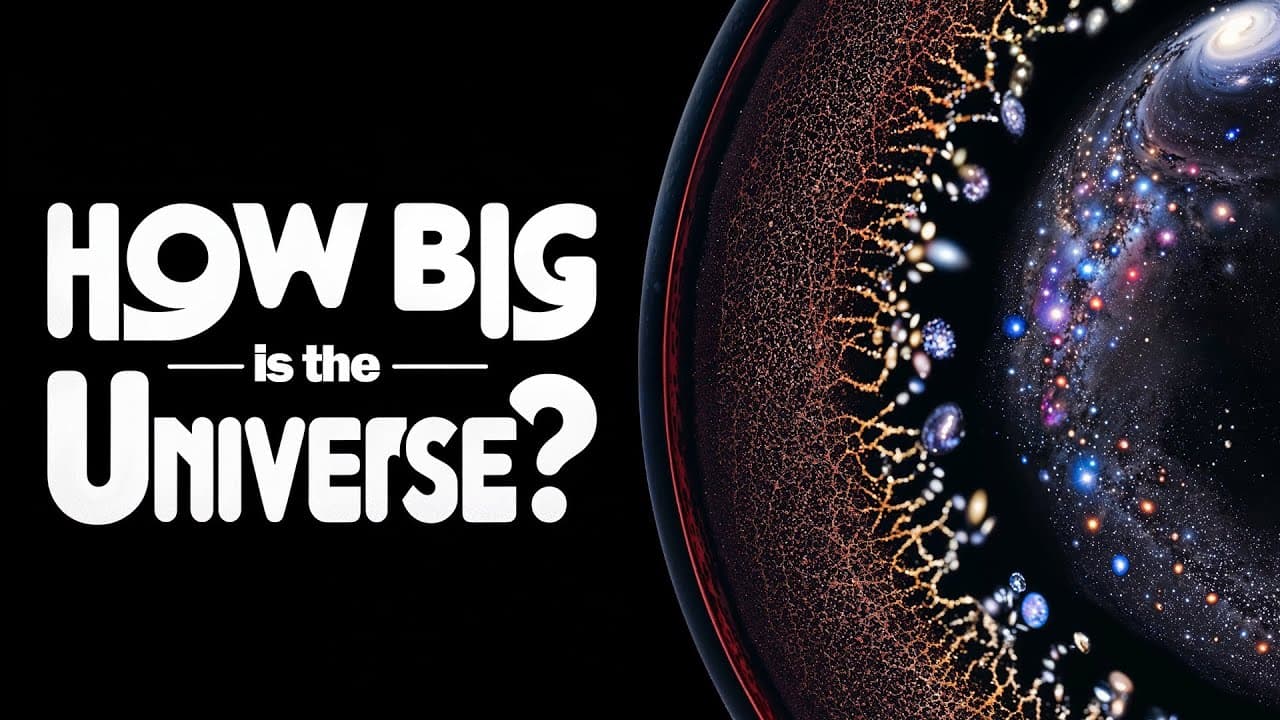
The observable universe is about 93 billion light-years across, although the universe’s true size remains unknown. Its scale unfolds from the Moon at 384,000 kilometers away to the 100,000-light-year-wide Milky Way and beyond. Concrete travel times and distance measurements reveal why even nearby destinations are extraordinarily remote. Read on to compare the major milestones of this cosmic journey.
Transcript
Earth our home planet a tiny blue dot floating in the immense Cosmic ocean here resides everyone you ever knew every human who ever lived every story that was ever told it's where our journey begins but as we zoom out beyond our atmosphere past the moon Beyond The Familiar planet and the sun we embark on an Epic Quest a quest to grasp the true s... Read More
Key Insights
- Earth is a tiny blue dot in the vast cosmic ocean, highlighting our smallness in the universe.
- The Moon is 384,000 km away, a distance that takes over 160 days to travel by car at 100 km/h.
- Light from the Sun takes about 8 minutes and 20 seconds to reach Earth, showcasing the vastness of space.
- Mars' distance from Earth varies greatly, taking upwards of 50 years to reach by commercial jet.
- Voyager 1, the farthest human-made object, has traveled over 22 billion kilometers from Earth.
- The Oort Cloud marks the theoretical boundary of our solar system, extending up to 100,000 astronomical units.
- The Milky Way spans about 100,000 light years in diameter, containing hundreds of billions of stars.
- The observable universe is about 93 billion light years in diameter, but its true size remains unknown.
Install to Summarize YouTube Videos and Get Transcripts
Explore YouTube Video Summarizer or Get YouTube Transcript Extractor
Questions & Answers
Q: How big is the universe?
The observable universe is about 93 billion light-years in diameter. Its true size remains unknown because it extends beyond what we can observe.
Q: How far is the Moon from Earth?
The Moon is about 384,000 kilometers from Earth. Driving continuously at 100 kilometers per hour would take more than 160 days to cover that distance.
Q: How long does sunlight take to reach Earth?
Light from the Sun takes about 8 minutes and 20 seconds to reach Earth. The Sun is approximately one astronomical unit away, equivalent to about 150 million kilometers.
Q: How far is Mars from Earth?
Mars is about 54.6 million kilometers away at its closest approach, but the distance can grow to 401 million kilometers when the planets are on opposite sides of the Sun. At commercial-jet speed, the trip would take upwards of 50 years.
Q: How far has Voyager 1 traveled?
Voyager 1 has traveled more than 22 billion kilometers from Earth after launching in 1977. It is the farthest human-made object from our planet.
Q: How large is the Oort Cloud?
The theoretical Oort Cloud may extend as far as 100,000 astronomical units from the Sun, or about 1.9 light-years. It represents the distant boundary zone where the Sun’s influence wanes and interstellar space begins.
Q: How long would it take Voyager to reach Alpha Centauri?
Alpha Centauri is about 4.4 light-years, or 41.3 trillion kilometers, away. A Voyager spacecraft traveling at about 17 kilometers per second would take more than 70,000 years to reach it.
Q: How large is the Milky Way?
The Milky Way spans about 100,000 light-years and contains hundreds of billions of stars. Humanity’s radio bubble extends only about 100 light-years from Earth, so our signals have not reached most of the galaxy.
Summary & Key Takeaways
-
Earth, our home, is a small part of the vast universe. Starting from the Moon, we measure distances using astronomical units, which highlight the scale of our solar system. The Sun's light takes over 8 minutes to reach us, and Mars is a significant challenge for space travel due to its variable distance from Earth.
-
Voyager 1, launched in 1977, has traveled over 22 billion kilometers, representing humanity's curiosity to explore beyond known boundaries. The Oort Cloud, a theoretical boundary, marks the edge of our solar system, extending up to 100,000 astronomical units, illustrating the immense scale of space.
-
The Milky Way, our galaxy, is about 100,000 light years in diameter, and it is part of the Local Group, which is within the Virgo Supercluster. The observable universe is about 93 billion light years across, but its true size is unknown, as it continues to expand beyond our view.
Read in Other Languages (beta)
Share This Summary 📚
Summarize YouTube Videos and Get Video Transcripts with 1-Click
Try YouTube Summary with ChatGPT & Claude or YouTube Transcript Generator
Explore More Summaries from Science Time 📚





Summarize YouTube Videos and Get Video Transcripts with 1-Click
Try YouTube Summary with ChatGPT & Claude or YouTube Transcript Generator