How to Write Hooks That Stop Social Media Scrolls
TL;DR
Effective hooks stop scrolling by immediately identifying the subject and showing viewers an outcome or reason to care. Build them with four qualities: a clear subject, meaningful stakes, compressed delivery, and unmistakable wording, then align the on-screen text, spoken line, and opening visual so they communicate the same idea without confusion.
Transcript
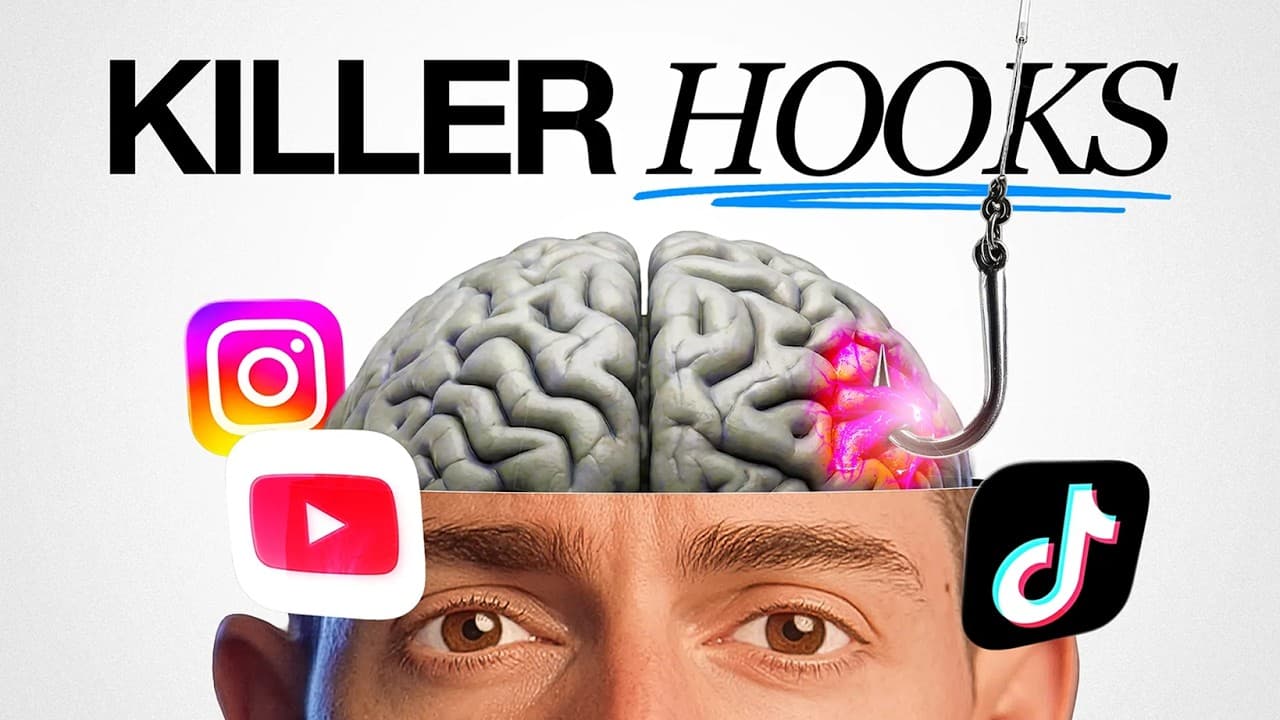
Today we're talking about hooks. If you want your videos to perform better, the number one thing to understand is hook psychology. This is the neuroscience that explains why certain videos hijack attention so much better than others. Now, look, I've studied literally thousands of the top videos. I've also made four of the most popular hook training... Read More
Key Insights
- Interrupt theory is a framework for stopping habitual scrolling by triggering an orienting response to a new stimulus. Its immediate objective is the freeze point, a brief moment when the viewer's thumb stops and attention shifts toward understanding what has appeared.
- A hook is effective when it answers two questions in the viewer's mind: what the content is about and what the viewer will receive by continuing. These questions correspond to the hook's subject and its promised outcome or stakes.
- The four S's of hook writing are subject, stakes, speed, and super clear communication. The framework treats all four as necessary building blocks because missing one can leave viewers uncertain about the topic, indifferent to the outcome, or unable to process the message quickly.
- The subject is the person, object, mission, or place that the content concerns. It must be identifiable immediately so viewers do not spend their brief pause trying to determine the basic topic before deciding whether the content deserves attention.
- The stakes are the viewer's reason to care about what happens next. Entertainment creates stakes through a curiosity-inducing scenario, while educational content can connect attention to desired outcomes such as more views, stronger skills, additional customers, more money, or more family time.
- Speed is message compression rather than excessively rapid speech. A short hook reduces the number of words the viewer must hold and connect, while rushed delivery can prevent absorption and make the hook as ineffective as one that was never understood.
- Super clear communication uses simple words, avoids vague setups, and limits the hook to one interpretation. Even temporary confusion can send viewers back to scrolling because social feeds provide a continuing stream of alternative stimulation.
- The triple hook method combines the text hook, spoken hook, and visual hook to interrupt scrolling. All three must communicate approximately the same idea, because individually strong components can still create confusion and lose attention when their subjects or implied outcomes conflict.
Install to Summarize YouTube Videos and Get Transcripts
Explore YouTube Video Summarizer or Get YouTube Transcript Extractor
Questions & Answers
Q: What is interrupt theory for social media hooks?
Interrupt theory describes how a hook breaks a viewer's habitual scrolling pattern and redirects attention toward new content. The desired interruption is called the freeze point, when the viewer pauses for even a brief moment. A hook creates this response by making the subject recognizable and presenting an outcome or situation that gives the viewer a reason to continue watching.
Q: How does a video hook trigger an orienting response?
A video hook triggers an orienting response by presenting a new stimulus that makes the viewer pause and ask what just appeared. The transcript compares this reaction to suddenly seeing a wolf in a backyard. For content, the response becomes useful when the opening quickly reveals what the content concerns and why the next moment could matter to the viewer.
Q: What questions should a strong hook answer?
A strong hook should answer two immediate questions: what is the content about, and what will the viewer get by continuing to watch? The first establishes the subject, while the second communicates the outcome or stakes. Answering both quickly reduces uncertainty and gives the viewer a concrete reason to stop scrolling instead of moving to the next piece of content.
Q: What are the four S's of hook writing?
The four S's of hook writing are subject, stakes, speed, and super clear communication. Subject tells viewers who or what the content concerns. Stakes establish why they should care. Speed compresses those ideas into as few useful words as possible. Super clear communication uses simple, unambiguous language so the viewer can understand the opening without pausing to interpret it.
Q: How should educational videos create meaningful stakes?
Educational videos create meaningful stakes by connecting the opening to an outcome the intended viewer already wants. The transcript gives examples including more views, more skills, more customers, more money, and more time with family. When the creator understands the desired outcome, the hook can state or strongly imply that benefit, giving the viewer an immediate reason to care and continue.
Q: Why should a spoken hook be short but not rushed?
A spoken hook should be short because viewers must retain its words long enough to understand the complete meaning. The transcript describes this as compression rather than velocity. Speaking too quickly can make the words difficult to absorb, while using too many words increases the mental load. The goal is concise phrasing delivered at a pace the viewer can readily process.
Q: How do text, spoken, and visual hooks work together?
Text, spoken, and visual hooks work together by aiming the viewer's attention at the same subject and expected outcome. Each component should support the others closely enough that someone seeing only the visual could approximately predict the text or spoken message. If the components communicate conflicting ideas, they create confusion, even when each one would have been effective on its own.
Q: How should on-screen text hooks be designed and placed?
On-screen text hooks should prioritize readability, clear sequencing, and fast recognition of important phrases or keywords. The transcript recommends placing the text near the top, roughly a third of the way down, or closer to the middle when the frame requires it. The text should appear where viewers look quickly without covering important elements such as the creator's eyes or mouth.
Summary & Key Takeaways
-
Interrupt theory frames a successful hook as an interruption of habitual scrolling. The hook should trigger an orienting response, creating a brief freeze point in which the viewer pauses and pays attention. It does this by prompting two immediate questions: what the content is about and what the viewer gains by continuing.
-
The four S's are subject, stakes, speed, and super clear communication. The subject establishes who or what the content concerns, while the stakes supply a reason to care. Speed means compressing the message into fewer words, and clarity means using simple language that permits only one reasonable interpretation.
-
The triple hook method combines on-screen text, spoken words, and opening visuals, with the caption's first visible line acting as another influence. These components must align so each supports the same subject and outcome. Text should be easy to read, positioned where eyes find it quickly, and kept away from important visuals.
Read in Other Languages (beta)
Share This Summary 📚
Summarize YouTube Videos and Get Video Transcripts with 1-Click
Try YouTube Summary with ChatGPT & Claude or YouTube Transcript Generator
Explore More Summaries from Kallaway 📚
Summarize YouTube Videos and Get Video Transcripts with 1-Click
Try YouTube Summary with ChatGPT & Claude or YouTube Transcript Generator