How to Use AI to Think More Deeply at Work
TL;DR
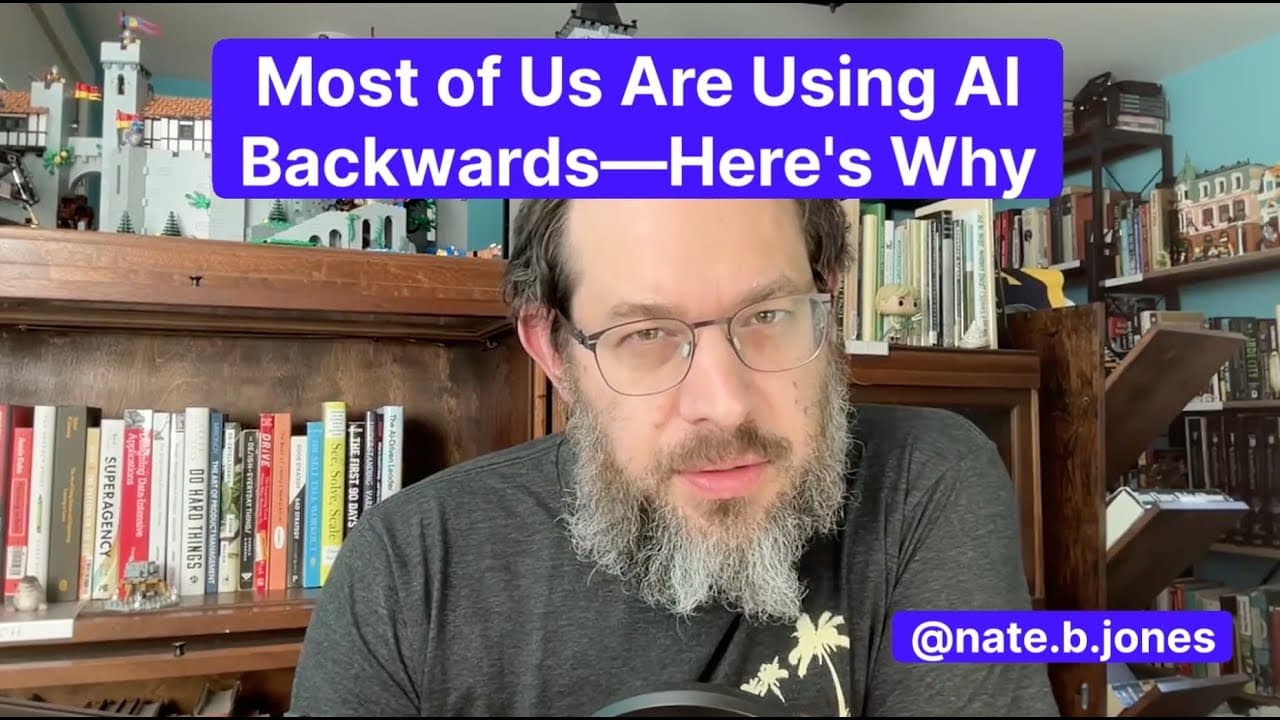
Use AI as a cognitive partner when a subject deserves deep thought, not merely as a tool for shortening documents or repackaging information. Choose interactions and models that support each thinking phase, such as talking ideas out loud, identifying the central thesis, critiquing results, and refining structure, while reserving compression for routine communication and lower-priority material.
Transcript
I want to suggest that most of us are using AI a little bit backwards. Stay with me. This is worth it. We are using AI primarily for information compression. So take my meeting notes and turn them into really neat outputs. Take this large product requirements doc, turn it into this for engineers and this for my executive stakeholders. Take this 100... Read More
Key Insights
- Information compression is the default AI use case for many people and companies, including shortening meeting notes, product requirements, PDFs, articles, and routine messages. It can save time and reduce communication costs, but it represents only one category of value available from AI.
- Deep learning is supported by extended time with a subject because the brain forms connections while engaging with complex material. A short executive briefing can convey a book's main points, but it is unlikely to reproduce the transformative experience that sustained reading and reflection can create.
- AI use is the problem when compression replaces necessary thinking, not because compression itself is inherently harmful. Routine notes and stakeholder communications are reasonable compression tasks, while books, theses, and other demanding work require deliberate cognitive engagement over a longer period.
- Cognitive partnership extends beyond writing a strong individual prompt. Prompting remains useful and efficient, but an ongoing exchange can help a person articulate unfinished ideas, examine assumptions, critique emerging conclusions, and remain mentally immersed in work that deserves sustained attention.
- Conversational AI works as a thinking aid by listening, taking notes, and offering enough engagement to keep ideas moving. During a 25-minute advanced voice conversation, the model's most valuable contribution was not profound insight, but its ability to help the speaker continue thinking aloud.
- A multi-model workflow assigns tools according to cognitive function rather than forcing one model to complete every phase. The speaker used advanced voice mode for articulation, O3 for clarifying the central thesis, and considered Opus 4 for refining an outline that initially felt too heavy.
- Human critique remains essential because model responses may be generic, structurally weak, or poorly matched to the intended idea. The speaker explicitly rejected some voice responses as vanilla and later judged the proposed outline too heavy, then selected a different model for the next stage.
- The best AI workflow depends on how an individual's brain works. Speaking while walking helped the speaker develop ideas, but another person might need to write by hand. There is no single magic prompt because productive cognitive engagement must fit the person's task and thinking style.
Install to Summarize YouTube Videos and Get Transcripts
Explore YouTube Video Summarizer or Get YouTube Transcript Extractor
Questions & Answers
Q: How can AI help people think more deeply?
AI can support deeper thinking by sustaining engagement with an important subject rather than immediately reducing it to a summary. A person can talk through an emerging idea, let the model listen and respond, examine the resulting transcript, and ask another model to clarify the thesis or map the conceptual terrain. The person must continue evaluating the responses so that AI expands the thinking process instead of replacing it.
Q: Why can relying on AI summaries weaken learning?
Relying on summaries can weaken learning when the value of the source lies in spending extended time with its ideas. Reading a deep book gives the brain time to form new connections while remaining immersed in the subject. A short briefing may accurately communicate major points, but it is unlikely to create the same cognitive journey or potentially life-changing experience as sustained engagement with the complete work.
Q: When should AI be used for information compression?
AI compression is appropriate for tasks where saving time matters more than prolonged reflection. Examples from the transcript include cleaning up meeting notes, adapting messages for different stakeholders, shortening product requirements for engineers or executives, and handling routine business communication. Compression becomes a trap when it is applied to work that needs deep understanding, original thinking, or the fullest attention a person can give.
Q: How does conversational AI support brainstorming?
Conversational AI supports brainstorming by giving a person space to speak ideas aloud while providing responses at a useful cadence. In the speaker's 25-minute session, advanced voice mode listened, took notes, and offered enough interest and riffing to keep the thought process flowing. Its value was not that every response was insightful, but that the interaction helped draw an unfinished idea out through conversation.
Q: What is a multi-model workflow for developing an idea?
A multi-model workflow gives each phase of thinking to a model suited to that role. The speaker began with advanced voice mode to articulate an idea aloud, moved the raw transcript through a Google document into O3 to identify the heart of the thesis, and considered Opus 4 to refine an outline. The workflow changes partners when the cognitive task changes instead of demanding everything from one conversation.
Q: Why is prompting alone insufficient for cognitive partnership?
Prompting primarily emphasizes a single instruction followed by a response, while cognitive partnership develops through continued interaction. Strong prompting is still described as a useful, efficient, and durable skill, but deeper work may require speaking, listening, revising, critiquing, and changing models across several stages. The important decision is not finding a secret prompt, but matching the AI interaction to the thinking task that must occur.
Q: How should someone choose an AI model for deep work?
A model should be selected according to the cognitive function needed at the current stage. A conversational model can help someone name the work and keep ideas flowing, a stronger reasoning model can clarify intent and define the conceptual terrain, and another model can reshape an outline or develop concepts. Model choice should change when the output is too generic, too heavy, or otherwise mismatched to the goal.
Q: What role does human judgment play in AI-assisted thinking?
Human judgment directs the entire AI-assisted thinking process. The person decides which work deserves deeper attention, identifies the intended idea, critiques generic or weak responses, evaluates whether a model has captured the thesis, and changes tools when necessary. In the example, the speaker called some voice responses vanilla and rejected an outline as too heavy. AI provides cognitive support, but the person remains responsible for direction and quality.
Summary & Key Takeaways
-
AI is commonly used to compress meeting notes, product requirements, long documents, and articles into shorter outputs. That approach saves time, but summaries cannot reproduce the connections formed through extended engagement with a subject. Important work may therefore benefit more from AI-assisted exploration than from immediate reduction into concise deliverables.
-
For a possible book about AI, the speaker used advanced voice mode for 25 minutes as a conversational thinking partner. It listened, took notes, and responded often enough to sustain the flow of ideas. The raw transcript was then transferred through a Google document into a stronger reasoning model for deeper analysis.
-
The workflow assigns different cognitive roles to different models. A conversational model helps articulate emerging thoughts, a reasoning model clarifies the thesis and maps the conceptual terrain, and another model can refine an outline or shape ideas. The goal is greater time on important subjects, with human judgment continuously critiquing model output.
Read in Other Languages (beta)
Share This Summary 📚
Summarize YouTube Videos and Get Video Transcripts with 1-Click
Try YouTube Summary with ChatGPT & Claude or YouTube Transcript Generator
Explore More Summaries from AI News & Strategy Daily | Nate B Jones 📚






Summarize YouTube Videos and Get Video Transcripts with 1-Click
Try YouTube Summary with ChatGPT & Claude or YouTube Transcript Generator