How to Create Winning Meta Ads from Proven Ideas
TL;DR
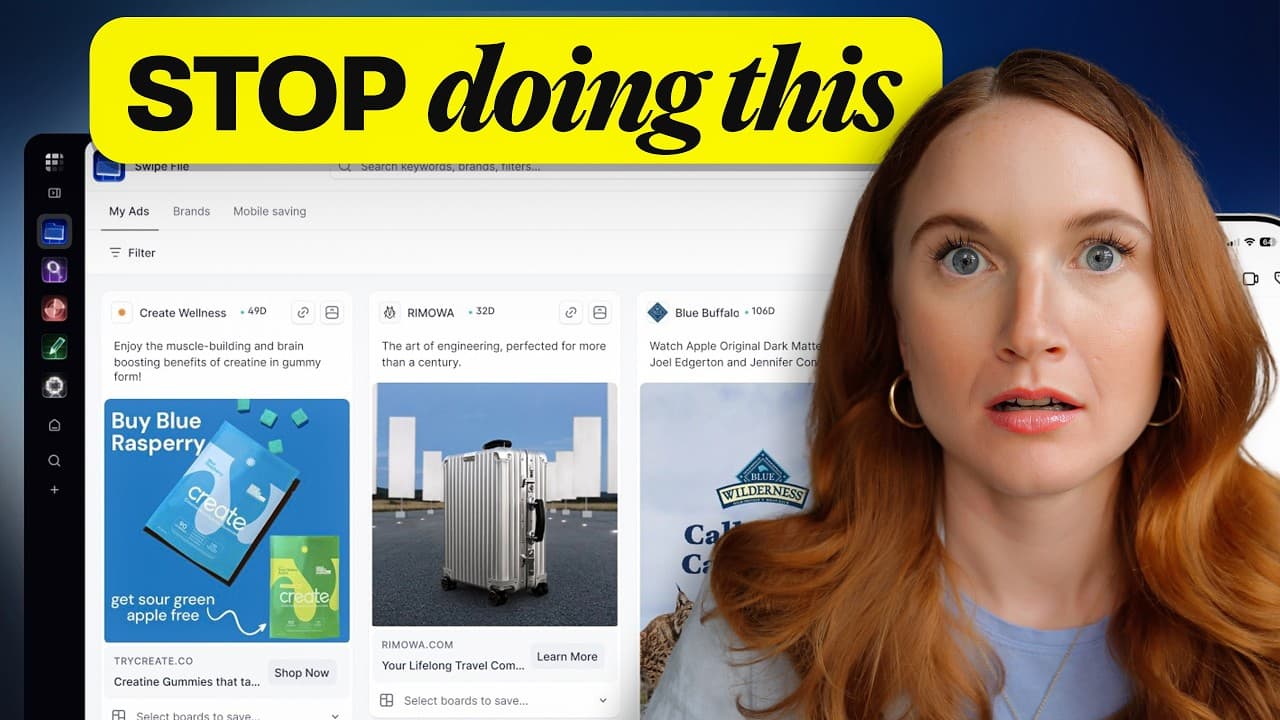
Build winning Meta ads by extracting the big ideas from proven creatives, identifying repeated performance patterns, and adapting those ideas into new formats. Prioritize concepts that are quick to validate and supported by evidence, then repeat effective messaging across statics, creator content, and partnership ads. If historical ad data is limited, research viral TikTok and Reels content for promising angles, formats, and personas.
Transcript
If you are copying what your competitors are doing to get winning ads or you are optimizing for volume because you don't really know what is going to convert on meta, then this video is for you because I'm going to show you the easiest way to make winning ads on meta. Now, every time I hear one of these two things, I always want to shake these foun... Read More
Key Insights
- A big idea is the unique and compelling creative concept that drives an advertising campaign, distinguishes the brand, and gives consumers a reason to buy. Every proposed ad should have an essence that a strategist can state clearly and succinctly.
- Pattern recognition is a core skill for Meta advertisers because it reveals which personas, messages, concepts, and formats repeatedly appear in winning creatives. It also exposes approaches that have consistently underperformed within a niche, industry, or individual ad account.
- Creative prioritization is the practice of ranking ideas by how quickly they can be produced and how strongly existing evidence supports their likely performance. An expensive concept can often be validated first with a static ad, internal creator, or founder-led execution.
- A brand's next top-performing creative may already exist within its ad account as a proven idea that has not yet been fully developed. Reviewing leading ads and extracting their central concepts can uncover opportunities to adapt validated messaging into new formats.
- The five-minute makeup routine became a stronger concept when the strategist focused on the audio's time-saving promise instead of the video's generic get-ready-with-me format. The resulting creative reportedly spent well over $2 million for the brand, demonstrating the value of isolating the real idea.
- A creative ecosystem is a collection of ads that presents consistent big ideas and proof through varied formats and creators, supporting a cohesive customer journey. Creative diversity alone is insufficient when successful messages do not recur across the brand's advertising.
- Repetition can strengthen performance when the same validated idea appears in varied, entertaining executions. The transcript states that an average customer may see ads seven times before purchasing in the best cases, so one concept should appear through multiple credible touchpoints.
- Viral TikTok and Reels content can provide research signals when an advertiser lacks substantial historical ad data. Recurring organic messaging angles, formats, and customer personas can reveal promising directions for Meta creative development and support the need for more top-of-funnel content.
Install to Summarize YouTube Videos and Get Transcripts
Explore YouTube Video Summarizer or Get YouTube Transcript Extractor
Questions & Answers
Q: How do you create winning Meta ads without copying competitors?
Start with evidence from your own ad account instead of duplicating a competitor's execution. Identify the central big idea behind each top-performing creative, look for repeated messages, personas, and formats, and adapt the strongest concepts into new executions. Prioritize versions that are fast to produce and easy to validate, such as statics, founder content, or internal creator content, before committing to costly production.
Q: What is a big idea in Meta advertising?
A big idea is the core unique and compelling creative concept that drives an advertising campaign, helps the brand stand out, and encourages consumers to buy. A strategist should be able to describe an ad's big idea succinctly. Doing so makes it easier to compare creatives, recognize repeated performance patterns, and transfer a validated concept into additional formats without merely copying the original execution.
Q: How can pattern recognition improve Meta ad performance?
Pattern recognition helps advertisers identify the personas, messages, creative concepts, and formats that repeatedly appear in successful ads. It also reveals approaches that have performed poorly. By reducing each creative to its core idea and comparing results across an account, a strategist can make evidence-based decisions about which concepts deserve further iteration and which ideas should receive lower priority.
Q: How should Meta ad creative ideas be prioritized?
Prioritize ideas on two main dimensions: how easily and quickly they can be made, and how much evidence suggests they will perform. Before funding a large shoot or hiring several creators, test the concept through a simpler static, founder-led ad, or internal creator. Favor concepts with demonstrated evergreen potential over complicated executions that may deliver only a brief result for a narrow audience.
Q: How do you find new ad ideas in an existing Meta account?
Review the account's leading creatives over a meaningful period, state the big idea behind each one, and look for concepts that appear repeatedly among strong performers. Then identify formats in which those ideas have not yet been expressed. A successful video concept, for example, can be tested as a static, creator ad, founder ad, or partnership ad while preserving the original message that produced results.
Q: What is a creative ecosystem for Meta ads?
A creative ecosystem is a coordinated collection of ads that presents the same proven ideas and supporting proof through multiple formats and creators. Its purpose is to give potential customers a cohesive journey while keeping repeated exposure varied and entertaining. The approach goes beyond creative diversity because it deliberately carries successful messaging across statics, creator content, founder content, and partnership ads to support scale.
Q: How long should you iterate on a successful Meta ad concept?
Continue iterating on a successful ad concept until it stops working. Rather than abandoning a winner after one execution, extract its central idea and develop additional versions across formats, headlines, creators, and presentations. This process helps a brand get more value from existing creative learnings and allows the same proof or promise to reach customers through several distinct but connected advertisements.
Q: How can brands create Meta ads without much historical data?
Brands with limited ad history can use viral organic content from TikTok and Reels as an inspiration and research source. They should examine recurring messaging angles, formats, and customer personas, then use those observations to develop Meta ad tests. This viral content process can be applied during onboarding and repeated weekly, particularly when a brand needs more top-of-funnel creative and lacks established account-level learnings.
Summary & Key Takeaways
-
Effective Meta ad development begins with three principles: define each creative's big idea, recognize patterns across successful and unsuccessful ads, and prioritize tests by production ease and likelihood of performance. These principles replace copying competitors or maximizing creative volume with a more confident, evidence-based process for building a creative roadmap.
-
Brands with substantial ad history can examine their top-performing creatives, summarize the central idea behind each one, and find concepts that repeatedly drive results. Those validated ideas can then be transferred between video, static, creator, founder, and partnership formats, creating additional opportunities for emotional resonance, audience exposure, and scale.
-
Brands without extensive advertising history can use viral organic content from TikTok and Reels as a research source. Recurring messaging angles, content formats, and customer personas can inform new Meta ad concepts. The broader goal is a cohesive creative ecosystem that repeats proven ideas in diverse and entertaining executions until performance declines.
Read in Other Languages (beta)
Share This Summary 📚
Summarize YouTube Videos and Get Video Transcripts with 1-Click
Try YouTube Summary with ChatGPT & Claude or YouTube Transcript Generator
Explore More Summaries from Dara Denney 📚
Summarize YouTube Videos and Get Video Transcripts with 1-Click
Try YouTube Summary with ChatGPT & Claude or YouTube Transcript Generator