How Do Generative AI, AI Agents, and Agentic AI Differ?
TL;DR
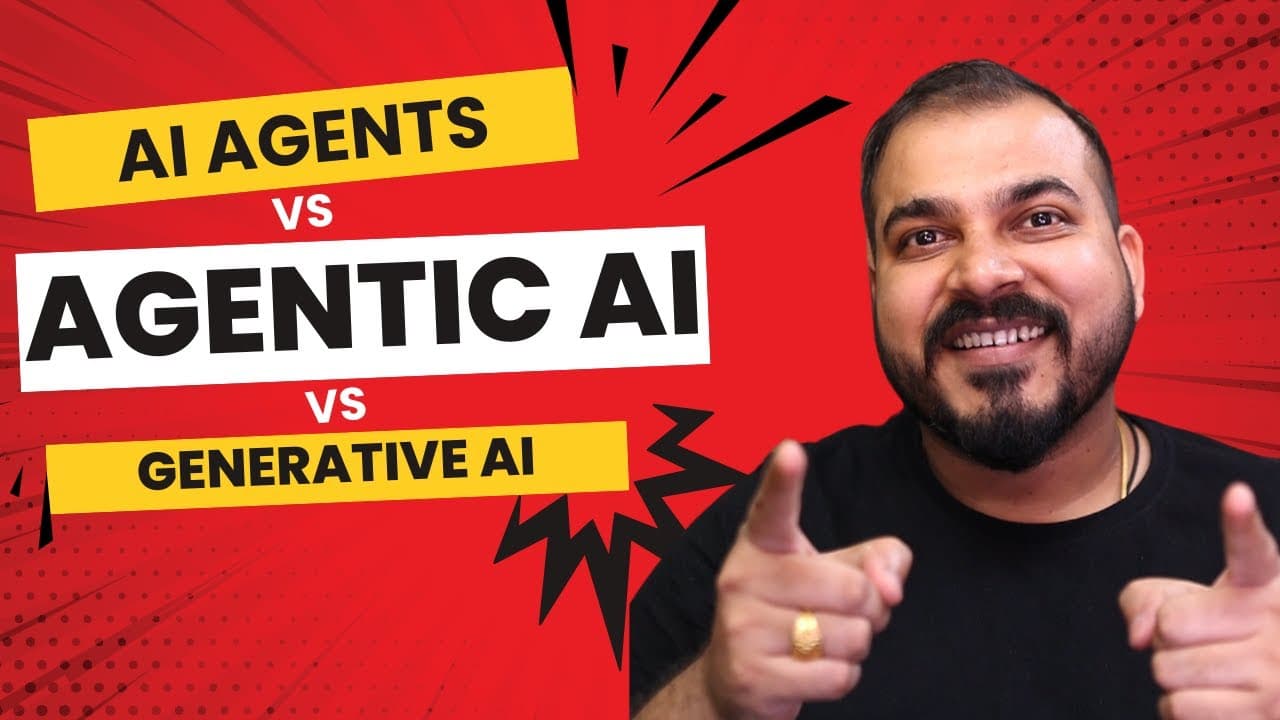
Generative AI reacts to prompts by producing new content, while an AI agent uses an LLM and connected tools to complete a specific task that the model cannot handle alone. Agentic AI extends this idea to autonomous, context-aware systems that adapt in real time, coordinate complex workflows, solve multi-step problems, and can incorporate human feedback.
Transcript
Hello all, my name is Krishna and welcome to my YouTube channel. So guys, today in this particular video we are going to discuss about the basic differences between generative AI versus AI agents versus agentic AI. Now this is one of the most trending topics that is currently going on and it is necessary that you need to have your understanding ver... Read More
Key Insights
- Generative AI is focused on generating new content from user input, including text, images, audio, video frames, and videos. Large language, image, and multimodal models support this process after being trained on large amounts of data.
- Generative AI applications are reactive because their behavior begins with a prompt or instruction. A user can ask a model to assume a role, perform a task, or create particular content, and the model responds according to that request.
- Large models can contain billions of parameters and are trained with large datasets. The examples mentioned include Llama 3 and OpenAI models, while the broader category also includes large image models and models with multimodal content-generation capabilities.
- A standalone LLM is limited by the data used during its training. It may be unable to answer questions about current news, recent match results, or private company information when it lacks internet access or a connection to relevant external data.
- Tool calling is the mechanism that allows an LLM to request help from a connected third-party API or data source. The model identifies an appropriate tool, sends the request, receives the response, and can summarize that information for the user.
- An AI agent is presented as an LLM-based system that uses a tool to complete a specific task. The example agent answers a current-news request by calling the Tavily internet-search service and then turning the returned information into a useful response.
- Agentic AI is an AI system that acts autonomously, adapts in real time, and solves multi-step problems according to context and objectives. Its scope includes automating complex tasks and workflows rather than handling only one narrowly defined tool-assisted task.
- Human feedback can be incorporated within an agentic AI workflow. This makes it possible to combine automated execution with human involvement while the overall application works through a complex task involving multiple stages or decisions.
Install to Summarize YouTube Videos and Get Transcripts
Explore YouTube Video Summarizer or Get YouTube Transcript Extractor
Questions & Answers
Q: What is generative AI and what content can it create?
Generative AI uses large language, image, or multimodal models to produce new content after receiving an input. The generated output can include text, images, audio, video frames, or videos. These models are trained on large amounts of data and may contain billions of parameters. Their primary role in the described applications is content generation based on prompts supplied by users.
Q: Why are generative AI applications described as reactive?
Generative AI applications are described as reactive because they depend on a user prompt or instruction before producing an output. The prompt tells the model what to create or how to behave, such as acting as a data scientist and conducting an interview. The model then generates content in response to that instruction instead of independently initiating a broader workflow.
Q: What is the limitation of using a standalone LLM?
A standalone LLM is limited by the past data on which it was trained and by the information available within the model. Without internet access or external connections, it may not know current news or a recent match result. It may also lack private company information that was never included in its training data, even though it can still generate new content.
Q: How does tool calling help an LLM answer current questions?
Tool calling lets an LLM use a connected external API or data source when its own stored knowledge cannot answer a question. The model evaluates the request, identifies a suitable tool, calls that tool, and receives a response. It can then summarize the returned information and present it as the final answer, such as when retrieving news for the current date.
Q: What is an AI agent according to the video?
An AI agent is presented as a system in which an LLM can select and use an external tool to complete a specific task. For example, when asked for current AI news, the model can recognize that it needs internet search, call the connected Tavily service, receive the search response, and summarize that response for the user. The agent is centered on that defined task.
Q: How is an AI agent different from a basic generative AI application?
A basic generative AI application primarily reacts to prompts by generating new content from the capabilities and information already available to its model. An AI agent adds the ability to select and call connected tools for a specific task. This allows it to retrieve external information, receive a tool response, and use that response when preparing its final output.
Q: What is agentic AI and what problems does it address?
Agentic AI is described as an AI system that acts autonomously, adapts in real time, and solves multi-step problems using context and objectives. It is intended for automating complex tasks and entire workflows. The discussion also connects agentic applications with human feedback, allowing people to participate within an otherwise automated process when their input is needed.
Q: Which libraries and services are mentioned for building these AI applications?
The discussion mentions LangGraph, LangChain, and LlamaIndex as libraries that can be used when developing generative AI applications. It also refers to Groq code and OpenAI code as ways to begin building applications. For the AI-agent example, Tavily is presented as a third-party internet-search service that an LLM can access through a tool call.
Summary & Key Takeaways
-
Generative AI applications use large language, image, or multimodal models trained on large datasets to create new text, images, audio, videos, or other content. They are described as reactive because users provide prompts or instructions, and the model generates content according to those inputs and the behavior requested.
-
A standalone LLM is limited by its training data and may lack current news, private company information, or other external data. Connecting the model to an API or data source addresses this limitation. Tool calling enables the LLM to choose a suitable external resource, send a request, and receive relevant information.
-
An AI agent can use an LLM to select and call a tool for a specific task, such as retrieving current news through an internet-search API and summarizing the response. Agentic AI covers broader autonomous systems that adapt to context and objectives, solve multi-step problems, automate complex workflows, and allow human feedback.
Read in Other Languages (beta)
Share This Summary 📚
Summarize YouTube Videos and Get Video Transcripts with 1-Click
Try YouTube Summary with ChatGPT & Claude or YouTube Transcript Generator
Explore More Summaries from Krish Naik 📚


Summarize YouTube Videos and Get Video Transcripts with 1-Click
Try YouTube Summary with ChatGPT & Claude or YouTube Transcript Generator