What Does the Agentic AI Bootcamp Cover?
TL;DR
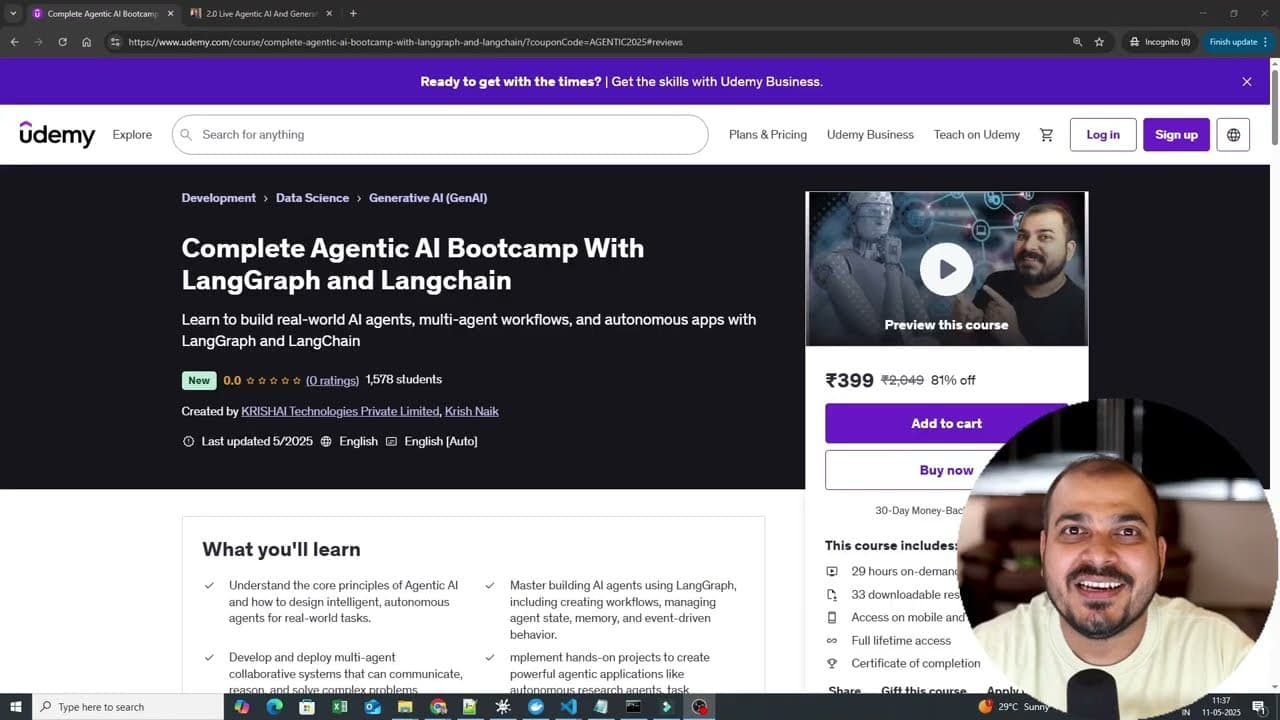
The bootcamp teaches agentic AI through LangGraph and LangChain, beginning with Python prerequisites and generative AI applications before progressing to agents, workflows, human feedback, debugging, and several RAG patterns. The released course contains 29 hours, with plans to expand beyond 55 hours through additional modules, four end-to-end projects, MCP integration, and LangGraph Cloud deployment.
Transcript
Hello all, my name is Krishna and welcome to my YouTube channel. So guys, I am super excited to announce our new Udemy course on the complete agenti boot camp with Langraph and Langchain. So this was one of the most requested batch from past couple of months and finally yesterday we have launched this particular batch and uh the kind of feedbacks t... Read More
Key Insights
- The course is structured as a progression from Python prerequisites and conventional generative AI applications to AI agents, agentic systems, and increasingly complex LangGraph workflows, allowing foundational topics to be established before advanced implementations are introduced.
- LangGraph fundamentals include creating simple graphs and workflows, defining nodes and edges, working with state graphs, compiling graphs, and developing an LLM-powered chatbot through LangGraph, with implementation tied to concrete application examples.
- The LangGraph components module combines theoretical explanations with practical implementations based on specific use cases, so learners can see how individual components contribute to complete agentic AI applications rather than studying each component only in isolation.
- LangGraph Studio is used to debug agentic applications by examining communications, agentic execution flows, and outputs from individual nodes, helping learners identify how a workflow behaves and where its outputs may be improved through a cloud-based environment.
- The workflow section covers prompt chaining, parallelization, routing, orchestrator-worker patterns, and evaluator-optimizer patterns, with each implementation presented step by step and each implementation video described as lasting at least 15 to 20 minutes.
- Human-in-the-loop workflows allow human feedback to be inserted into complex AI processes, enabling a person to review or guide execution before the workflow continues instead of allowing the LLM to execute every stage without intervention.
- The RAG material includes eight to nine implementation types, including agentic RAG, corrective RAG, adaptive RAG, and self-RAG within adaptive RAG, with both theoretical intuition and practical implementation included in the instruction.
- The published course contains 29 hours and is planned to grow beyond 55 hours, with four end-to-end projects, MCP integration with LangGraph, and LangGraph Cloud deployment identified as forthcoming material that will be uploaded as recording and access become available.
Install to Summarize YouTube Videos and Get Transcripts
Explore YouTube Video Summarizer or Get YouTube Transcript Extractor
Questions & Answers
Q: What topics does the Agentic AI Bootcamp cover?
The bootcamp covers Python prerequisites, LangChain, open-source LLMs, OpenAI, Grok, traditional generative AI application development, AI agents, and agentic AI. Its LangGraph material includes graphs, nodes, edges, state graphs, compilation, chatbots, components, advanced techniques, debugging, workflow patterns, human-in-the-loop systems, and eight to nine RAG implementations. Planned additions include projects, MCP integration, and cloud deployment.
Q: How does the bootcamp introduce LangGraph fundamentals?
The LangGraph section starts with creating a simple graph or workflow and then introduces nodes, edges, state graphs, and graph compilation. Learners also build a simple LLM-powered chatbot with LangGraph. The instruction emphasizes practical use cases alongside explanations, with the stated goal of developing a strong foundation before moving into advanced LangGraph components, workflows, and debugging.
Q: Which agentic workflow patterns are taught in the course?
The workflow module teaches prompt chaining, parallelization, routing, orchestrator-worker patterns, and evaluator-optimizer patterns, along with additional workflows mentioned by the instructor. The implementations are presented step by step, with code written and explained line by line. Each implementation video is described as lasting at least 15 to 20 minutes and connecting the workflow pattern to use cases.
Q: How does the course teach debugging with LangGraph Studio?
The course uses LangGraph Studio to inspect and debug agentic AI applications. Learners can track communications within an application, observe the agentic flow being followed, review the output generated by each node, and identify possible improvements. The instructor says this verification and debugging work will be performed directly through the cloud platform provided for LangGraph applications.
Q: What RAG approaches are included in the bootcamp?
The RAG section includes eight to nine different implementation types. The specifically named approaches are agentic RAG, corrective RAG, adaptive RAG, and self-RAG, which is discussed within the adaptive RAG material. These approaches are taught through both theoretical intuition and practical implementation, giving learners conceptual explanations as well as code-based examples of the different patterns.
Q: How is human feedback added to agentic AI workflows?
The human-in-the-loop module demonstrates how human feedback can be incorporated into complex workflows. Although an AI model may be capable of executing most or all workflow stages, the course presents human input as an important control point. Learners are shown how feedback can be provided within the workflow and how execution can continue after that feedback has been received.
Q: How long is the course, and what content is still planned?
The released course contains 29 hours of material, and the instructor plans to expand it to more than 55 hours. Four to five modules were described as pending, with uploads targeted approximately every two weeks because recording takes time. Planned content includes four end-to-end projects, MCP with LangGraph, and deployment using LangGraph Cloud once the required access is available.
Q: What price and coupon are mentioned for the Udemy course?
The instructor provides the coupon code AGENTIC2025 and says that people in India can obtain the course for 399 rupees while the limited Udemy coupon remains available. The description also includes an enrollment link containing that coupon code. The instructor presents the offer as time-dependent because Udemy supplies limited coupons, so continued availability is not guaranteed in the source.
Summary & Key Takeaways
-
The course begins with a dedicated Python prerequisite module, LangChain, open-source LLMs, OpenAI, Grok, and traditional generative AI application development. It then transitions into AI agents and agentic AI, giving learners a progressive route from foundational application building to graph-based systems designed around practical use cases.
-
LangGraph instruction covers simple graphs, nodes, edges, state graphs, compilation, and an LLM-powered chatbot. Later modules address individual LangGraph components, advanced techniques, debugging through LangGraph Studio, and workflow patterns such as prompt chaining, parallelization, routing, orchestrator-worker systems, and evaluator-optimizer processes, with code written and explained step by step.
-
The published material totals 29 hours, while the planned course is expected to exceed 55 hours. Upcoming additions include four end-to-end projects, MCP with LangGraph, and deployment through LangGraph Cloud. The AGENTIC2025 coupon was presented as offering an Indian price of 399 rupees while the limited coupon remains available.
Read in Other Languages (beta)
Share This Summary 📚
Summarize YouTube Videos and Get Video Transcripts with 1-Click
Try YouTube Summary with ChatGPT & Claude or YouTube Transcript Generator
Explore More Summaries from Krish Naik 📚

Summarize YouTube Videos and Get Video Transcripts with 1-Click
Try YouTube Summary with ChatGPT & Claude or YouTube Transcript Generator