How Do Hemiacetals and Acetals Function as Protecting Groups?
TL;DR
Hemiacetals form when aldehydes react with alcohols under acidic conditions, while acetals arise from further reaction with additional alcohol. These structures can be reversed back to aldehydes or ketones via H3O+. Cyclic acetals, like those formed with ethylene glycol, serve as effective protecting groups in organic synthesis, allowing selective functional group manipulation.
Transcript
now let's say we have an aldehyde and we choose to react it with an alcohol what type of product will we get in this reaction and let's say it's catalyzed by an acid the product will be a hemiacetal so we're going to get an or group plus an oh group so that's a hemiacetal now it doesn't have to stop here the hemiacetal can react with another methan... Read More
Key Insights
- 💁 Aldehydes can react with alcohols under acidic conditions to form hemiacetals and further react to form acetals.
- ❓ Acetals can be converted back to the original aldehyde or ketone compound by reacting with H3O+ under acidic conditions.
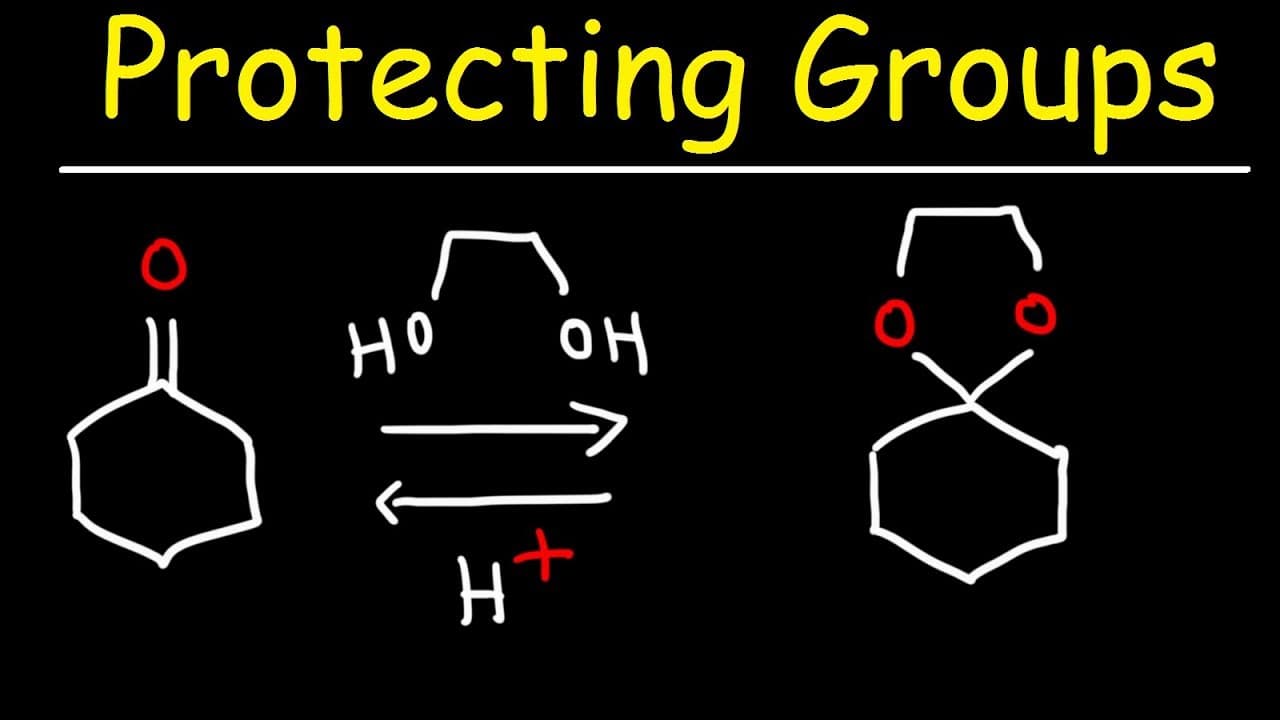
- 💁 Cyclohexanone can form a cyclic acetal when reacted with ethylene glycol, which can serve as a protecting group in organic synthesis.
- 👥 Protecting groups are crucial in organic synthesis to selectively manipulate specific functional groups without affecting others.
- ✋ The reactivity of ketones is higher than that of esters, making ketones more susceptible to reactions with protecting groups.
- ❓ The choice of reducing agent, such as sodium borohydride or lithium aluminum hydride, depends on the desired reduction outcome.
- 💄 Acetals and cyclic acetals have reversible reactions, making them versatile in organic synthesis.
Install to Summarize YouTube Videos and Get Transcripts
Explore YouTube Video Summarizer or Get YouTube Transcript Extractor
Questions & Answers
Q: What type of product is formed when an aldehyde reacts with an alcohol under acidic conditions?
The product formed is a hemiacetal, which contains an OR group and an OH group.
Q: Can a hemiacetal react further to form a different compound?
Yes, a hemiacetal can react with another alcohol molecule under acidic conditions to form an acetal, which contains two OR groups.
Q: Is the reaction of acetals reversible?
Yes, the reaction of acetals with H3O+ under acidic conditions is reversible, and it can regenerate the original aldehyde or ketone compound.
Q: How can a cyclic acetal be used as a protecting group?
A cyclic acetal, formed by reacting cyclohexanone with ethylene glycol, can protect a ketone group while allowing selective reduction of an ester group using lithium aluminum hydride.
Summary & Key Takeaways
-
Aldehydes can react with alcohols under acidic conditions to form hemiacetals, which contain an OR group and an OH group.
-
Hemiacetals can further react with another alcohol molecule to form acetals, which contain two OR groups.
-
Acetals can be converted back to the original aldehyde or ketone compound by reacting with H3O+ under acidic conditions.
-
Cyclohexanone can form a cyclic acetal when reacted with ethylene glycol, and this reaction can be used as a protecting group in organic synthesis.
Read in Other Languages (beta)
Share This Summary 📚
Summarize YouTube Videos and Get Video Transcripts with 1-Click
Try YouTube Summary with ChatGPT & Claude or YouTube Transcript Generator
Explore More Summaries from The Organic Chemistry Tutor 📚




Summarize YouTube Videos and Get Video Transcripts with 1-Click
Try YouTube Summary with ChatGPT & Claude or YouTube Transcript Generator