How to Calculate Molecular Speed of Nitrogen Gas
TL;DR
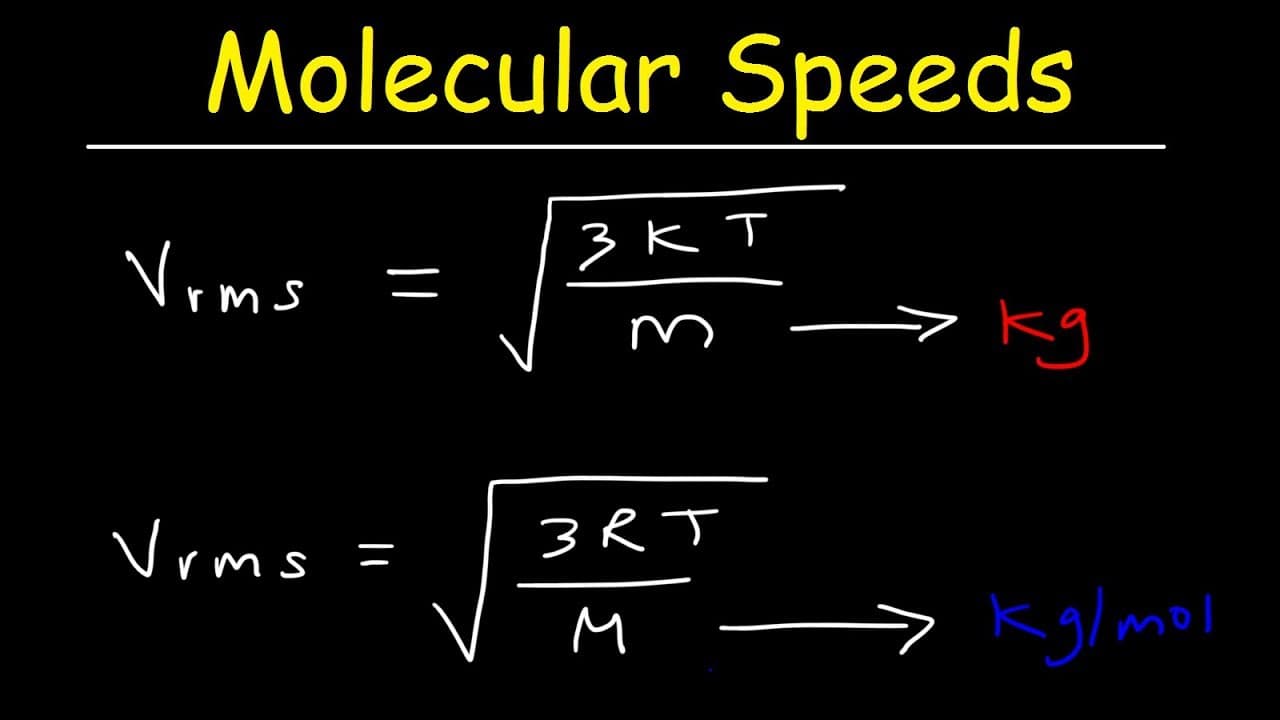
To calculate the root mean square molecular speed of nitrogen gas at 300 Kelvin, use the formula √(3kT/m), where k is Boltzmann's constant and m is the mass of a nitrogen molecule, calculated as 4.651 x 10^-26 kilograms. Alternatively, the formula √(3RT/M) can be applied using the molar mass of N2, yielding the same speed of 517 meters per second.
Transcript
in this video we're going to talk about two ways in which we could calculate the root mean square molecular speed of nitrogen gas at 300 kelvin so let's start with this formula it's equal to 3 kt divided by the mass now k is boltzmann's constant and m is the mass of a single nitrogen gas molecule in kilograms now using the periodic table the atomic... Read More
Key Insights
- 💆 The root mean square molecular speed of nitrogen gas at 300 Kelvin can be calculated using either the formula 3kt/mass or 3rt/molar mass.
- ✖️ Converting atomic mass units to kilograms is a simple process involving multiplication by 1.66 x 10^-27.
- 💆 The molar mass of N2 can be obtained by multiplying the atomic mass of nitrogen by 2 and then converting grams to kilograms.
- ☺️ Boltzmann's constant is 1.38 x 10^-23 and the ideal gas constant is 8.3145 in the formulas.
Install to Summarize YouTube Videos and Get Transcripts
Explore YouTube Video Summarizer or Get YouTube Transcript Extractor
Questions & Answers
Q: What is the formula for calculating the root mean square molecular speed of nitrogen gas at 300 Kelvin?
The formula is 3kt/mass, where k is Boltzmann's constant and mass is the mass of a single nitrogen gas molecule.
Q: How can the atomic mass of nitrogen be converted to kilograms?
The atomic mass of nitrogen is 14.01 atomic mass units, so by multiplying it by 1.66 x 10^-27, we get 4.651 x 10^-26 kilograms.
Q: What is the alternative formula for calculating the root mean square velocity?
The alternative formula is 3rt/molar mass, where r is the ideal gas constant and molar mass is the molar mass of N2.
Q: How can the molar mass of nitrogen gas be converted to kilograms per mole?
The molar mass of N2 is 28.02 atomic mass units, which can be converted to grams per mole (28.02 grams per mole). By further converting grams to kilograms (0.02802 kilograms per mole), we get the desired conversion.
Summary & Key Takeaways
-
The root mean square molecular speed of nitrogen gas at 300 Kelvin can be calculated using the formula 3kt/mass, where k is Boltzmann's constant and mass is the mass of a single nitrogen gas molecule.
-
The atomic mass of nitrogen is 14.01, but since we have two nitrogen gas molecules in this problem, the mass is 28.02 atomic mass units, which can be converted to 4.651 x 10^-26 kilograms.
-
Another equation that can be used is 3rt/molar mass, where r is the ideal gas constant, and molar mass is the molar mass of N2. By converting the atomic mass to grams and then to kilograms, the molar mass is calculated as 0.02802 kilograms per mole.
Read in Other Languages (beta)
Share This Summary 📚
Summarize YouTube Videos and Get Video Transcripts with 1-Click
Try YouTube Summary with ChatGPT & Claude or YouTube Transcript Generator
Explore More Summaries from The Organic Chemistry Tutor 📚



Summarize YouTube Videos and Get Video Transcripts with 1-Click
Try YouTube Summary with ChatGPT & Claude or YouTube Transcript Generator