How to Determine Acceleration from a Velocity-Time Graph
TL;DR
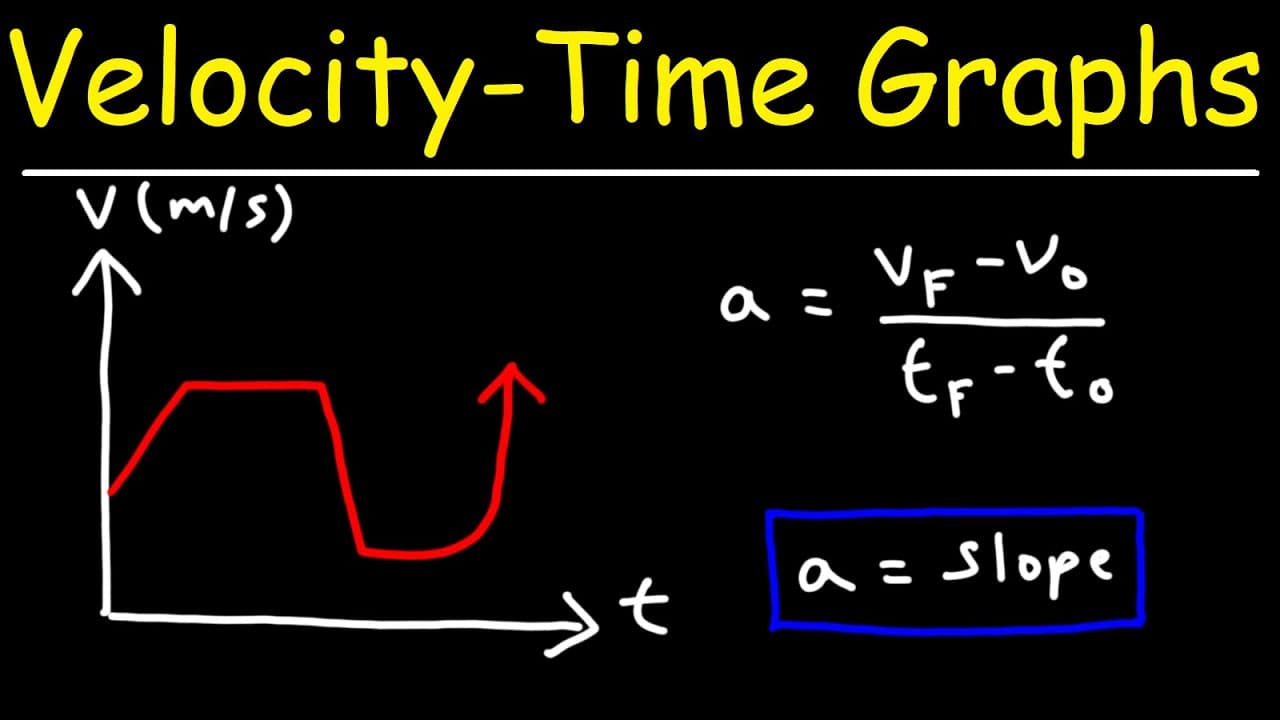
To find acceleration from a velocity-time graph, calculate the slope of the graph between two points. Positive slopes indicate positive acceleration, slopes of zero indicate constant velocity, and negative slopes indicate negative acceleration. For straight lines, average acceleration equals instantaneous acceleration, while for curves, approximate instantaneous acceleration using the slope of a secant line.
Transcript
in this video we're going to focus on finding the acceleration of a particle given the velocity time graph now before we do that let's talk about some things that you need to note whenever the velocity is increasing the acceleration is positive whenever the velocity is constant the acceleration is zero and when the velocity is decreasing the accele... Read More
Key Insights
- 📈 Velocity-time graphs provide information about the acceleration of a particle based on the behavior of the graph.
- 💱 The average acceleration can be found using the change in velocity divided by the change in time between two points on the graph.
- 🫥 For straight line segments, the average acceleration is equal to the instantaneous acceleration.
- 😥 Approximating the instantaneous acceleration at a specific point on a curved segment can be done by calculating the slope of the secant line between two points.
- 😥 The closer the two points are to the point of interest, the more accurate the estimation of instantaneous acceleration.
- ☠️ The slope of the velocity-time graph represents the rate of change, which is equal to acceleration.
- 😮 The acceleration can be determined by finding the slope of the graph, which is equivalent to finding rise over run.
Install to Summarize YouTube Videos and Get Transcripts
Explore YouTube Video Summarizer or Get YouTube Transcript Extractor
Questions & Answers
Q: How does the behavior of the velocity-time graph relate to acceleration?
When the velocity is increasing, the acceleration is positive. When the velocity is constant, the acceleration is zero. When the velocity is decreasing, the acceleration is negative.
Q: How can the average acceleration of a particle be calculated on a velocity-time graph?
The average acceleration can be calculated by finding the change in velocity divided by the change in time between two points on the graph.
Q: How can the instantaneous acceleration of a particle be approximated on a velocity-time graph?
In the absence of a velocity function, the instantaneous acceleration can be approximated by finding the slope of the secant line between two points on the graph.
Q: How can the acceleration be determined at a specific point on a curved segment of the velocity-time graph?
The slope of the tangent line at the point can be used to find the instantaneous acceleration, but in the absence of the velocity function, the slope of the secant line can be used to approximate it.
Summary & Key Takeaways
-
Velocity-time graphs provide information about acceleration based on the behavior of the graph. Increasing velocity indicates positive acceleration, constant velocity indicates zero acceleration, and decreasing velocity indicates negative acceleration.
-
The average acceleration of a particle can be determined by calculating the slope of the graph between two points. The instantaneous acceleration can be approximated by the slope of the tangent line at a specific point.
-
For straight line segments on the graph, the acceleration can be calculated using the change in velocity divided by the change in time. For curved segments, the slope of the secant line can be used to approximate the instantaneous acceleration.
Read in Other Languages (beta)
Share This Summary 📚
Summarize YouTube Videos and Get Video Transcripts with 1-Click
Try YouTube Summary with ChatGPT & Claude or YouTube Transcript Generator
Explore More Summaries from The Organic Chemistry Tutor 📚

Summarize YouTube Videos and Get Video Transcripts with 1-Click
Try YouTube Summary with ChatGPT & Claude or YouTube Transcript Generator