How to Learn Coding for Agentic Engineering
TL;DR
Start with coding fundamentals, then study software architecture, testing, deployment, version control, security, and privacy before relying heavily on AI coding agents. Modern coding increasingly involves directing agents, but effective oversight still requires enough engineering knowledge to define systems, provide context, recognize incorrect output, track changes, and keep development environments safe.
Transcript
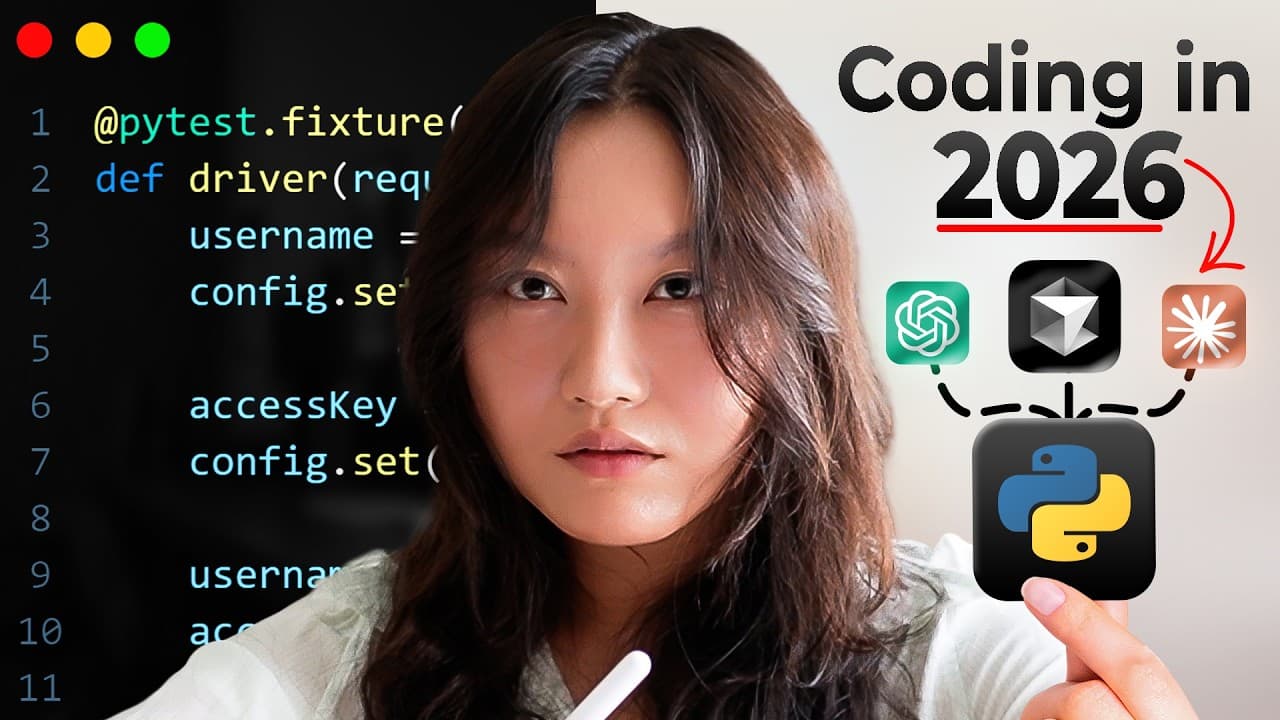
Learning to code is so different in 2026. So, in this video, I shall explain to you how to learn to code in 2026. Starting off with what coding actually looks like today. It looks very different. Then, I'll explain what you should be learning that is still relevant right now and for the future. And finally, some tips on how to supercharge your lear... Read More
Key Insights
- Coding remains worth learning in 2026 because people who understand it can access opportunities and build software, while modern tools can make the learning and development process faster than it was previously.
- Agentic engineering is a professional workflow in which developers direct multiple AI coding agents through a terminal or IDE, request builds and fixes, review their behavior, and redirect them when their implementation choices are incorrect.
- Effective AI agent supervision requires software engineering knowledge because developers must structure the intended product, provide useful context and documentation, identify incorrect output, and understand what the correct implementation or design should be.
- Programming fundamentals are necessary for reading and evaluating generated code, including variables, types, conditional statements, loops, object-oriented programming, and APIs. Python suits AI agent and data projects, while JavaScript may suit web application development.
- Software architecture covers project structure, technology stack selection, system design, APIs, data flow, storage, databases, testing, and deployment. Understanding these areas helps developers translate requirements into an end product and direct agents toward an appropriate design.
- Version control tracks changes to files and code over time, supports history and reversion, and enables collaboration. Git is identified as the most popular version control software, while GitHub is described as an industry standard for displaying, sharing, and collaborating on code.
- Security and privacy require explicit attention because they are described as common blind spots for AI coding agents. Human developers cannot simply assume agents will handle these concerns, so relevant principles must be deliberately incorporated into software design and implementation.
- Containerization packages application code with the files, libraries, and dependencies it needs, isolates it from the surrounding computer, and supports consistent execution across environments. This isolation can also contain problems caused by an AI agent behaving unpredictably.
Install to Summarize YouTube Videos and Get Transcripts
Explore YouTube Video Summarizer or Get YouTube Transcript Extractor
Questions & Answers
Q: Should beginners still learn to code in 2026?
Beginners should still learn to code because many opportunities remain available to people who understand programming, especially those who want to build software. AI tools can make coding faster and easier, but they do not eliminate the need for knowledge. A developer must still understand requirements, inspect generated code, recognize mistakes, and guide AI agents toward correct results.
Q: What is agentic engineering in software development?
Agentic engineering is a workflow in which a developer uses a terminal or IDE to direct one or more AI coding agents. The developer asks agents to build or fix components, observes their work, and redirects them when needed. Unlike casual vibe coding for throwaway projects, this workflow involves professional oversight, scrutiny, context, documentation, and informed technical judgment.
Q: Why are coding fundamentals necessary when using AI agents?
Coding fundamentals are necessary because users must be able to read and assess the code an AI agent generates. Important basics include variables, types, conditional statements, loops, object-oriented programming, and APIs. Without this foundation, a user may be unable to spot incorrect behavior, explain a correction, or determine whether the implementation matches the intended product requirements.
Q: Which programming language should a beginner choose?
Python is presented as a strong demonstration language for people interested in building AI agents or working with data. JavaScript may be a more suitable starting point for someone focused on websites and web applications. The choice should follow the learner's goals, and the provided study-plan prompt can help adapt the learning sequence and resource list to a chosen direction.
Q: What software architecture topics should new developers study?
New developers should study project structure, technology stack selection, system design, API choices, data flow, data storage, databases, testing, and deployment. These topics help a developer conceptualize an end product from its requirements. They also support decisions about cost, safety, speed, simultaneous users, hosting, and how different parts of an application should interact.
Q: Why are Git and GitHub important for AI-assisted coding?
Git and GitHub help developers track and manage changes made by people or AI coding agents. Version control preserves file and code history, allows earlier versions to be restored, and supports simultaneous collaboration. Git is used for version control, while GitHub displays, shares, and supports collaboration on code. Together, they provide a recovery path when an agent makes damaging mistakes.
Q: Why should security and privacy be studied separately?
Security and privacy deserve separate attention because they are described as areas where AI coding agents commonly have blind spots. A human developer should not merely hope that an agent will handle them correctly. Instead, the developer must understand the relevant principles and explicitly incorporate them, including security-related concerns that may otherwise appear only within topics such as application authentication.
Q: How does containerization make AI coding safer?
Containerization packages application code together with its required files, libraries, and dependencies, then isolates that application from the surrounding computer. This supports more consistent execution across computers, computing systems, and clouds. When AI agents work inside a containerized environment, unexpected behavior can remain confined there, and the environment can be shut down if an agent runs amok.
Summary & Key Takeaways
-
Coding in 2026 increasingly includes agentic engineering, where professionals direct one or more AI agents through an IDE or terminal. However, natural-language instructions do not remove the need for engineering expertise. Developers must structure requirements, supply context and documentation, evaluate generated work, and correct agents when their decisions are wrong.
-
The recommended learning sequence begins with programming basics such as variables, types, conditional statements, loops, object-oriented programming, and APIs. It then expands into software architecture, system design, databases, data flow, testing, deployment, version control, GitHub, security, and privacy. These subjects provide the foundation required to supervise AI-generated code responsibly.
-
Containerization is presented as an optional but valuable advanced topic because it packages code with its files, libraries, and dependencies while isolating the application from its surroundings. This can improve consistency across computing environments and limit the damage if an AI coding agent disrupts its assigned development environment or produces deployment problems.
Read in Other Languages (beta)
Share This Summary 📚
Summarize YouTube Videos and Get Video Transcripts with 1-Click
Try YouTube Summary with ChatGPT & Claude or YouTube Transcript Generator
Explore More Summaries from Tina Huang 📚


Summarize YouTube Videos and Get Video Transcripts with 1-Click
Try YouTube Summary with ChatGPT & Claude or YouTube Transcript Generator