What Is R Naught (R0) and Why Is It Important?
TL;DR
R naught (R0) is the average number of new infections generated by each infected person, indicating a disease's contagiousness. Values can be less than 1 (decreasing cases), equal to 1 (stable cases), or greater than 1 (self-sustaining outbreak). Understanding R0 is crucial for effective disease control and public health planning.
Transcript
Hello, and welcome to the Penguin Prof Channel. In today's episode, we're talking about R naught, the reproductive number. What is it? What are some values of R naught for different diseases? And what factors influence what those values actually are? Before we get into it really quick I'm going to ask for your support. Please go down there and c... Read More
Key Insights
- 🍉 R naught is an epidemiological term that indicates the contagiousness of a disease.
- 😘 A higher R naught value indicates easier transmission, while a lower value indicates more difficult transmission.
- ✋ Diseases like measles and influenza have historically high R naught values, emphasizing the importance of control measures.
- ☠️ Factors such as duration of infectiousness and rate of contact impact the value of R naught.
- 🎮 Behavior, such as social distancing, can play a role in reducing R naught and controlling the spread of a disease.
- 🦸 Challenges in determining R naught include the need to gather data after the outbreak and the presence of super spreaders.
- 💼 The calculation of R naught can be affected by how cases are defined and healthcare system differences.
Install to Summarize YouTube Videos and Get Transcripts
Explore YouTube Video Summarizer or Get YouTube Transcript Extractor
Questions & Answers
Q: What does R naught measure?
R naught measures the average number of new infections caused by one infected person, indicating how easily a disease spreads.
Q: What are the three possible values for R naught?
R naught can be less than 1 (decreasing cases over time), equal to 1 (stable cases over time), or greater than 1 (increasing cases over time).
Q: How does R naught vary for different diseases?
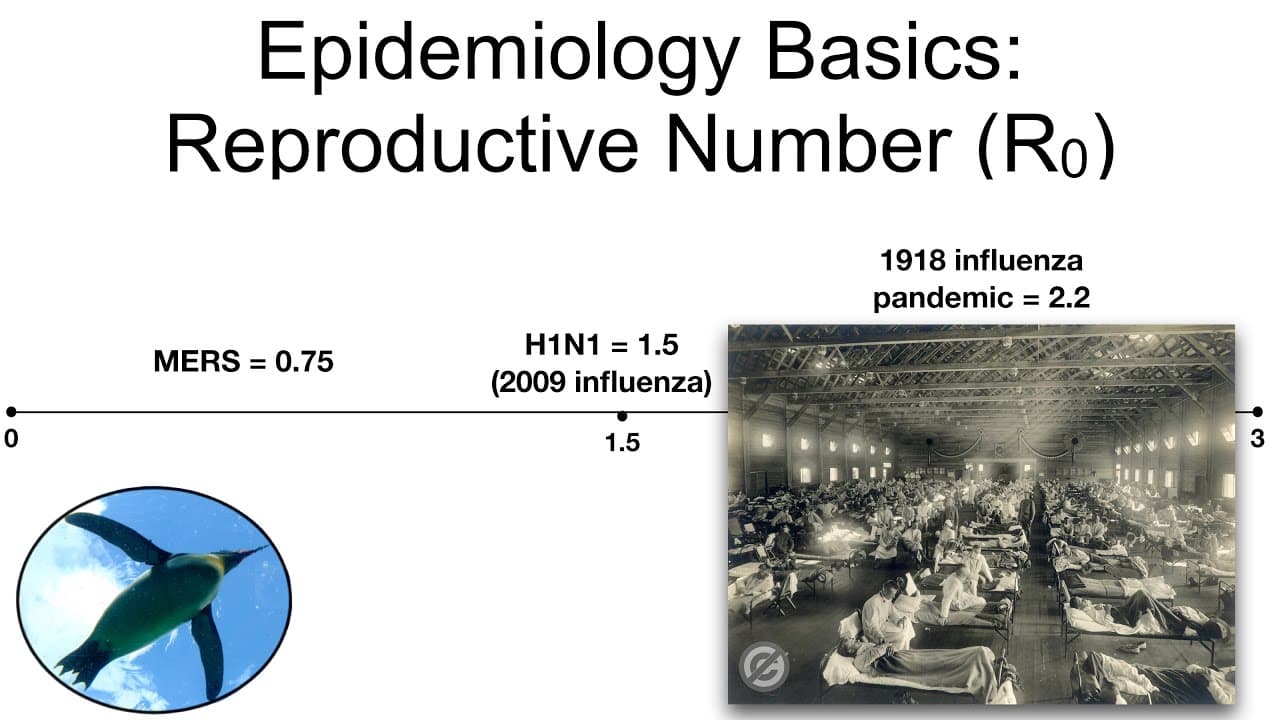
Different diseases have different R naught values, with some diseases like measles having a high R naught of 18, while diseases like MERS have a low R naught of 0.71.
Q: What factors influence the value of R naught?
The value of R naught depends on the duration of infectiousness, probability of transmission, and rate of contact between infected and susceptible individuals.
Summary & Key Takeaways
-
R naught represents the average number of new infections generated by each infected person, with high values indicating easy transmission and low values indicating difficult transmission.
-
R naught can be less than 1 (decreasing cases over time), equal to 1 (stable cases over time), or greater than 1 (self-sustaining outbreak unless controlled).
-
Different diseases have varying R naught values, ranging from as low as 0.71 (MERS) to as high as 18 (measles).
Read in Other Languages (beta)
Share This Summary 📚
Summarize YouTube Videos and Get Video Transcripts with 1-Click
Try YouTube Summary with ChatGPT & Claude or YouTube Transcript Generator
Explore More Summaries from ThePenguinProf 📚






Summarize YouTube Videos and Get Video Transcripts with 1-Click
Try YouTube Summary with ChatGPT & Claude or YouTube Transcript Generator