How to Fix 5 Common English Speaking Mistakes
TL;DR
Use “I think” or “in my opinion” for your own views, say “have a party,” treat “agree” as a verb, omit “to” before “home,” and place a plural noun after “one of.” These corrections address five frequent errors and make sentences such as “Do you agree?” and “This is one of the best places I know” grammatically natural.
Transcript
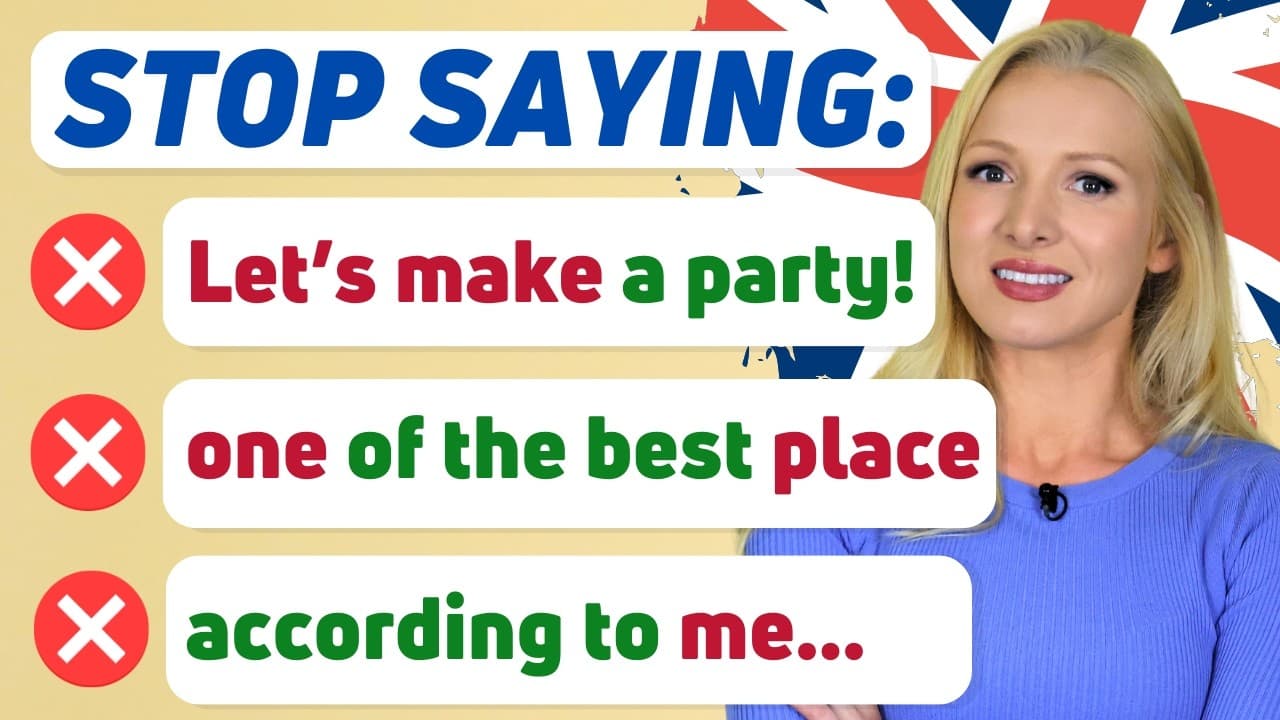
Do you make any of these common mistakes in English? Are you agree? According to me, this is the best solution. It's one of the best place I know. All of these are incorrect. Today, we are looking at five of the most common mistakes that my students make. But I have something even better to offer you for free. I have put together an ebook of the 35... Read More
Key Insights
- “According to” is used for another person’s opinion or evidence found in official reports and articles. A speaker presenting a personal view should say “I think,” “in my opinion,” or “in my view,” while a group can use “we think” or “in our view.”
- The phrase “according to me” is not the natural choice for introducing the speaker’s own opinion. The same principle excludes “according to us,” because both expressions refer to the speaker’s perspective rather than attributing a view or evidence to another source.
- “Have a party” is the most common English collocation for describing a party, while “throw a party” is a more informal option. “Throw” can be especially suitable when someone organizes a celebration for another person, such as a party for a promotion.
- “Agree” is a verb rather than an adjective, so standard sentences use “I agree” and questions use “Do you agree?” Because it is a state verb, it is not generally used in continuous forms such as “I am agreeing with you.”
- “In agreement” is a valid structure because “agreement” appears in a prepositional phrase. Sentences such as “I am in agreement with the contract” and “Are we all in agreement with the terms?” are different from the incorrect construction “I am agree.”
- “Home” functions as an adverb after movement verbs such as “go,” “come,” and “get,” so it normally takes no preposition. Correct examples include “I’m going home,” “He came home late,” and “What time did you get home?”
- “Make it home” and “be home” also omit a preposition before “home.” Examples include asking whether someone made it home safely in the snow and saying that someone will be home soon, where “be” still carries an idea of movement or travel.
- “One of” is followed by a plural noun because it identifies a single member of a larger group. This rule applies after superlatives, comparatives, and possessive expressions, producing phrases such as “one of the worst flights,” “one of the better students,” and “one of my favorite shops.”
Install to Summarize YouTube Videos and Get Transcripts
Explore YouTube Video Summarizer or Get YouTube Transcript Extractor
Questions & Answers
Q: What should I say instead of “according to me”?
Use “I think,” “in my opinion,” or “in my view” when introducing your own opinion. The last two options are described as slightly more formal. For a shared opinion, use “we think,” “in our opinion,” or “in our view.” Reserve “according to” for another person’s opinion or for evidence attributed to reports, articles, and surveys.
Q: When should I use “according to” in English?
Use “according to” when attributing information or an opinion to another person, such as “According to Marie, this is the best solution.” It can also identify evidence from an official report, article, or survey. It is not the natural expression for introducing your own view, so avoid “according to me” and “according to us.”
Q: Is it correct to say “make a party” in English?
No, “make a party” and “do a party” are not the correct English collocations presented in the lesson. Say “have a party” in the most common formulation, as in “We’re having a party next Saturday.” You can also say “throw a party,” a more informal expression often used when organizing a celebration for someone else.
Q: What is the difference between “have a party” and “throw a party”?
“Have a party” is the most common collocation and works for general descriptions of holding a celebration, such as having a party next Saturday or having one for an anniversary. “Throw a party” is more informal and can emphasize organizing the event, including organizing it for someone else, such as throwing a party for a promotion.
Q: Why is “Are you agree?” incorrect?
“Are you agree?” is incorrect because “agree” is a verb, not an adjective. Questions with this verb use the auxiliary “do,” so the correct form is “Do you agree?” Similarly, say “I agree with you,” not “I am agree with you.” The related phrase “in agreement” can correctly follow “be,” as in “Are we all in agreement?”
Q: Can I say “I am agreeing with you”?
The lesson advises against “I am agreeing with you” in the ordinary sense because “agree” is a state verb and is not generally used in continuous tenses. Use “I agree with you” instead. Questions follow the same pattern: say “Does he agree?” rather than “Is he agreeing?” A separate valid construction is “I am in agreement.”
Q: Why do English speakers say “go home” without “to”?
After movement verbs such as “go,” “come,” and “get,” “home” functions as an adverb, and the lesson states that prepositions are generally not used before adverbs. Therefore, say “I’m going home,” “He came home late,” and “What time did you get home?” The omission also applies to expressions such as “make it home” and “be home.”
Q: Why does “one of” require a plural noun?
“One of” requires a plural noun because the phrase selects one member from a group of people or things. Therefore, say “one of the best places,” not “one of the best place.” The rule also applies in phrases such as “one of the worst flights,” “one of the better students,” and “one of my favorite shops.”
Summary & Key Takeaways
-
The lesson corrects five common English errors involving opinions, collocations, verb forms, movement expressions, and plural nouns. It replaces “according to me” with first-person opinion phrases, “make a party” with “have a party,” “are you agree” with “do you agree,” and “go to home” with “go home.”
-
“According to” introduces another person’s view or information from a report, article, or survey. Personal opinions instead use “I think,” “in my opinion,” or “in my view.” Pronunciation can include a weak form of “to” before consonants and an optional soft W glide before a following vowel sound.
-
The final quiz reinforces every correction through five faulty sentences. Its answers require “have” or “throw” a party, a plural noun after “one of,” first-person expressions such as “we think,” no preposition before adverbial “home,” and the auxiliary “do” when forming a question with the state verb “agree.”
Read in Other Languages (beta)
Share This Summary 📚
Summarize YouTube Videos and Get Video Transcripts with 1-Click
Try YouTube Summary with ChatGPT & Claude or YouTube Transcript Generator
Explore More Summaries from English with Lucy 📚






Summarize YouTube Videos and Get Video Transcripts with 1-Click
Try YouTube Summary with ChatGPT & Claude or YouTube Transcript Generator