How to Start a Career in Data Engineering
TL;DR
Start with SQL, then master Python, PySpark, Git, and data pipelines before applying for data engineering jobs. Build a technical foundation around moving, transforming, and storing data, then create a CV, LinkedIn profile, and Git repository portfolio while applying broadly, and continue developing advanced skills during the hiring process or after securing a role.
Transcript
Hey everyone. So a friend of mine yesterday called me and asked me how to become a data engineer like you. So I walked them through the whole road map step by step exactly how I would do it from the start again and I thought why not sharing it with you. And if you are new here welcome. My name is Barra and I have master degree in data engineering a... Read More
Key Insights
- Data engineering is the behind-the-scenes work of moving, transforming, and storing massive amounts of data. A data engineer exposes complex, important company data and brings it to a suitable platform so that other people can use it for valuable work.
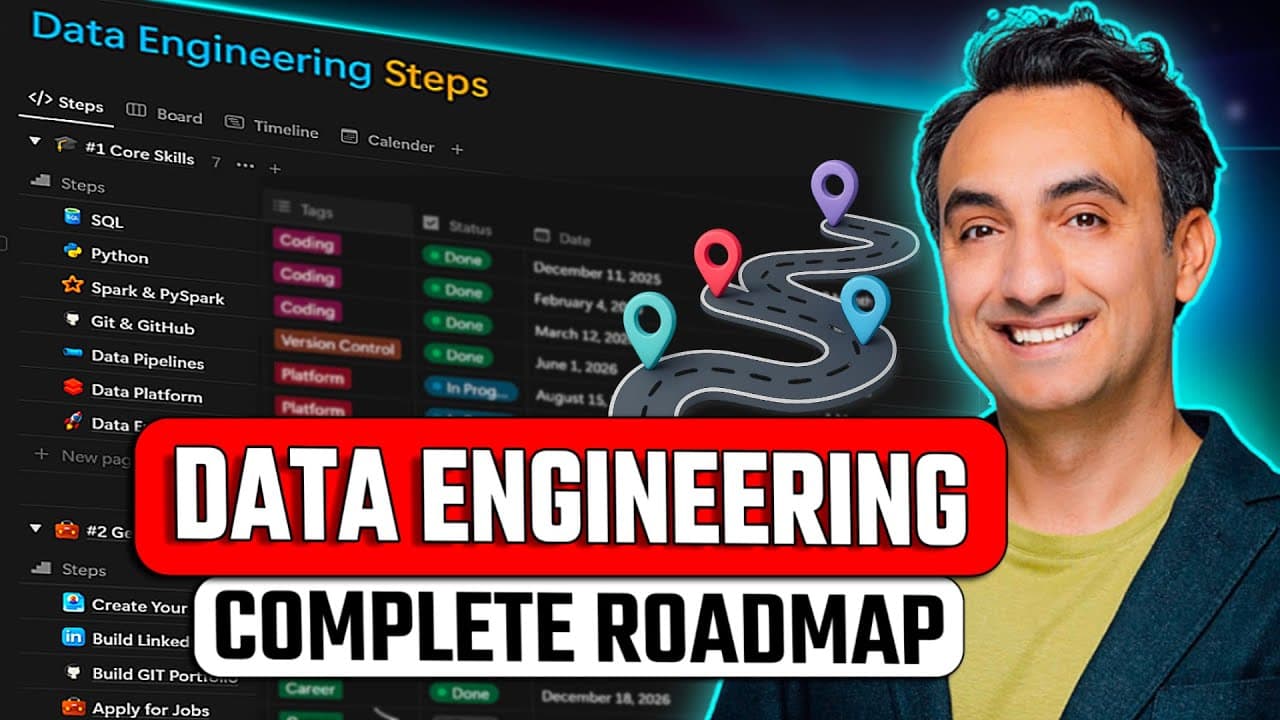
- The roadmap is organized into three phases: core skills, getting hired, and professional development. Beginners first build technical foundations, then prepare a CV, LinkedIn profile, and Git repository portfolio, apply broadly, and finally develop more advanced capabilities.
- SQL is a non-negotiable foundation because companies commonly store data in databases. Data engineers use SQL to retrieve data and to clean and transform it within pipelines, making the language the recommended first technical skill in the roadmap.
- The essential SQL topics are querying, joining and combining tables, window functions, and common table expressions. CTEs help create clean, reusable logic inside queries, while the choice among SQL Server, PostgreSQL, or MySQL matters less than developing strong SQL ability.
- Python is the primary programming language recommended for this data engineering path. It can connect solutions to files, APIs, and Kafka, transform data, automate tasks, and build workflows, while Visual Studio Code is recommended because it is used in serious projects.
- The essential Python topics are variables, data types, data structures, and reusable functions. File handling deserves particular attention because data engineers frequently read and write data in formats such as CSV, JSON, XML, Delta, and Parquet.
- PySpark combines Python with Apache Spark to process massive amounts of data. Beginners should understand Spark architecture, RDDs, DataFrames, transformation operations, and SQL-style work inside PySpark, with Databricks Community Edition recommended as a free, cloud-ready practice environment requiring no setup.
- Git is a fundamental collaboration and version-control skill for data engineering projects. Beginners should know how to create repositories, commit changes, branch, merge, pull, push, clone, and resolve merge conflicts before entering their first professional project.
Install to Summarize YouTube Videos and Get Transcripts
Explore YouTube Video Summarizer or Get YouTube Transcript Extractor
Questions & Answers
Q: What does a data engineer do?
A data engineer works behind the scenes to move, transform, and store massive amounts of data. Instead of primarily building shiny dashboards or front ends, the engineer exposes hidden, complex, and important company data and brings it to a suitable platform. Other people can then use that prepared data to perform useful work and make data-driven decisions.
Q: How should a beginner start learning data engineering?
A beginner should first decide whether moving and transforming data and building company data ecosystems feels interesting. The recommended technical sequence begins with SQL, followed by Python, PySpark, Git, and data pipelines. After building these foundations, the learner should prepare a CV, LinkedIn profile, and Git repository portfolio, then start applying broadly for data engineering jobs.
Q: Why is SQL important for data engineers?
SQL is important because most companies store data in databases, and data engineers need a language for communicating with that data. They use SQL to retrieve information and to clean and transform it inside pipelines. The roadmap therefore treats SQL as non-negotiable and places it first, before the other technical skills required for data engineering work.
Q: Which SQL skills should aspiring data engineers master?
Aspiring data engineers should learn SQL basics, including how to query data and how to join and combine multiple tables. They should also study window functions and common table expressions. CTEs are especially useful for producing clean, reusable query logic. SQL Server, PostgreSQL, and MySQL are presented as possible tools, but learning SQL itself is the priority.
Q: Which Python topics matter most for data engineering?
The most important Python topics include variables, data types, data structures, and functions that make code reusable. Learners should become comfortable with lists, tuples, dictionaries, and sets. They should also master reading and writing files because data engineers handle large amounts of file-based data, including CSV, JSON, XML, Delta, and Parquet formats.
Q: Why should data engineers learn PySpark?
Data engineers should learn PySpark because companies generate massive amounts of data, and Apache Spark is used to process that scale of information. PySpark provides a Python interface for working with Spark. The recommended learning areas are Spark architecture, RDDs, DataFrames, transformation operations, and SQL-style processing within Python, combining important Python and SQL capabilities.
Q: What is the recommended environment for practicing PySpark?
Databricks Community Edition is the recommended environment for beginning PySpark practice because it is described as simple, free, cloud-ready, and requiring no setup. Visual Studio Code with a PySpark setup and Jupyter notebooks are also possible options. At this stage, learners should focus on PySpark itself rather than trying to understand every part of the Databricks platform.
Q: What Git skills do beginner data engineers need?
Beginner data engineers need to understand how Git controls different versions of code and supports teamwork. Essential skills include creating a repository, committing new changes, working with branches, merging work, and using pull, push, and clone operations. They should also learn to resolve merge conflicts, since Git is commonly used for collaboration and deploying code to target environments.
Summary & Key Takeaways
-
Data engineers work behind the scenes to move, transform, and store large amounts of company data. Their role is to expose important, complex data and deliver it to a suitable platform where other people can use it. The roadmap begins by confirming that this type of systems work genuinely interests you.
-
The roadmap divides the journey into three phases: building core technical skills, getting hired, and leveling up professionally. The foundational phase narrows an overwhelming technology landscape to a focused sequence. The presented skills include SQL, Python, PySpark, Git, and data pipelines, with emphasis on knowledge used directly in data engineering projects.
-
SQL supports querying, joining, cleaning, and transforming database data. Python connects solutions to files, APIs, and Kafka while enabling automation and workflows. PySpark processes massive datasets through Apache Spark, and Git provides version control and team collaboration. Together, these skills prepare beginners to build systems instead of leaving transformations as disconnected scripts.
Read in Other Languages (beta)
Share This Summary 📚
Summarize YouTube Videos and Get Video Transcripts with 1-Click
Try YouTube Summary with ChatGPT & Claude or YouTube Transcript Generator
Explore More Summaries from Data with Baraa 📚



Summarize YouTube Videos and Get Video Transcripts with 1-Click
Try YouTube Summary with ChatGPT & Claude or YouTube Transcript Generator