Which Level of AI Assistance Does Your Team Need?
TL;DR
Most teams need a tool-augmented assistant, not a fully autonomous AI agent. Choose among six levels of assistance by matching autonomy and structure to the actual problem, starting with advice or co-piloting and advancing only when routine cases, review requirements, scale, and the value of human involvement justify a more complex system.
Transcript
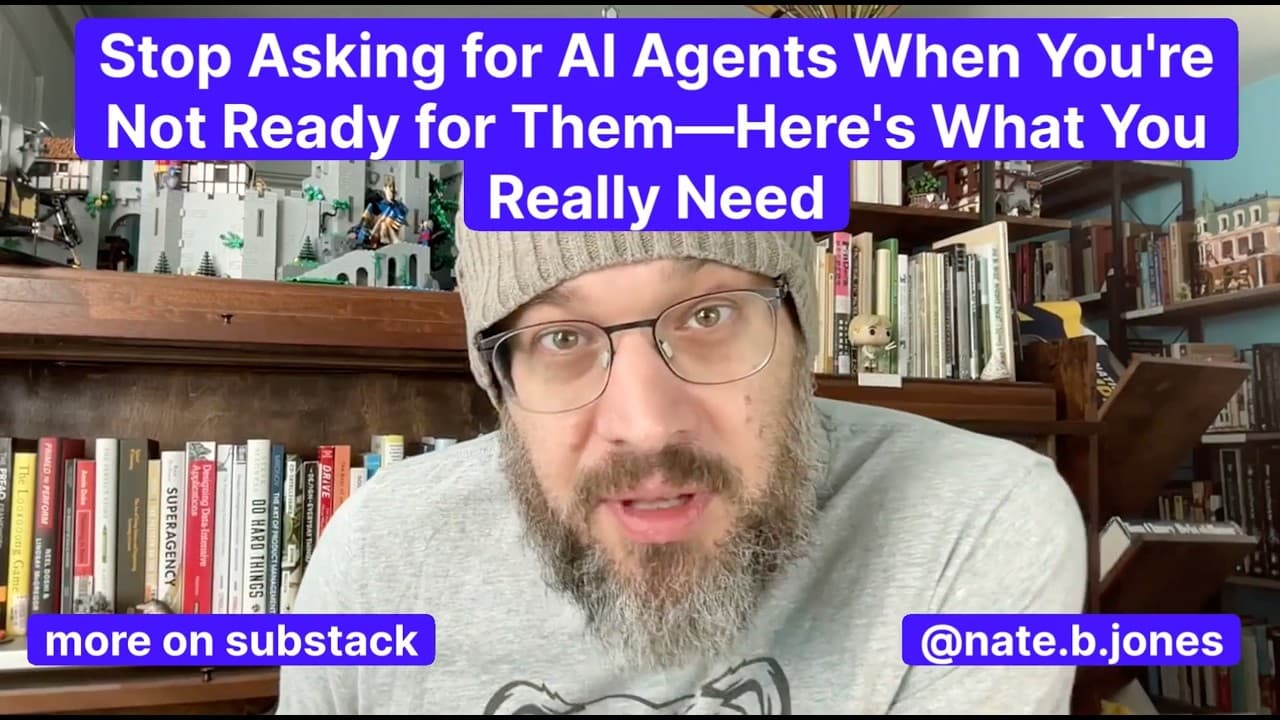
I am so tired of the AI agent discourse. Everyone is asking, "Can I use an AI agent for this?" I'm getting people asking me, "Can I use an AI agent for this?" And that is the wrong question to ask about AI. You probably don't need an agent for most of the things that you think you do. And I want to spend this video talking about the forgotten spect... Read More
Key Insights
- AI assistance is a spectrum with six levels, not a binary choice between chatbots and autonomous agents. The levels progress from adviser to co-pilot, tool-augmented assistant, structured workflow, semi-autonomous system, and finally a fully autonomous system monitored through metrics.
- An adviser is an LLM that provides guidance while the human performs all of the work. Its usefulness depends heavily on the quality of the prompt, and it represents how most people already use ChatGPT or Claude through free or paid access.
- A co-pilot suggests actions while a person remains in control of the task. It fits repetitive work with known patterns, such as code completion, and can make the user 40 or 50% faster when those patterns are sufficiently predictable.
- A tool-augmented assistant is a chat system that can access data, search the web, run calculations, and build or edit assets. Its value expands with the tools available, making it a strong fit for finance, marketing, product, and other team workflows.
- A structured workflow is choreographed work in which AI completes a step, a human reviews it, and AI continues. This approach fits processes such as contract review, where consistency, correctness, and liability make deliberate human checkpoints more valuable than complete autonomy.
- The goal of workplace AI is to help the best humans engage more directly with important work. AI should surround their judgment like supportive equipment, allowing them to contribute at the right moments instead of disconnecting them from the process.
- A semi-autonomous system handles routine cases independently while directing exceptions and edge cases to humans. Customer success can suit this model because common complaints can be mapped to defined workflows, with AI receiving the tools and guidance needed to resolve standard problems.
- A fully autonomous system is appropriate only when AI can perform the entire process and human touches are not relevant. Production examples exist, but full autonomy requires dependable processes, effective monitoring metrics, and a compelling reason to remove direct human participation.
Install to Summarize YouTube Videos and Get Transcripts
Explore YouTube Video Summarizer or Get YouTube Transcript Extractor
Questions & Answers
Q: What are the six levels of AI assistance?
The six levels are adviser, co-pilot, tool-augmented assistant, structured workflow, semi-autonomous system, and fully autonomous system. They range from an LLM that only gives advice while a person works to a system that performs the entire process while humans monitor metrics. The framework helps teams select the simplest level that adequately solves their business problem.
Q: How do you choose the right level of AI assistance?
Choose the level by examining the problem rather than beginning with a demand for an agent. Consider whether the work is repetitive, whether tools can supply the needed capabilities, whether the process requires a fixed sequence, whether humans must review individual steps, and whether routine cases can be separated from exceptions. Advance toward autonomy only when those requirements justify the added complexity.
Q: What is a tool-augmented AI assistant?
A tool-augmented assistant combines an LLM with tools and human guidance. It can access data, search the web, run calculations, create assets, and edit assets instead of merely offering conversational advice. Because almost anything, including another LLM, can function as a tool, this level can support many finance, marketing, product, and individual workflows without requiring complete autonomy.
Q: Why might a tool-augmented assistant be better than an AI agent?
A tool-augmented assistant can deliver much of the desired business value while remaining dramatically easier and cheaper to implement than an enterprise agentic system. It keeps the user involved but expands chat with data access, web search, calculations, and asset creation or editing. For many teams, those practical capabilities address the real need more directly than building a fully autonomous system.
Q: When should a business use a structured AI workflow?
A business should use a structured workflow when work requires a consistent sequence and deliberate review rather than simple suggestions or isolated tool calls. AI can complete one step, pause for a human check, and then continue. This is especially suitable for high-liability work such as contract review, where correctness and repeatability matter and human oversight remains valuable throughout the process.
Q: How does a semi-autonomous AI system work?
A semi-autonomous system resolves routine cases independently and sends exceptions or edge cases to humans. The AI receives the problem-solving tools, workflow guidance, and ability to read and respond within an agentic pipeline. Customer success is a strong example because common complaints can be mapped to defined workflows, allowing humans to concentrate on the smaller set of unusual situations.
Q: When is a fully autonomous AI system appropriate?
A fully autonomous system is appropriate when AI can perform the complete process, humans can monitor meaningful metrics, and direct human touches do not add relevant value. Full automation should follow from a compelling process requirement, not enthusiasm for agents. Teams should first confirm that simpler approaches, including tool use, structured reviews, or exception-based escalation, cannot solve the problem more effectively.
Q: What role should humans retain in workplace AI systems?
Humans should remain engaged where their judgment and expertise improve the work. The design goal is for the best people to touch important work more effectively, not to become detached from it. Structured workflows preserve review checkpoints, while semi-autonomous systems reserve human attention for exceptions. Even fully autonomous systems require people to monitor performance through appropriate metrics.
Summary & Key Takeaways
-
AI assistance exists on a six-level spectrum: adviser, co-pilot, tool-augmented assistant, structured workflow, semi-autonomous system, and fully autonomous system. Teams should begin by defining their problem and selecting the least complex level that solves it, rather than treating basic chat and autonomous agents as the only available choices.
-
Tool-augmented assistants offer a major increase in practical value because they can access data, search the web, perform calculations, and create or edit assets. They can support finance, marketing, and product workflows while remaining far easier and cheaper to implement than enterprise systems designed around extensive autonomy.
-
Greater autonomy is appropriate only when the work supports it. Structured workflows preserve human review for consistent, high-liability processes, while semi-autonomous systems handle routine cases and escalate exceptions. Fully autonomous systems make sense when human touches provide little value, the process is dependable, and people can monitor meaningful performance metrics.
Read in Other Languages (beta)
Share This Summary 📚
Summarize YouTube Videos and Get Video Transcripts with 1-Click
Try YouTube Summary with ChatGPT & Claude or YouTube Transcript Generator
Explore More Summaries from AI News & Strategy Daily | Nate B Jones 📚






Summarize YouTube Videos and Get Video Transcripts with 1-Click
Try YouTube Summary with ChatGPT & Claude or YouTube Transcript Generator