How to Build an Outbound Appointment-Setting Team
TL;DR
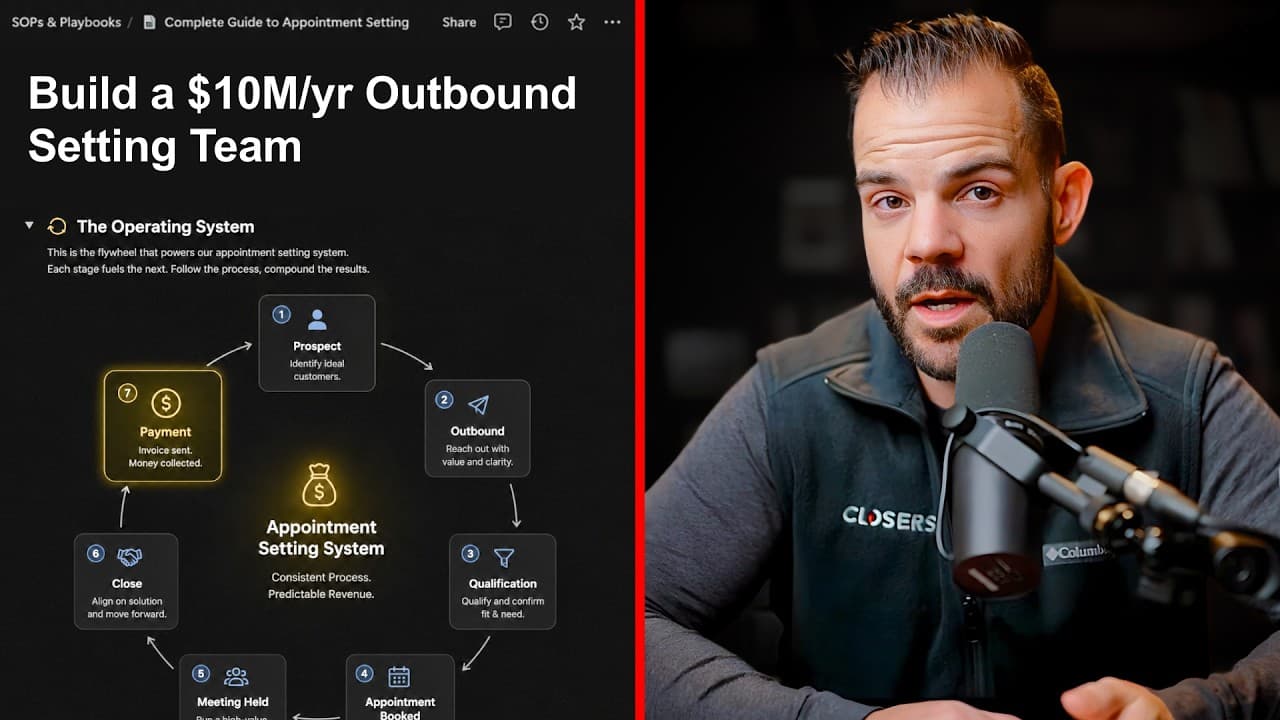
Choose an SDR model for cold outreach to high-value accounts, or an MDR model to follow up with leads generated by marketing. Match outreach volume, personalization, channels, and compensation to market size, customer lifetime value, accessibility, appointment frequency, and sales-cycle length, because those factors determine whether the economics can support the team.
Transcript
I created three multiple 8 figureure companies totaling a combined 150 million in cash collected revenue. And in each of those companies, a huge part of our revenue, probably 75 million plus, came from our outbound appointment setting teams. And so, after consulting 3,000 plus sales teams on how to build their outbound appointment setting teams ove... Read More
Key Insights
- Outbound appointment-setting teams have three principal forms: SDRs pursue cold prospects, MDRs work marketing-generated leads, and BDRs develop strategic partnerships, affiliate relationships, and joint ventures. The training concentrates on SDR and MDR systems rather than the partnership-oriented BDR model.
- An SDR system starts with a cold prospect list sourced from data providers or assembled manually, then uses cold email, LinkedIn outreach, or cold calling. Its typical objective is a 15-minute triage appointment that can be handed to an account executive.
- SDRs differ from MDRs because traditional SDRs do not work in conjunction with inbound marketing. MDRs instead capitalize on leads created through paid campaigns, content, webinars, lead magnets, events, or other marketing activities where prospects have already shown some interest.
- The appropriate SDR approach depends on total addressable market, customer lifetime value, and channel accessibility. Small markets containing highly valuable accounts favor low-volume, highly personalized, multichannel campaigns, while broader markets with lower-value customers favor higher-volume outreach and less personalization.
- Account-based marketing can justify building an entire campaign around one prospective customer when the market is small and each account is highly valuable. Such campaigns may continue for years and combine LinkedIn, email, direct mail, trade shows, cold calling, and in-person event outreach.
- Scaled SDR outreach can combine automated email and LinkedIn campaigns with minor personalization. Prospect engagement, including email opens, replies, link clicks, or LinkedIn responses, can place warmer leads into a calling list so representatives can follow up based on demonstrated activity.
- Compensation structure should reflect appointment frequency, deal frequency, and sales-cycle length. Low-frequency opportunities and long enterprise sales cycles require higher base salaries, while high-volume, transactional offers with short closing cycles can support lower base salaries or entirely commission-based compensation.
- SDR models are best suited to high-value mid-market or enterprise opportunities that are difficult to reach through advertising. Although validated outbound systems can scale linearly, the speaker says they are difficult to establish and may become economically constrained when used for lower-value small-business markets.
Install to Summarize YouTube Videos and Get Transcripts
Explore YouTube Video Summarizer or Get YouTube Transcript Extractor
Questions & Answers
Q: What is the difference between an SDR and an MDR?
A sales development representative performs traditional outbound prospecting against a cold list of people who may not know the company. The representative uses channels such as cold email, LinkedIn, and cold calling to generate an initial appointment. A marketing development representative instead follows up with inbound leads produced by advertising, content, webinars, lead magnets, events, or similar marketing efforts.
Q: How does an SDR appointment-setting system work?
An SDR system begins with a cold prospect list purchased from a provider or built manually by assistants or other team members. Representatives contact those prospects through email, LinkedIn, cold calls, or a combination of channels. The typical goal is to secure a 15-minute triage appointment and then transfer the qualified opportunity to an account executive.
Q: How should a company choose its outbound strategy?
A company should choose its outbound strategy according to its total addressable market, customer lifetime value, and the accessibility of customers through particular channels. A small market with extremely valuable accounts supports personalized, multichannel campaigns. A larger market with lower-value accounts generally requires higher outreach volume, more automation, and less individual personalization to make the economics practical.
Q: When should account-based marketing be used for outbound sales?
Account-based marketing is appropriate when the target market is small and an individual customer can be worth a substantial amount. The transcript gives Fortune 500 companies with customer lifetime values above $100,000 as an example. In that situation, a representative can justify a personalized campaign lasting years and spanning email, LinkedIn, direct mail, trade shows, cold calls, and events.
Q: How can engagement signals improve cold outreach?
Engagement signals can turn a purely cold campaign into a warmer follow-up process. Email opens, replies, link clicks, or LinkedIn responses can automatically place prospects into an SDR calling list. The representative can then contact people who have demonstrated activity, instead of treating every name identically, while automated campaigns continue generating engagement across email or LinkedIn.
Q: How should outbound sales representatives be compensated?
Compensation should correspond to how frequently representatives generate appointments and deals. When frequency is low and the sales cycle is long, as in a nine-month enterprise process, the role requires a higher base salary and may use quarterly bonuses. Highly transactional, high-volume offers with one-call closes can support lower base pay or entirely commission-based compensation.
Q: What are the advantages and disadvantages of an SDR model?
An SDR model can reach valuable mid-market or enterprise customers who are difficult to access through advertising, help a company move upmarket, and scale linearly after validation. Its disadvantages include lower appointment and deal frequency, higher salary requirements, and significant difficulty establishing the system. The speaker also says scaling it for services or small-business prospects can create challenging economics.
Q: What types of leads do marketing development representatives handle?
Marketing development representatives handle inbound leads created by a company’s marketing. Those leads may come from paid video sales letter funnels, webinars, lead magnets, social media, YouTube content, event sponsorships, stage presentations, free offers, or direct-message prompts. The defining feature is that the representative capitalizes on marketing-generated interest instead of beginning with an entirely cold list.
Summary & Key Takeaways
-
Outbound appointment-setting teams fall into three categories: sales development representatives, marketing development representatives, and business development representatives. SDRs contact cold prospects, MDRs capitalize on inbound leads generated by marketing, and BDRs pursue strategic partnerships, affiliate relationships, and joint ventures. The course focuses primarily on the first two models.
-
An SDR strategy should reflect total addressable market, customer lifetime value, and prospect accessibility. Fortune 500 accounts with lifetime values above $100,000 can justify long, personalized, multichannel campaigns. A broader market of real estate agents worth $10,000 each may instead support automated email and LinkedIn outreach with limited personalization.
-
Sales-cycle length and activity frequency influence compensation. Low-frequency enterprise selling requires higher base salaries because appointments and deals occur less often, while short, transactional sales can support lower base pay or commission-only arrangements. SDR programs are most suitable when high average order value and lifetime value justify their operational difficulty.
Read in Other Languages (beta)
Share This Summary 📚
Summarize YouTube Videos and Get Video Transcripts with 1-Click
Try YouTube Summary with ChatGPT & Claude or YouTube Transcript Generator
Explore More Summaries from Cole Gordon 📚



Summarize YouTube Videos and Get Video Transcripts with 1-Click
Try YouTube Summary with ChatGPT & Claude or YouTube Transcript Generator