How to Scale a Business Without Being in the Day-to-Day
TL;DR
The core lesson is to build high-impact systems and recruit top people so the business scales without your constant involvement. You should focus on hiring for performance, investing in better pay, and expanding interview volume to upgrade the team. This approach lowers day-to-day reliance on you while increasing output and freedom.
Transcript
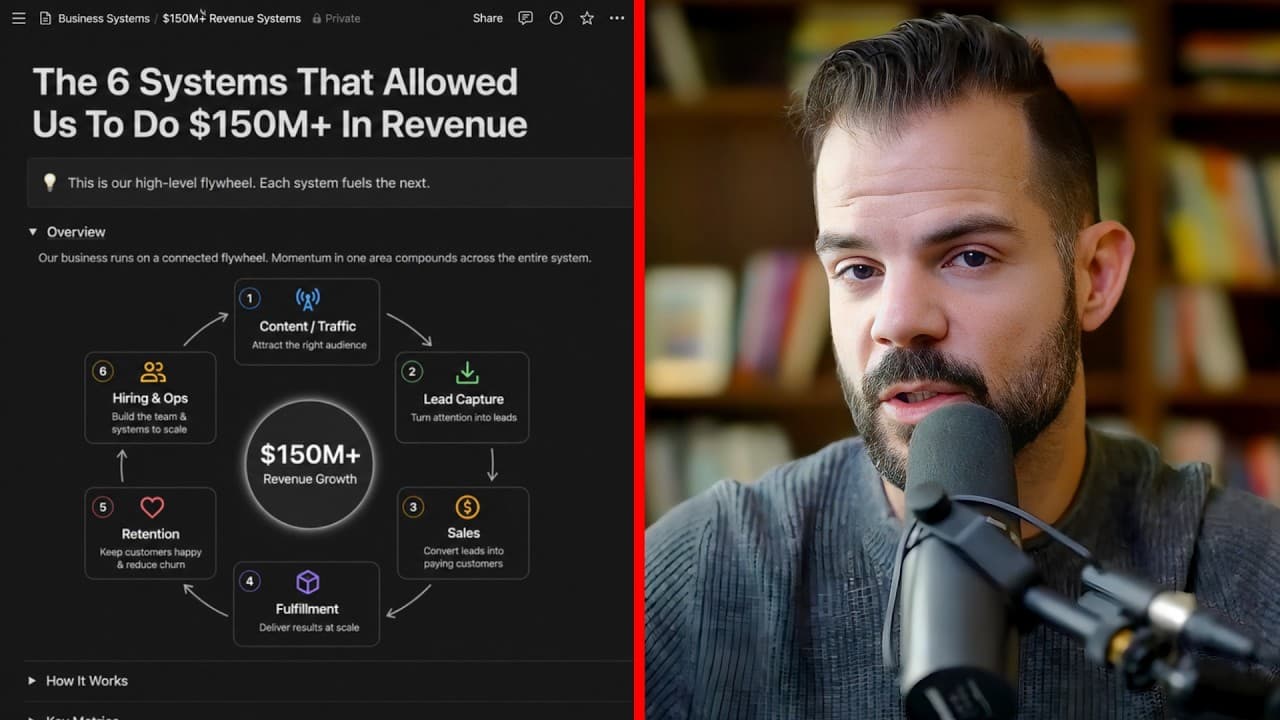
I built three multi-eight-figure companies and two seven-figure SaaS companies now totaling over 150 million in revenue, maybe even 200 million, and that's just in the past 5 years. But the thing is, I wouldn't have been able to do any of that if I didn't build systems that allowed me to remove myself from the day-to-day of my company, so everythin... Read More
Key Insights
- Hiring high-impact performers reduces ongoing management needs.
- Paying top of market for the right roles increases interview quality and outcomes.
- Investing in more interviews expands the candidate pool for crucial roles.
- Better people lead to higher output and may reduce overall headcount while maintaining capacity.
- SOPs become less critical when the right talent performs at a high level.
- SOP-focused culture without strong talent is inefficient and draining.
- Raising pay can unlock access to top talent that otherwise would be unattainable.
- Recruiting volume acts as a multiplier for long-term scalability and freedom.
Install to Summarize YouTube Videos and Get Transcripts
Explore YouTube Video Summarizer or Get YouTube Transcript Extractor
Questions & Answers
Q: How do you determine the right level of pay for a high-impact hire
Determining the right pay starts with identifying the dream hire or ideal performer for the role, an ICP-like profile for recruiting. Then assess what it would take to attract that person, often involving more interviews and potentially a 20 to 50 percent higher pay band. The goal is to access higher talent who can perform with minimal training and deliver outsized results, which can justify the initial higher compensation through greater output and efficiency over time.
Q: Why is increasing recruiting volume important for scaling
Increasing recruiting volume is essential because it expands the funnel of qualified candidates for crucial roles. A higher interview-to-hire ratio allows you to identify top performers who can self-manage and deliver substantial results. This approach reduces the risk of poor hires and accelerates the transition to a team capable of running the business with less founder involvement.
Q: What is the role of SOPs when you hire better people
SOPs remain important but become less of a bottleneck when you hire high-quality, capable people. The key is that great talent can often operate effectively with minimal handholding, potentially creating their own efficient processes. Relying too heavily on SOPs without strong people can stall growth, whereas skilled hires help accelerate scale and reduce the need for constant process overhauls.
Q: How can pay adjustments impact long-term labor costs
In the short term, labor costs may rise due to higher pay for top performers. However, the long-term effect often leads to outsized productivity gains, allowing you to accomplish the same or more with fewer employees. This can offset initial costs by achieving higher output per hire and reducing ongoing coaching and QC needs.
Q: What is the relationship between talent quality and SOP focus
The relationship is inverse in the sense that better talent reduces the need for elaborate SOPs. When you have people who can run with minimal guidance, the emphasis shifts from creating perfect documentation to enabling and supporting high performers. Poor hiring creates dependency on procedures to compensate for weak execution.
Q: What did the speaker learn from the Airbnb quote about superstars
The speaker cites a quote attributed to Brian Chesky, suggesting that superstars can be 10 to 100 times more productive than B players. This underlines the importance of recruiting for exceptional capability and fit rather than settling for adequate performers. The takeaway is to pursue transformative hires even if it means changing pay and interview strategies.
Q: How does the video suggest handling administrative hires vs high-impact hires
Administrative, low-impact roles can be offshored or paid at a lower rate to optimize cost efficiency, while high-impact roles should be prioritized for premium compensation and more rigorous, higher-volume interviewing. This bifurcated approach helps you control cost while ensuring critical functions are executed by top-performing individuals who drive scale.
Q: What are the practical steps to start implementing these six systems
Begin by identifying the six frameworks and the first one, which centers on recruiting and compensation strategy. Then map out a plan to increase interview volume, adjust pay bands for target roles, and align SOPs with the capabilities of new hires. Implement stronger recruitment processes, track performance improvements, and iterate to improve scalability and personal time freedom.
Summary & Key Takeaways
-
The video argues that growth comes from replacing weak performers with high-impact people and reducing reliance on the founder. It emphasizes a strong recruiting engine, better compensation, and a balanced mix of training and SOPs to support scalable systems.
-
A key takeaway is that SOPs matter less when you hire great people, because capable talent self-manages and creates better processes. The speaker also warns against over-optimizing for documentation at the expense of recruiting.
-
Lastly, the speaker links recruiting volume to management load, noting that more interviews yield better hires and long-term efficiency, ultimately enabling the business to run more independently from the founder.
Read in Other Languages (beta)
Share This Summary 📚
Summarize YouTube Videos and Get Video Transcripts with 1-Click
Try YouTube Summary with ChatGPT & Claude or YouTube Transcript Generator
Explore More Summaries from Cole Gordon 📚




Summarize YouTube Videos and Get Video Transcripts with 1-Click
Try YouTube Summary with ChatGPT & Claude or YouTube Transcript Generator