How Ryan Deiss Builds Trust With Content
TL;DR
Build trust by publishing content consistently in a format you enjoy, then use paid advertising and organic media as parts of one connected marketing ecosystem. Direct attribution cannot reliably identify every influence on a sale, so evaluate content partly by whether prospects remember it, mention it during sales calls, and encounter the brand when they are ready to buy.
Transcript
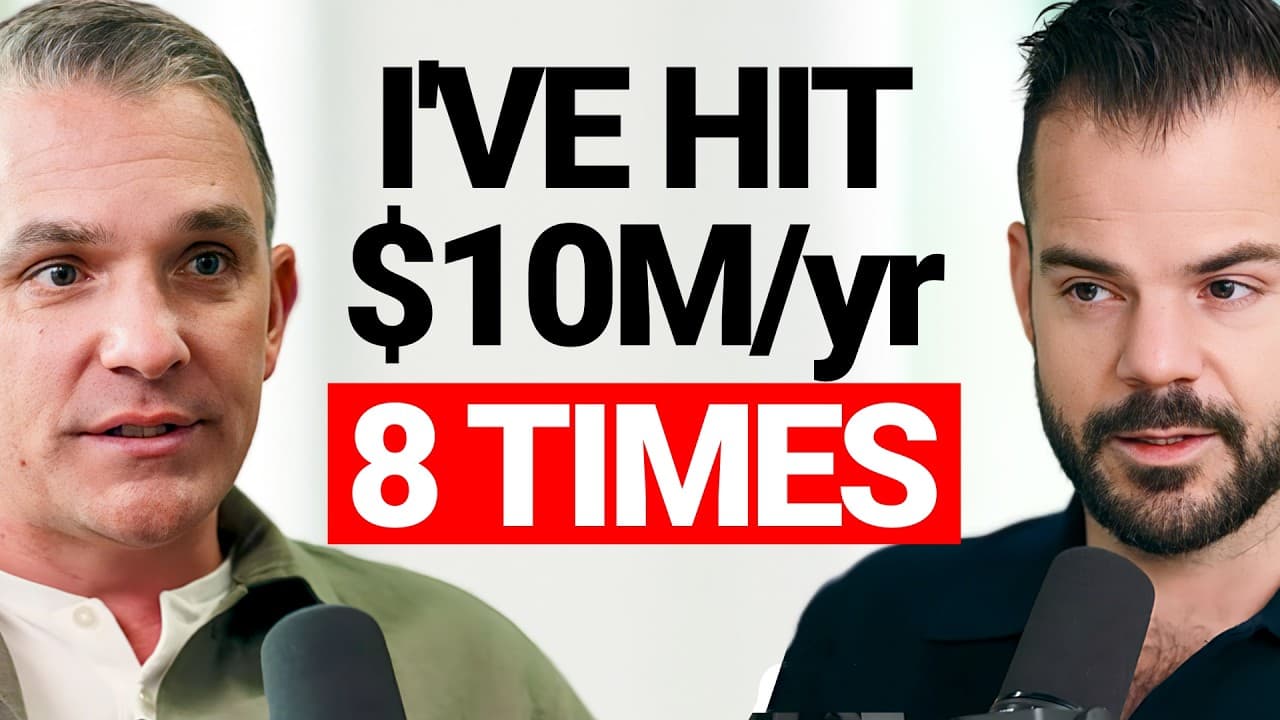
You've been in business since 1999, 27 years in. And I think in that time, correct me if I'm wrong, eight companies to eight figures. Yeah. Four exits. You do 200 million PCO now. So I want to dive into that because I'm really interested in the Porco, how that works, how you scale the internal companies. >> But first, I want to talk about one thing... Read More
Key Insights
- Diminishing returns are a warning that an established marketing method may be fighting broader changes. Deiss became concerned when advertising results declined despite his team’s experience and repeated attempts to improve performance, prompting him to explore content as another way to build trust.
- YouTube is valuable for high-intent learning because people often visit it when they are serious about understanding a subject. Deiss also chose the platform because long-form communication matched his natural tendency to discuss ideas extensively, making the format personally sustainable.
- A sustainable content system must fit the creator’s life and working style. Deiss rejected constant filming and a large production setup, then adopted a flexible commitment to make roughly one video each week about subjects he believed were interesting and useful.
- Enthusiasm is communicated through recorded content. Videos that creators are excited to make tend to perform better because their energy reaches the audience, while mechanical, derivative work also reveals the creator’s lack of interest and can produce material they dislike.
- Customer recall can reveal influence that tracking systems miss. Prospects repeatedly said they discovered the company through Deiss’s YouTube content, even when internal data showed that an advertisement, lead magnet, or email signup had created the first measurable interaction.
- Marketing now functions as an ecosystem rather than a linear funnel. A person may encounter advertisements, emails, YouTube videos, Instagram clips, and other touchpoints before buying, making it difficult to assign the sale accurately to a single first or last interaction.
- Attribution data is useful but cannot reproduce human decision-making precisely. Deiss says it lies relatively consistently, which permits directional analysis, but warns that overoptimizing for measurable credit can undervalue content that creates trust before a prospect becomes ready to purchase.
- Brand availability matters when customers enter the market. Companies must publish content and build familiarity before purchase intent emerges, because a prospect who is ready to act may choose a competitor that has already earned attention and trust across the channels they use.
Install to Summarize YouTube Videos and Get Transcripts
Explore YouTube Video Summarizer or Get YouTube Transcript Extractor
Questions & Answers
Q: Why did Ryan Deiss shift attention from ads to YouTube?
Ryan Deiss saw diminishing returns from marketing activities that had previously generated predictable results. His team understood paid advertising but could not restore its earlier performance, which he interpreted as a sign of fighting broader market forces. He concluded that advertising would remain useful, but that a low-trust environment also required sustained trust-building on channels such as YouTube, Instagram, and TikTok.
Q: Why did Ryan Deiss choose YouTube for content marketing?
Ryan Deiss chose YouTube because it was the platform he personally used when he was serious about learning something. He believed that behavior made it suitable for reaching people with meaningful interest. Long-form videos also matched his communication style because he enjoys discussing topics at length, giving him a format that felt more natural and sustainable than alternatives.
Q: How did Ryan Deiss make content creation sustainable?
Ryan Deiss rejected a production model built around a large media operation, constant filming, and people following him and his family. Instead, he set terms he could tolerate: he would endeavor to publish one video each week, accept that some weeks would be missed, and begin with topics he personally found interesting rather than following an elaborate strategy.
Q: How can businesses tell whether YouTube content influences sales?
Businesses can compare tracking data with what prospects say during sales conversations. Deiss’s team found that customers often credited YouTube or Instagram for their awareness, although internal records showed earlier interactions with advertisements, lead magnets, and email lists. These answers reveal which experiences shaped trust and created a favorable sales environment, even when those experiences did not receive direct attribution.
Q: Why can marketing attribution data be misleading?
Marketing attribution is misleading because buyers do not necessarily follow one orderly path from discovery to purchase. A prospect can click an advertisement, download a lead magnet, receive emails, watch YouTube videos, and later respond to another promotion. Choosing the first touch, last touch, or a distributed model cannot fully explain which interaction created enough trust for the purchase.
Q: What does it mean to treat marketing as an ecosystem?
Treating marketing as an ecosystem means recognizing that advertising, email, YouTube, Instagram, TikTok, and sales conversations can influence the same customer at different moments. These channels operate like a broad net rather than an isolated funnel. A measurable advertisement may initiate contact, while later content builds familiarity and confidence until the prospect is ready to move forward.
Q: Why should creators make content about topics they enjoy?
Creators should choose topics and formats they enjoy because enthusiasm transfers through video and affects how audiences experience the material. Deiss observed that videos he felt excited about tended to perform well, though not every time. By contrast, content produced mechanically from accumulated tactics can feel derivative, reduce the creator’s commitment, and result in work the creator dislikes.
Q: Should a business stop paid ads when investing in content?
Investing in content does not mean advertising must disappear. Deiss viewed ads as one component of a larger system, particularly because tracked customer journeys often began with an advertisement before content influenced trust. The practical lesson is to avoid judging each channel in isolation and instead examine how paid acquisition, email, long-form media, short-form clips, and sales activity work together.
Summary & Key Takeaways
-
Ryan Deiss turned toward YouTube after established paid advertising produced diminishing returns that his team could not reverse. He believed a low-trust environment required brands to earn confidence through channels where audiences spend time. Long-form YouTube suited both his own media habits and his preference for discussing subjects at length.
-
Deiss initially resisted content strategies that required large media teams, constant filming, and cameras following his family. He eventually committed on his own terms: aim to publish weekly, accept occasional missed weeks, and discuss topics he genuinely found interesting. Early videos gained traction and began appearing in prospects’ explanations of their buying journeys.
-
Advertising and content operate as an ecosystem rather than a linear funnel. Prospects might first click an advertisement, join an email list, and later credit YouTube for introducing them to the company. Attribution remains useful because its errors can be relatively consistent, but optimizing exclusively around direct credit misrepresents how people develop trust and buy.
Read in Other Languages (beta)
Share This Summary 📚
Summarize YouTube Videos and Get Video Transcripts with 1-Click
Try YouTube Summary with ChatGPT & Claude or YouTube Transcript Generator
Explore More Summaries from Cole Gordon 📚

Summarize YouTube Videos and Get Video Transcripts with 1-Click
Try YouTube Summary with ChatGPT & Claude or YouTube Transcript Generator