How to Build an Offer That Scales Your Business
TL;DR
A strong offer combines differentiated packaging, favorable economics, and scalability. Clear positioning gives unfamiliar prospects a reason to engage, supports premium pricing, and improves the conditions for paid acquisition, sales conversion, and reinvestment. The offer should also resist commoditization by making the business appear meaningfully different rather than interchangeable with competitors.
Transcript
Have you ever seen a business owner in your space cross eight or even nine figures and you think to yourself, "That guy's a complete idiot. Like, I know that guy. How the hell did that guy pull that off?" Well, the truth actually might surprise you a little bit. So, for context, I've just gotten my own company past $30 million a year. I personally ... Read More
Key Insights
- An offer is the combination of what a business sells, how it communicates and positions that product or service, and the terms attached to the deal. Improving only delivery without improving positioning and terms leaves important parts of the offer unchanged.
- The offer is presented as the source of 80% of a business's success or failure. It influences pricing power, costs, advertising conversion, sales closing performance, and the relationship between lifetime value and customer acquisition cost.
- Meaningful differentiation gives cold prospects a reason to engage with an unfamiliar business. It also creates market power, allowing the company to raise prices with a smaller decline in conversions than a provider perceived as an interchangeable commodity.
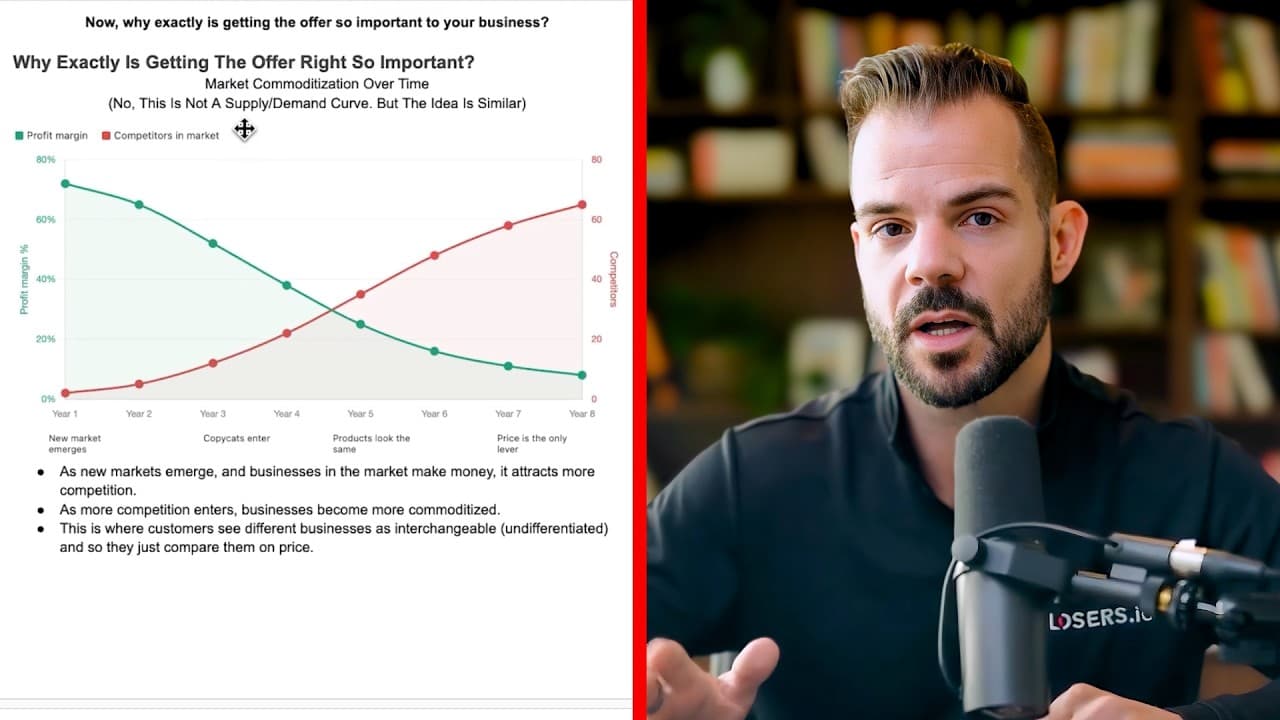
- Market commoditization occurs as profitable markets attract additional competition. As supply increases, customers begin viewing businesses as interchangeable and comparing them on price, which pushes pricing and profit margins downward across competing providers.
- Low barriers to entry accelerate competitive pressure in coaching, consulting, agencies, med spas, and HVAC businesses. Software has a somewhat higher barrier, but the transcript argues that AI and faster coding are bringing that barrier down as well.
- Weak differentiation makes paid acquisition harder because unfamiliar prospects lack a compelling reason to risk their time by responding to marketing. Lower commodity pricing also reduces the margins available to recruit talent, build leverage, and remove the owner from routine delivery.
- Trust can temporarily overcome a weak offer through referrals, word of mouth, or a large content presence. Revenue from these channels can make an offer appear stronger than it is because existing trust, rather than differentiation, may be driving purchases and supporting higher prices.
- Premium pricing is more accessible than lowest-cost positioning because only one business can be the lowest-cost provider in a market, while several premium providers can coexist. Each premium provider can use differentiated packaging to carve out a smaller category or market.
Install to Summarize YouTube Videos and Get Transcripts
Explore YouTube Video Summarizer or Get YouTube Transcript Extractor
Questions & Answers
Q: What are the three parts of a strong business offer?
The three parts are packaging, economics, and scalability. Packaging is how the business communicates its work so it appears meaningfully different. Strong packaging supports higher pricing and creates an economic advantage over competitors. Scalability concerns the offer's cost curve and whether its margins can remain workable as the business grows and acquisition expands.
Q: How does an offer affect business growth?
An offer affects pricing power, the cost curve, advertising conversion, sales closing performance, and the relationship between lifetime value and customer acquisition cost. The training describes the offer as the most important business lever and attributes 80% of success or failure to it. These downstream effects determine how much runway a company has to scale.
Q: What makes an offer meaningfully differentiated?
An offer becomes meaningfully differentiated when its packaging communicates the product or service as distinct from competing alternatives. The difference must give people who do not know the business a reason to respond to its marketing. Effective differentiation also creates market power, helping the company charge more without experiencing the same conversion loss as a commodity provider.
Q: Why does market commoditization reduce profit margins?
Commoditization develops when profitable markets attract more competitors and customers begin to see providers as interchangeable. Customers then compare businesses primarily on price. That comparison pushes prices and margins downward, making cold advertising harder to justify and leaving less money available to hire strong talent, create operational leverage, and support continued growth.
Q: Why can an undifferentiated offer struggle with paid acquisition?
An undifferentiated offer gives an unfamiliar prospect little reason to take a chance on the business or spend time speaking with its sales team. Commodity pricing also compresses margins, making it harder to earn an acceptable return from cold advertising. Meaningful differentiation addresses both problems by creating interest and supporting greater pricing power.
Q: Can referrals and content compensate for a weak offer?
Referrals, word of mouth, and a large content presence can compensate for a weak offer because they create trust before the purchase decision. A strong recommendation may persuade someone to buy and accept a higher price even when the offer is not differentiated. However, this can disguise the offer's weakness because trust, rather than packaging, is driving results.
Q: How does packaging create pricing power?
Packaging shapes how customers understand and compare what a business sells. When it makes the offer appear uniquely different, customers are less likely to treat the provider as interchangeable with competitors. This creates market power, meaning prices can increase with a smaller decline in conversions. Strong packaging therefore produces an economic advantage through premium pricing.
Q: Should a business compete on low cost or premium pricing?
The training identifies lowest cost and premium as the two pricing strategies. Only one company can occupy the lowest-cost position in a market, while several premium providers can coexist by differentiating their offers and carving out smaller categories. For that reason, distinctive packaging can make premium pricing a more available strategy for multiple competing businesses.
Summary & Key Takeaways
-
An offer consists of what a business sells, how that product or service is positioned, and the terms of the deal. The training argues that a strong offer is meaningfully differentiated and scalable, giving cold prospects a reason to respond while helping the business preserve pricing power as competition increases.
-
Markets tend to become commoditized as profitable opportunities attract competitors. When customers view providers as interchangeable, they compare them primarily on price, pushing prices and margins downward. Low barriers to entry accelerate this pressure in online services, in-person services, and increasingly software because AI has reduced some coding barriers.
-
Effective offer design has three parts: packaging, economics, and scalability. Packaging communicates the service as uniquely different, which can create market power and support premium pricing without the same conversion decline faced by commodities. Better margins can then fund paid acquisition, stronger talent, and operational leverage as the company grows.
Read in Other Languages (beta)
Share This Summary 📚
Summarize YouTube Videos and Get Video Transcripts with 1-Click
Try YouTube Summary with ChatGPT & Claude or YouTube Transcript Generator
Explore More Summaries from Cole Gordon 📚



Summarize YouTube Videos and Get Video Transcripts with 1-Click
Try YouTube Summary with ChatGPT & Claude or YouTube Transcript Generator