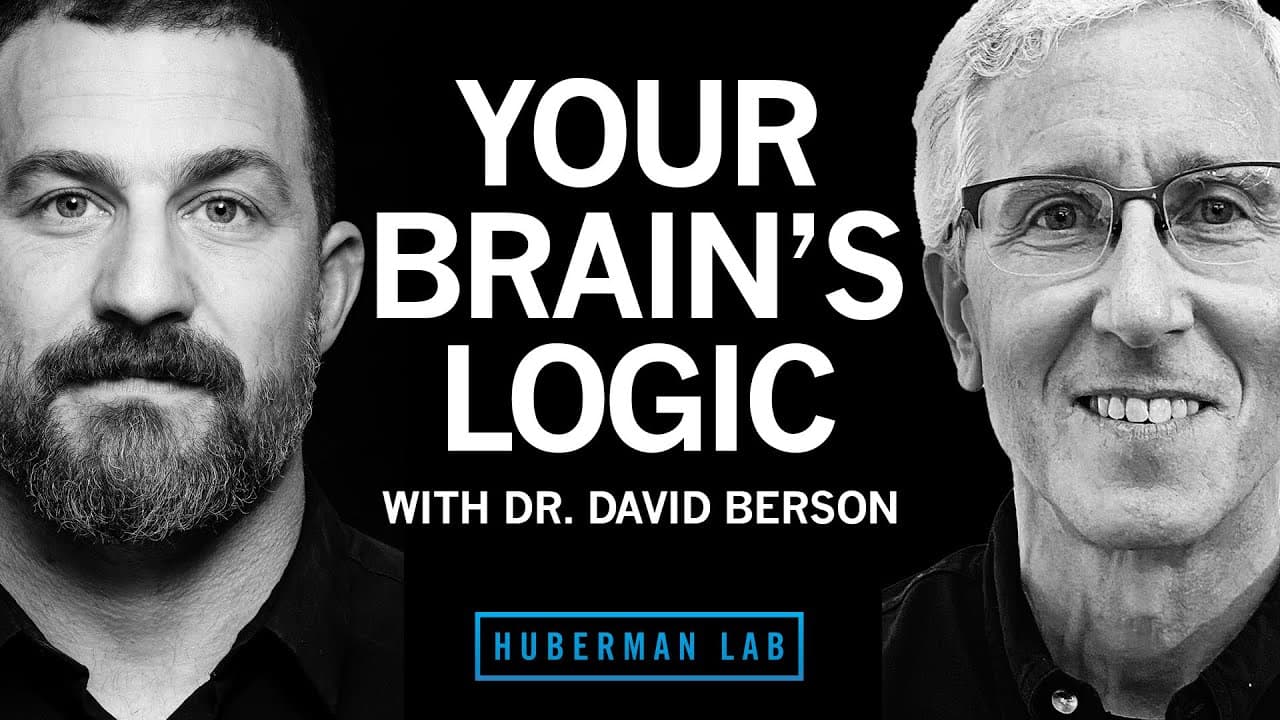
Dr. David Berson: Your Brain's Logic & Function | Huberman Lab Podcast #50
TL;DR
The nervous system turns light and sensory input into circadian timing, color perception, balance, and coordinated movement. Dr. David Berson explains how intrinsically photosensitive melanopsin cells inform the brain about the time of day, why conflicting visual and vestibular signals can cause motion sickness, and how the cerebellum refines motor commands. Read on for direct answers about the specialized cells and circuits behind these functions.
Transcript
- Welcome to the Huberman Lab Podcast, where we discuss science and science-based tools for everyday life. [upbeat music] I'm Andrew Huberman and I'm a Professor of Neurobiology and Ophthalmology at Stanford School of Medicine. Today my guest is Dr. David Berson, Professor of Medical Science, Neurobiology and Ophthalmology at Brown University. Dr. ... Read More
Key Insights
- 😃 The intrinsically photosensitive melanopsin cells in the eye play a vital role in regulating circadian rhythms and informing the brain about the time of day.
- 🙂 Different wavelengths of light are decoded by the nervous system to create our perceptions of color.
- 👀 Motion sickness occurs when there is a conflict between visual and balance signals, such as when looking at a stationary object while in motion.
Install to Summarize YouTube Videos and Get Transcripts
Explore YouTube Video Summarizer or Get YouTube Transcript Extractor
Questions & Answers
Q: How do melanopsin cells inform the brain about the time of day?
Intrinsically photosensitive melanopsin cells in the retina absorb light and convert it into neural signals. Those signals report ambient light levels to the brain and help set circadian rhythms and the body's internal clock.
Q: Who discovered the eye cells that set circadian rhythms?
Dr. David Berson's laboratory is credited with discovering the eye cells that set circadian rhythms. These cells are called intrinsically photosensitive melanopsin cells.
Q: How does the nervous system create the perception of color?
Different wavelengths of light are decoded by the nervous system to produce perceptions of color. Colorblindness can limit a person's ability to distinguish among different wavelengths.
Q: Why do dogs and cats have more limited color vision than humans?
Dogs and cats have fewer types of cone cells in their retinas than humans. They primarily rely on two cone types, while humans have three, resulting in a more limited color spectrum for dogs and cats.
Q: How does visual input affect balance?
The brain combines visual information from the eyes with balance information from the vestibular system in the inner ear. Together, these signals help maintain stability and coordinate movement.
Q: Why can reading in a moving vehicle cause motion sickness?
Motion sickness can occur when visual and vestibular signals conflict. Reading a stationary object while the body is moving creates such a mismatch and can lead to nausea.
Q: What role does the cerebellum play in movement?
The cerebellum integrates sensory information to refine and adjust motor commands. It supports precision, coordination, balance, and motor learning, functioning like an air traffic control system for movement.
Q: What does Dr. David Berson explain in Huberman Lab Podcast #50?
Dr. Berson traces the nervous system from its periphery into deeper structures, moving layer by layer and circuit by circuit. He explains how individual circuits work and how they operate together to shape feeling, experience, and movement.
Summary & Key Takeaways
-
Dr. David Berson is a renowned expert in neuroscience and discusses various aspects of the nervous system, including the intrinsically photosensitive melanopsin cells that inform the brain about the time of day.
-
He explains how the perception of color is a result of different wavelengths of light being decoded by the nervous system, and how colorblindness can limit a person's ability to distinguish different wavelengths.
-
Dr. Berson also delves into the connection between the visual system and the balance system, and how conflicts between visual and vestibular (balance) signals can cause motion sickness.
-
He highlights the role of the cerebellum in coordinating movement and motor learning, emphasizing its importance in precision and coordination.
Read in Other Languages (beta)
Share This Summary 📚
Summarize YouTube Videos and Get Video Transcripts with 1-Click
Try YouTube Summary with ChatGPT & Claude or YouTube Transcript Generator
Explore More Summaries from Andrew Huberman 📚

Summarize YouTube Videos and Get Video Transcripts with 1-Click
Try YouTube Summary with ChatGPT & Claude or YouTube Transcript Generator