How to Boost Learning Speed with Neuroscience
TL;DR
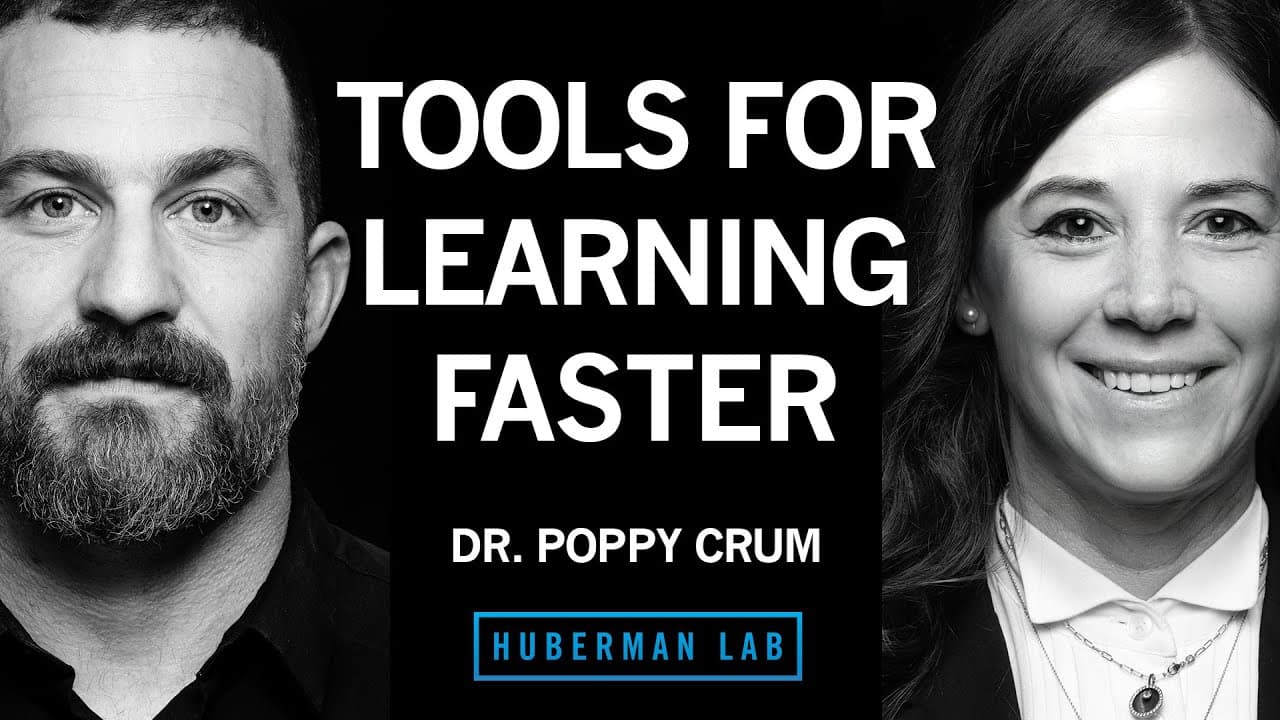
Utilize neuroscience-based protocols to enhance learning speed and health by leveraging technology. Wearables and AI can monitor and adjust your environment for optimal focus and relaxation. Dr. Poppy Crum provides a zero-cost protocol to build custom AI tools for skill improvement without needing programming knowledge.
Transcript
Welcome to the Huberman Lab podcast, where we discuss science and science-based tools for everyday life. I'm Andrew Huberman and I'm a professor of neurobiology and opthalmology at Stamford School of Medicine. My guest today is Dr. Poppyrum. Dr. Poppyrum is a neuroscientist, a professor at Stanford, and the former chief scientist at Dolby Laborator... Read More
Key Insights
- Neuroplasticity is the ability of the brain to change in response to experiences and can be enhanced through technology.
- Wearable and hearable technologies can monitor brain states and adjust environments for better focus and relaxation.
- Digital twins, virtual models of physical systems, can provide real-time insights to improve health and performance.
- AI can be used to create personalized learning tools, enhancing memory retention by self-testing and identifying weak areas.
- The integration of AI in everyday technology can optimize cognitive performance by providing personalized feedback.
- Using AI to replace cognitive tasks can diminish learning and understanding if not paired with active engagement.
- Understanding and optimizing different states of wakefulness can lead to better productivity and well-being.
- Future technologies will enable homes and vehicles to dynamically adjust to our physiological and emotional states.
Install to Summarize YouTube Videos and Get Transcripts
Explore YouTube Video Summarizer or Get YouTube Transcript Extractor
Questions & Answers
Q: How can technology enhance neuroplasticity?
Technology can enhance neuroplasticity by using wearables and AI to monitor brain states and adjust environments. These technologies can optimize conditions for focus and relaxation, thereby facilitating learning and skill acquisition. By integrating real-time feedback, technology helps the brain adapt more effectively to new experiences.
Q: What are digital twins and how do they improve health?
Digital twins are virtual models of physical systems that provide real-time insights into health and performance. By analyzing data from various sources, digital twins can offer personalized recommendations for improving health routines and environments, allowing for more informed decision-making and optimized well-being.
Q: How does AI improve learning and memory retention?
AI improves learning and memory retention by creating personalized learning tools that focus on self-testing and identifying weak areas. This approach enhances memory by reinforcing the retrieval process, which is crucial for long-term retention. AI can also provide feedback on performance, helping learners focus on areas needing improvement.
Q: What is the impact of using AI for cognitive tasks?
Using AI for cognitive tasks can lead to diminished learning if it replaces active engagement. While AI can speed up processes and provide answers, it may reduce the mental effort needed to build cognitive schemas. To maintain cognitive skills, AI should be used to complement learning by offering insights and feedback, rather than replacing the learning process.
Q: How can understanding wakefulness states improve productivity?
Understanding wakefulness states can improve productivity by allowing individuals to optimize their activities according to their cognitive and emotional needs. By recognizing different states of alertness and focus throughout the day, people can tailor their tasks to match their optimal performance times, leading to more efficient and effective work.
Q: What role do wearables play in optimizing focus and relaxation?
Wearables play a crucial role in optimizing focus and relaxation by monitoring physiological signals and environmental conditions. They can adjust factors like temperature, lighting, and sound to create ideal conditions for cognitive tasks or relaxation. This personalized approach helps individuals maintain optimal brain states for various activities.
Q: How does technology influence learning speed and health?
Technology influences learning speed and health by providing tools that enhance the brain's adaptability and optimize environmental conditions. Through personalized feedback and real-time data analysis, technology helps individuals improve their learning efficiency and maintain better health routines, ultimately leading to enhanced overall well-being.
Q: What are the potential drawbacks of relying on AI for learning?
The potential drawbacks of relying on AI for learning include reduced engagement in the learning process and diminished cognitive development. If AI is used to replace rather than complement active learning, it can lead to a lack of deep understanding and poor retention of information. It's essential to use AI as a tool to enhance, not replace, cognitive effort.
Summary & Key Takeaways
-
Neuroplasticity allows the brain to change based on experiences, and technology can enhance this process. Wearables and AI can monitor brain states to optimize environments for better focus and relaxation, offering tools for skill improvement.
-
Digital twins can provide insights into health and performance by using real-time data from physical systems. AI can help create personalized learning tools, improving memory retention through self-testing and identifying weak areas.
-
AI integration in technology can optimize cognitive performance by offering personalized feedback. However, reliance on AI for cognitive tasks without active engagement can diminish learning. Understanding wakefulness states can improve productivity and well-being.
Read in Other Languages (beta)
Share This Summary 📚
Summarize YouTube Videos and Get Video Transcripts with 1-Click
Try YouTube Summary with ChatGPT & Claude or YouTube Transcript Generator
Explore More Summaries from Andrew Huberman 📚


Summarize YouTube Videos and Get Video Transcripts with 1-Click
Try YouTube Summary with ChatGPT & Claude or YouTube Transcript Generator