How Magic Reveals the Brain's Hidden Gaps
TL;DR
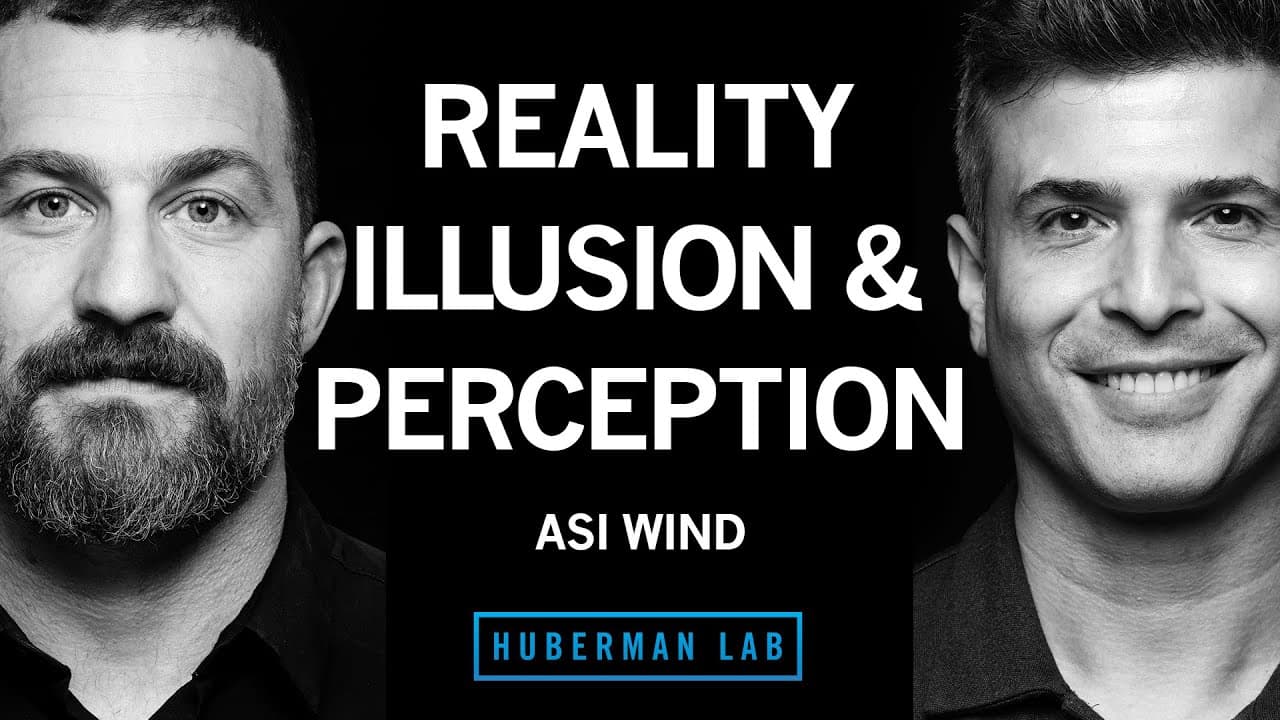
Magic succeeds by exploiting gaps in perception, memory, and the narratives people construct about events. Storytelling, emotion, empathy, and social collaboration can strengthen genuine memories or help create shared beliefs about events that may not have occurred as remembered, while improvisation lets a magician adapt when an intended path fails.
Transcript
welcome to the huberman Lab podcast where we discuss science and science-based tools for everyday life I'm Andrew huberman and I'm a professor of neurobiology and Opthalmology at Stanford School of Medicine my guest today is AI wind aie wind is one of the top magicians and mentalists in the world now you may be asking yourself why would the hubman ... Read More
Key Insights
- Human perception is constructive rather than a complete record of events. Magic takes advantage of informational gaps that the brain fills with assumptions, allowing an observer to experience a convincing outcome even when the physical sequence of events differed from the sequence they remember.
- Memory is organized through storytelling. A coherent narrative connects selected details into an experience that feels complete, which helps explain why people can become confident that something happened even when parts of their recollection were shaped after the event.
- Emotion and empathy are tools for strengthening a shared experience. By establishing an emotional connection, a performer can encourage audience members to participate in constructing and believing a common narrative, including a narrative that does not fully correspond to what occurred.
- Social collaboration can reinforce a perception across multiple observers. When several people agree about an experience, their agreement can make the interpretation feel more credible, even though the shared account may reflect collective narrative construction rather than an exact record.
- Magic performance is partly structured improvisation. Asi Wind compares his approach to jazz because the performance can change as it unfolds, with the magician redirecting the effect when an audience member behaves differently from what was anticipated.
- An apparent failure can become an invisible detour. If a participant does not select an intended card or follow an attempted influence, Wind can pursue a different route while the audience assumes that the revised destination was planned from the beginning.
- Creativity is supported by practices beyond magic itself. Wind's engagement with painting, photography, and a specific daily routine contributes to how he accesses creative ideas and develops his artistic work.
- Fear, perfectionism, and deeply felt emotions are connected to Wind's craft. Rather than treating performance as a purely technical exercise, he draws on emotional sensitivity and artistic storytelling to shape how an audience experiences and remembers an effect.
Install to Summarize YouTube Videos and Get Transcripts
Explore YouTube Video Summarizer or Get YouTube Transcript Extractor
Questions & Answers
Q: How does magic reveal gaps in human perception?
Magic reveals that perception is not a complete recording of external events. The brain receives limited sensory information, fills gaps, and constructs a coherent account of what happened. A magician arranges an experience so those ordinary assumptions support an incorrect interpretation, giving observers the sincere impression that an impossible transformation or transfer occurred.
Q: Why does storytelling make magic more convincing?
Storytelling gives separate actions and sensations a meaningful sequence that the brain can organize and remember. When an effect has a coherent narrative, observers connect selected details into a complete experience rather than retaining every physical action independently. That constructed story can later feel like an accurate memory, even when it includes assumptions or events that did not occur.
Q: How can emotion influence memory during a magic trick?
Emotion can make an experience feel important and help organize how it is interpreted and remembered. Asi Wind uses emotional connection, empathy, and storytelling as parts of performance, encouraging observers to invest in a particular narrative. The remembered experience can therefore reflect both the physical event and the emotionally meaningful story the participants helped construct around it.
Q: Can a group share the same false perception of an event?
Several people can collaborate in forming and accepting a common narrative about an experience. Agreement among observers makes the account feel especially credible, but shared confidence does not guarantee that every remembered detail occurred. Magic demonstrates how social participation, emotional connection, and storytelling can lead multiple people toward the same interpretation of an ambiguous or carefully controlled event.
Q: Do mentalists always know that a trick will work?
Asi Wind does not describe every performance as following one fixed route with complete certainty. Audience members are unpredictable, so an attempted influence may fail or a participant may make an unexpected choice. He responds by improvising and taking the effect in another direction, while the audience remains unaware that the performance has departed from its originally intended path.
Q: What does Asi Wind mean by jazzy magic?
Jazzy magic is a performance approach in which the effect is partly written while it unfolds. Wind compares it to jazz because he can respond to a participant's unpredictable behavior, make a detour, and find a different destination. Only the magician knows that the route changed, so the audience experiences the final sequence as an intentionally designed whole.
Q: How does improvisation help a magician recover from failure?
Improvisation lets a magician reinterpret an unexpected response as part of the continuing performance. If a participant does not take the intended card or respond to an attempted influence, the performer can abandon that route and develop another effect. Because the audience does not know the original plan, the change appears to be progression rather than recovery from failure.
Q: What can magic teach people about learning and memory?
Magic shows that learning and memory depend on attention, narrative structure, emotion, and the interpretation of incomplete information. The discussion connects these principles with strengthening desired memories, forgetting others, and understanding how recollections can be altered. Its central lesson is that confidence in a memory does not necessarily prove that the remembered narrative precisely matches the original event.
Summary & Key Takeaways
-
Magic and mentalism expose gaps in perception and memory by creating convincing experiences that differ from what physically occurred. Asi Wind's performances illustrate that observers do not merely receive reality like recordings. Their brains organize incomplete sensory information into narratives, then treat those constructed narratives as coherent accounts of past events.
-
Storytelling, emotion, empathy, and social interaction influence how experiences are interpreted and remembered. A magician can use these forces to encourage several people to participate in and accept a common narrative. The resulting belief can feel accurate even when parts of the remembered event were altered, omitted, or never occurred.
-
Asi Wind describes performance as a form of structured improvisation resembling jazz. If an audience member responds unpredictably or rejects an attempted influence, he can change direction without revealing the detour. His interests in painting, photography, daily routines, fear, perfectionism, and deeply felt emotion also contribute to his creative process and craft.
Read in Other Languages (beta)
Share This Summary 📚
Summarize YouTube Videos and Get Video Transcripts with 1-Click
Try YouTube Summary with ChatGPT & Claude or YouTube Transcript Generator
Explore More Summaries from Andrew Huberman 📚
Summarize YouTube Videos and Get Video Transcripts with 1-Click
Try YouTube Summary with ChatGPT & Claude or YouTube Transcript Generator