How to Filter Fine Particulates Using Celite
TL;DR
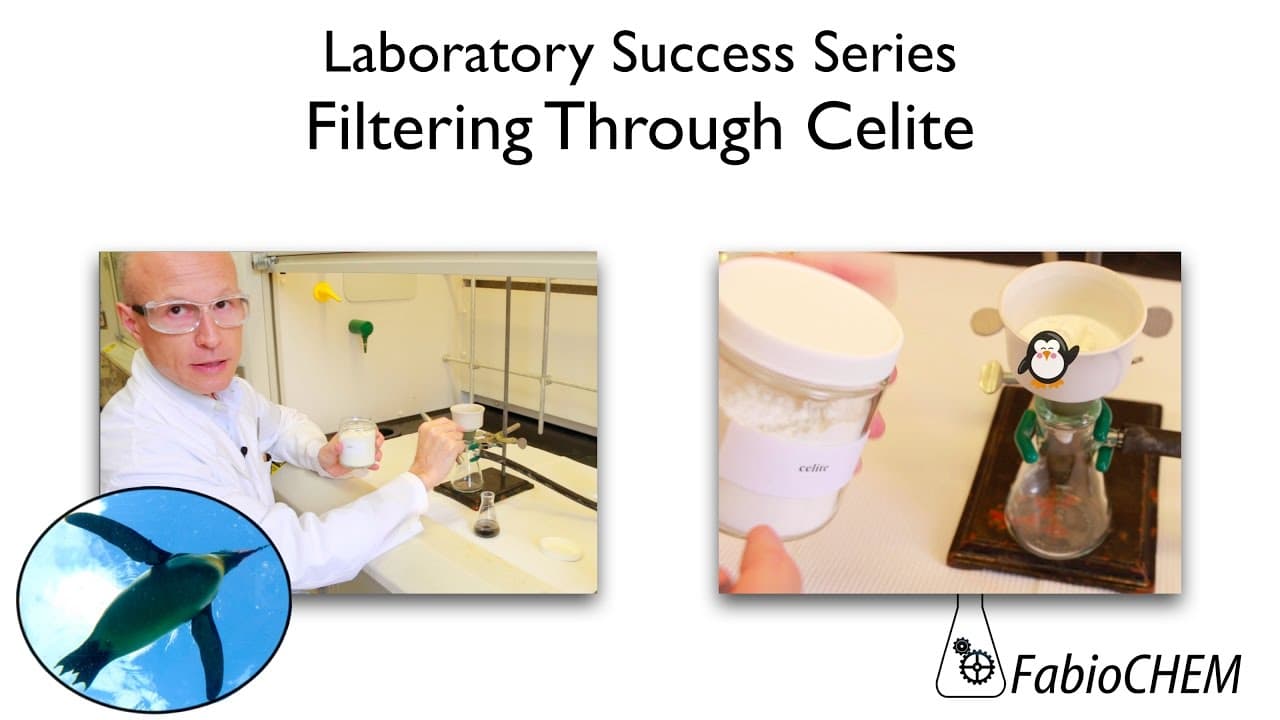
To filter fine particulates in organic chemistry, use celite, a filtering aid made from diatom shells. Begin by preparing the funnel with a thin layer of celite, then pour the solution carefully to avoid disturbing the celite. This method ensures you obtain a clear filtrate without losing product to the celite bed.
Transcript
[ Music ] >> Today we are talking about filtration through celite. It happens fairly often in organic chemistry laboratory that you have to filter off a very fine particulate from a solution. Sometimes the particulate is so fine that it would go through the pores of your regular filter paper. So you need to use a filtering aid. The most common filt... Read More
Key Insights
- 🏮 Filtration through celite is necessary when regular filter paper is unable to retain fine particulates in organic chemistry.
- 🦻 Celite, made from diatom shells, has micro pores that act as a sieve and aid in efficient filtration.
- 😫 The filtering apparatus should be set up properly with a Buchner funnel, clean filtering flask, and suitable filter paper.
- 🤔 Celite should be applied in a thin, uniform layer at the bottom of the funnel for effective filtration.
- 😨 Care should be taken while pouring the solution to avoid disturbing the celite surface and prevent divots.
- 🛌 Rinsing the filtering flask and celite with solvent helps ensure that no product is trapped in the celite bed.
- ❓ The filtrate obtained through celite filtration is the clear solution at the bottom of the filtering flask.
Install to Summarize YouTube Videos and Get Transcripts
Explore YouTube Video Summarizer or Get YouTube Transcript Extractor
Questions & Answers
Q: Why is celite used in filtration in organic chemistry?
Celite is used because its micro porous structure acts as a sieve, allowing for efficient filtration of fine particulates that may pass through regular filter paper.
Q: How do you prepare the filter before performing filtration through celite?
To prepare the filter, you need a Buchner funnel, a clean filtering flask with a vacuum adapter, and filter paper that fits properly inside the funnel. The filter paper should be weighed before filtering to determine the weight of the product collected.
Q: How do you apply celite in the filtering process?
After setting up the filtering apparatus, the filter paper is soaked with ethyl acetate solvent. Celite is then added on top of the wet filter paper, and the funnel is swirled to distribute the celite evenly. Vacuum is applied to create a uniform layer of celite at the bottom of the funnel.
Q: What precautions should be taken while pouring the solution during celite filtration?
It is important not to disturb the surface of the celite, as it may create divots. To prevent this, the solution can be poured carefully and slowly or a second piece of filter paper can be placed on top of the celite to break the fall of the solution.
Summary & Key Takeaways
-
Filtration through celite is a common practice in organic chemistry labs to separate fine particulates from solutions.
-
Celite, made from the shells of diatoms, acts as a sieve due to its micro porous structure.
-
The process involves preparing the funnel, applying celite, and filtering the solution while being careful not to disturb the celite surface.
Read in Other Languages (beta)
Share This Summary 📚
Summarize YouTube Videos and Get Video Transcripts with 1-Click
Try YouTube Summary with ChatGPT & Claude or YouTube Transcript Generator
Explore More Summaries from ThePenguinProf 📚





Summarize YouTube Videos and Get Video Transcripts with 1-Click
Try YouTube Summary with ChatGPT & Claude or YouTube Transcript Generator