How to Improve British English Pronunciation
TL;DR
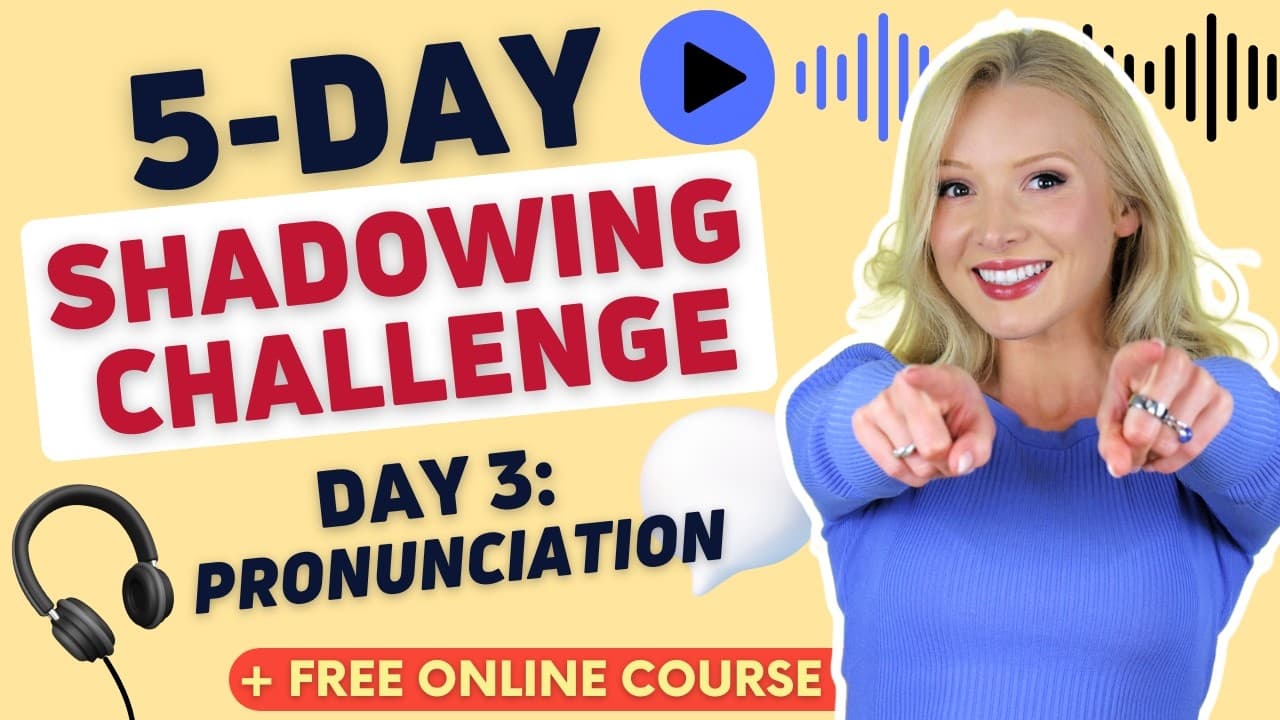
Improve British English pronunciation by shadowing complete sentences and practising vowel contrasts, weak forms, contractions, linking, elision, and glottal stops. Focus on how sounds change in connected speech, including reduced function words, omitted schwas, linked vowels, and compressed consonant clusters, because natural rhythm depends on more than pronouncing each word separately.
Transcript
Hello, everyone, and welcome back to English Challenge, where we follow one continuous story C1. Day 1 explored essential vocabulary. And Day day joining us, welcome! But I recommend starting There's a link to the full 5-Day Shadowing Today, we'll focus on one of my favourite B2 and C1 levels. And if you haven't yet now is the time because inside y... Read More
Key Insights
- Shadowing is a pronunciation exercise in which learners listen to complete sentences and repeat them while copying their sound patterns. The lesson alternates between story passages, detailed analysis, controlled repetition, and another full shadowing attempt so each feature can be applied in connected speech.
- The contrast between /iː/ and /ɪ/ depends on vowel length and mouth position. The lesson uses “feeling” to demonstrate a longer /iː/ with a relatively closed jaw and slightly smiling lips, then contrasts it with the shorter, more relaxed /ɪ/ sound.
- Weak forms are reduced pronunciations that support natural English rhythm. Words such as “and” and “to” need not receive their strong dictionary forms in ordinary connected speech, so the lesson practises relaxed alternatives built around the schwa while keeping the lips and jaw loose.
- Schwa deletion is a feature that can compress multisyllable words in fluent speech. The lesson presents “towards” with one syllable and suggests thinking of “camera” as “cam-ra,” showing how removing an unstressed middle vowel can create a smoother British pronunciation.
- Contractions are important for maintaining spoken rhythm. The story uses “I’d,” “rain’d,” and “sky’d” instead of fully pronouncing “I had,” “rain had,” and “sky had,” because expanded forms can slow the sentence and interfere with its intended rhythmic pattern.
- The pronunciation of “the” changes according to the following sound. The lesson demonstrates a strong /ðiː/ form before the vowel at the start of “autumn,” including a linking /j/, while using the reduced /ðə/ form before consonant sounds such as those in “cliffs.”
- Elision removes consonants when clusters would otherwise be difficult to pronounce smoothly. Advanced examples include words and phrases such as “endless,” “landscape,” “perfectly,” and “rust-coloured,” illustrating how sounds may disappear between consonants as speech becomes faster and more connected.
- A glottal stop can replace /t/ in selected connected-speech environments. The lesson describes it as briefly blocking airflow in the throat and demonstrates it in combinations such as “remote beach,” “it was,” and “nothing but mountains,” while presenting it as an optional Modern RP feature.
Install to Summarize YouTube Videos and Get Transcripts
Explore YouTube Video Summarizer or Get YouTube Transcript Extractor
Questions & Answers
Q: How can shadowing improve British English pronunciation?
Shadowing improves pronunciation by requiring learners to copy complete spoken sentences rather than practise isolated words alone. In this lesson, each travel-story passage is heard and repeated, then its vowel sounds, reductions, contractions, linking, or elision are analysed. Learners shadow the passage again afterward, applying those features to rhythm and connected speech while preserving the sentence’s meaning and flow.
Q: How do you pronounce the difference between /iː/ and /ɪ/?
The long /iː/ sound is produced with the jaw relatively closed and the lips slightly smiling, as demonstrated in “feeling.” The short /ɪ/ is more relaxed and shorter. Practising the two sounds side by side helps make the contrast audible and physical. The lesson stresses accurate long and short vowel production because confusing them can change how clearly words are understood.
Q: What are weak forms in spoken English?
Weak forms are reduced pronunciations used for common function words in connected speech. Instead of always pronouncing strong versions of words such as “and” and “to,” the lesson uses relaxed forms containing the schwa. The jaw opens slightly, while the lips remain relaxed. These reductions help prevent minor words from receiving too much emphasis and support a smoother English rhythm.
Q: Why is the schwa removed from some English words?
Removing an unstressed schwa can make a word quicker and smoother to pronounce in natural speech. The lesson pronounces “towards” as a single syllable rather than preserving a separate middle vowel. It offers a similar comparison for “camera,” encouraging “cam-ra” instead of a fully separated form. This compression is presented as a useful feature of fluent British English pronunciation.
Q: How are “I’d,” “rain’d,” and “sky’d” pronounced in connected speech?
“I’d,” “rain’d,” and “sky’d” are contracted forms of “I had,” “rain had,” and “sky had” in the story. The lesson recommends bringing the words together instead of fully expanding both parts, because the expanded forms can slow the sentence and spoil its rhythm. “I’d” is presented with one syllable, while “sky’d” includes a linking sound in its connected pronunciation.
Q: When should “the” be pronounced /ðiː/ or /ðə/?
The lesson uses the strong /ðiː/ pronunciation before a vowel sound, as in “the autumn colours,” and adds a linking /j/ between the words. Before consonant sounds, it uses the reduced /ðə/ form, as in “the cliffs.” The choice therefore depends on the opening sound of the following word, not simply on how that word is written.
Q: What is elision in British English pronunciation?
Elision is the omission of a sound in connected speech, especially when several consonants occur together. The advanced section notes that words need not be pronounced with every written consonant fully released. Examples include “endless,” “landscape,” “perfectly,” and “rust-coloured.” Removing a consonant from a difficult cluster can make the phrase easier to say while maintaining a fluent speech rhythm.
Q: How is a glottal stop used in Modern RP English?
A glottal stop is made by briefly blocking airflow in the throat and then releasing it, somewhat like a small cough. The lesson says it can replace /t/ in certain positions, particularly before another consonant, and demonstrates possibilities in “remote beach,” “it was,” and “nothing but mountains.” Learners are invited to compare versions with /t/ and with the glottal stop.
Summary & Key Takeaways
-
The lesson uses a continuous travel story for structured shadowing practice at B1, B2, and C1 levels. Learners first repeat complete sentences, then examine individual pronunciation features such as vowel length, reduced function words, contractions, linking, elision, and glottal stops before shadowing each passage again with greater precision and fluency.
-
At the earlier level, practice focuses on distinguishing the long /iː/ from short /ɪ/, producing the relaxed schwa, and reducing words such as “and” and “to.” It also demonstrates how removing a middle schwa can compress words such as “towards” and “camera,” making connected British speech smoother and more natural.
-
Later sections refine contracted forms such as “I’d,” vowel sounds in words including “stunning,” and connected pronunciations involving “the.” Advanced practice covers consonant elision, the long /ɑː/ in “last,” glottal stops before consonants, and /ɜː/ in words such as “word,” “superb,” and “early,” followed by repeated sentence shadowing.
Read in Other Languages (beta)
Share This Summary 📚
Summarize YouTube Videos and Get Video Transcripts with 1-Click
Try YouTube Summary with ChatGPT & Claude or YouTube Transcript Generator
Explore More Summaries from English with Lucy 📚





Summarize YouTube Videos and Get Video Transcripts with 1-Click
Try YouTube Summary with ChatGPT & Claude or YouTube Transcript Generator