How to Break Into Entry-Level IT Support With No Degree
TL;DR
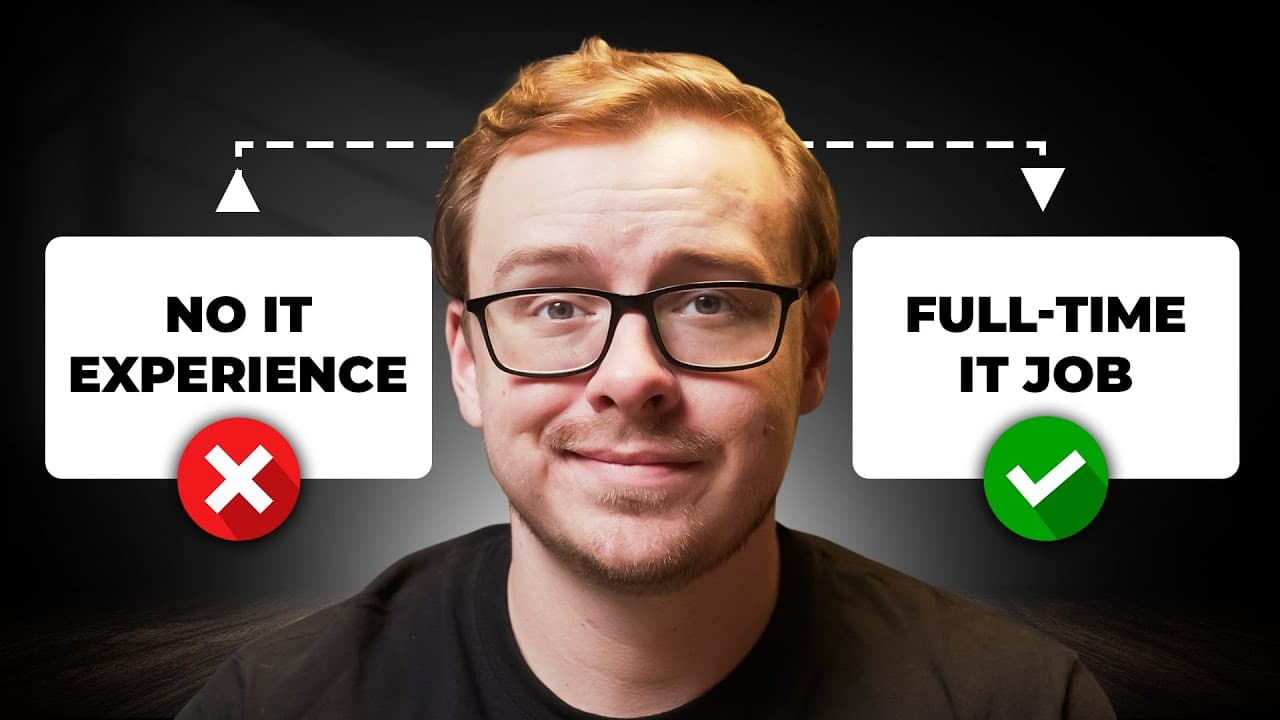
You can land an entry-level IT help desk job in a few months by following five steps: earn the $49 Google IT Support Professional Certificate on Coursera, build a hands-on portfolio through a home lab and volunteer troubleshooting, stack a specialized certification, bolster your portfolio, then optimize your job search. IT support remains one of the most accessible entry points into tech.
Transcript
Thousands of people a year are breaking into entry-level IT roles without a college degree or some expensive boot camp. Yet, there's millions of unfilled jobs worldwide. However, finding reliable information on how to break into IT efficiently without wasting time and money, well, that's the real challenge. And that's exactly what I'm going to go o... Read More
Key Insights
- IT support is one of the most accessible entry points into tech because, unlike software development or data science, you can land an entry-level help desk position with just a few months of focused learning and the right certifications.
- The Google IT Support Professional Certificate on Coursera costs $49 and is described as the best first step for beginners, covering technical support fundamentals, computer networking, operating systems, system administration, and IT security.
- Only 20% of a certificate's value comes from the actual information inside it, while 80% is the perception of that certificate by the hiring manager or decision maker, which is why brand-name credentials matter most.
- The Google certificate can be completed in 1 to 3 months studying part-time, gives access to Google's hiring network of 150-plus companies, and some people have landed jobs with just this certification alone.
- Building practical skills means setting up a home lab, installing Windows and Linux, practicing networking with virtual machines, documenting everything, volunteering to help friends and family, and joining forums like Reddit's r/techsupport.
- Complementary certifications to stack include CompTIA A+ for hardware, CompTIA Network+ for networking, Microsoft 365 fundamentals (MS-900) for corporate environments, and AWS Cloud Practitioner as a cheat code for cloud-focused roles.
- A strong portfolio includes documentation samples, troubleshooting case studies, home lab screenshots, and knowledge-base articles, and can be hosted for free on GitHub Pages or Notion with the link on your resume and LinkedIn.
- A cheat code for getting your foot in the door is applying for jobs in undesirable locations where cost of living is low and competition is minimal, working in person to gain that initial experience.
Install to Summarize YouTube Videos and Get Transcripts
Explore YouTube Video Summarizer or Get YouTube Transcript Extractor
Questions & Answers
Q: How can you break into IT support with no degree or experience?
You can break into IT support by following a five-step roadmap: start with the $49 Google IT Support Professional Certificate on Coursera, build practical skills through a home lab and volunteer troubleshooting, add complementary certifications, bolster your portfolio, and optimize your job search. Thousands of people a year enter entry-level IT roles without a college degree or expensive boot camp, and you can go from absolute beginner to job ready in just a few months of focused learning.
Q: What is the best first certificate for an IT support beginner in 2025?
The Google IT Support Professional Certificate on Coursera is called the best first step for any IT support beginner in 2025. For just $49, it teaches technical support fundamentals, computer networking, operating systems, system administration, and IT security. Because it is created by Google, it provides instant resume credibility, is comprehensive yet beginner friendly, and gives access to Google's hiring network of 150-plus companies once you complete it. It can be finished in 1 to 3 months studying part-time.
Q: Why does 80% of a certificate's value have nothing to do with learning?
According to the video, only 20% of the value of a certificate comes from the actual information inside it, while 80% is the perception of the certificate from the hiring manager or decision maker. This is why the channel focuses on credentials with a recognized brand name that are considered the gold standard by decision makers, rather than lesser-known courses that may teach the material well but lack that hiring-manager recognition.
Q: How do you build practical IT support skills for your portfolio?
Build practical skills by setting up a home lab environment, installing and configuring operating systems like Windows and Linux, and practicing networking concepts with virtual machines. Document everything as if in a real work environment and work on real troubleshooting scenarios. Volunteer to help friends and family with tech issues, join forums such as Reddit's r/techsupport, and learn basic scripting like PowerShell, Bash, and simple Python. A user commented that showing they could troubleshoot real problems during interviews landed them their first help desk job.
Q: What certifications should you stack after the Google certificate?
After completing the Google IT Support certificate and building your portfolio, consider adding one or more certifications based on your interests: CompTIA A+ as the industry standard for hardware knowledge, CompTIA Network+ for networking specialization, Microsoft 365 fundamentals or MS-900 for corporate environments, and AWS Cloud Practitioner, described as an absolute cheat code for cloud-focused roles. Many employers use these certifications as filters in their hiring process, and the Google certificate plus one specialized certification is often enough to land your first role.
Q: How long does it take to get a job in IT support?
The video says you can go from absolute beginner to job ready in just a few months of focused learning. The Google IT Support certificate alone can be completed in 1 to 3 months studying part-time, with some finishing in less than a month. One commenter mentioned landing a job in 2 weeks after completing the course with no prior formal IT experience, and the presenter has interviewed people who broke into IT in as little as 7, 10, or 12 days, though that was several years ago.
Q: Where should you host your IT support portfolio?
You can host your portfolio on a simple website, and GitHub Pages is recommended because it is free. Include the link on your resume and LinkedIn profile. Notion is also suggested as a good hosting option because many people at tech companies are familiar with it and it is a cool place to showcase your work. A strong portfolio should include documentation samples, troubleshooting case studies, home lab screenshots and explanations, and knowledge-base or tutorial-style articles that demonstrate your expertise.
Q: What roles should you target when searching for an IT support job?
Target entry-level roles such as help desk technician, IT support specialist, technical support representative, and desktop support analyst. While remote jobs are attainable, a cheat code for getting your foot in the door is applying for jobs in undesirable locations, whether in big cities or small towns nobody wants to live in, where you work in person. The cost of living is usually very low there, making it a good way to gain initial experience and start your career.
Summary & Key Takeaways
-
As of midyear 2025, LinkedIn shows over 69,000 IT jobs in the United States, and demand for entry-level IT support professionals keeps growing. IT support is the most accessible tech entry point, letting beginners with zero experience land a help desk role after just a few months of focused learning.
-
Step one is earning the $49 Google IT Support Professional Certificate on Coursera, which provides instant resume credibility. Step two is building practical skills through a home lab, configuring Windows and Linux, practicing networking with virtual machines, learning basic scripting like PowerShell, Bash, and Python, and volunteering to solve real tech problems.
-
Step three stacks complementary certifications such as CompTIA A+, Network+, MS-900, or AWS Cloud Practitioner. Step four bolsters the portfolio with documentation, case studies, and tutorials, even a YouTube channel. Step five optimizes the job search by targeting help desk roles and applying to undesirable locations to get a foot in the door.
Read in Other Languages (beta)
Share This Summary 📚
Summarize YouTube Videos and Get Video Transcripts with 1-Click
Try YouTube Summary with ChatGPT & Claude or YouTube Transcript Generator
Explore More Summaries from Shane Hummus 📚





Summarize YouTube Videos and Get Video Transcripts with 1-Click
Try YouTube Summary with ChatGPT & Claude or YouTube Transcript Generator