How to Write Better Nano Banana AI Image Prompts
TL;DR
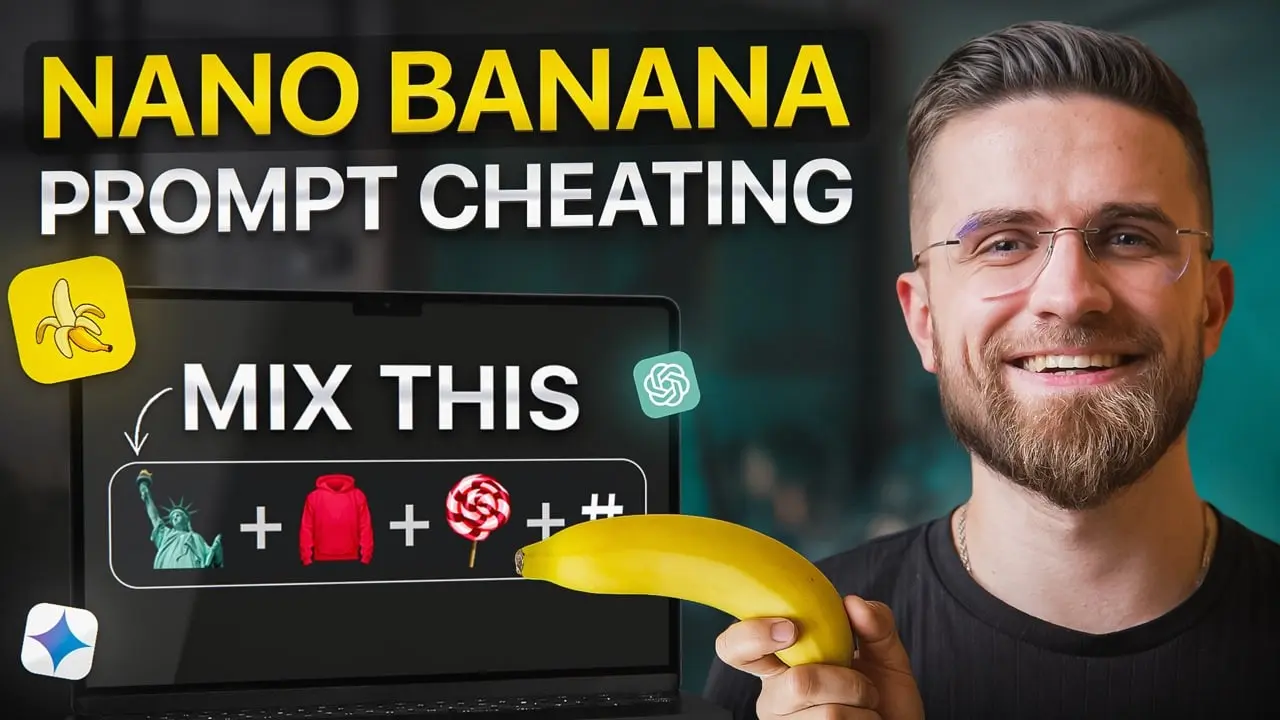
Every Nano Banana prompt should combine six components: subject, action, environment, art style, lighting, and details. Instead of typing 'woman in cafe,' specify a described subject, what she is doing, the setting, a camera reference like 'shot on a Canon 5D Mark IV,' the light source, and small realistic details. This structure produces consistent, professional-grade results.
Transcript
Listen, I've tested every AI image generator out there from first Dolly and Chad GPT to Midjourney to stable diffusion, but nothing has blown my mind quite like Nano Banana. And here's the thing, most people are using it completely wrong. We're not just talking about making pretty pictures here. I'm talking about creating professionalgrade visuals ... Read More
Key Insights
- The core Nano Banana prompt formula has six components: subject plus action plus environment plus art style plus lighting plus details. Following this structure produces consistent, professional results instead of the random output beginners get from vague prompts.
- Nano Banana runs inside Google Gemini Flash 2.5 and is selected from the tools dropdown. Its interface deliberately avoids offering a million confusing options, and that simplicity is presented as a strength because simplicity equals consistency.
- Specificity in every word matters more than general vibe. Saying 'dramatic window lighting creating rim light effect' beats 'nice lighting,' because the AI needs to understand exactly what you are visualizing rather than a loose description.
- Camera and lens references do heavy lifting in prompts. Instructions like 'shot on a Canon 5D Mark IV' or '85mm portrait lens on medium format film' tell the AI the image quality, compression, and bokeh you want for a professional photography look.
- Product photography has different requirements than portraits. Removing a 'macro lens for sharp detail' instruction makes a watch face go soft, so product shots need sharp detail, controlled lighting, and compositions that highlight features rather than mood.
- Landscape prompts depend on atmospheric detail. Without specifying 'crystal clear water showing perfect reflections,' results often look muddy or unclear, and timing cues like 'sunrise with warm golden light' set the entire mood of the image.
- Street photography prompts must preserve authenticity. Phrases like 'candid moment with genuine expression' and 'authentic street scene feeling' prevent the AI from producing images that look too perfect or staged, since the genre is about capturing life naturally.
- Abstract art prompts describe feelings, relationships, and dynamics rather than specific objects. Phrases like 'flowing liquid metal forms' give the AI permission to create impossible physics, offering artistic direction instead of photographic instruction.
Install to Summarize YouTube Videos and Get Transcripts
Explore YouTube Video Summarizer or Get YouTube Transcript Extractor
Questions & Answers
Q: What is the Nano Banana prompt formula?
The formula has six components combined together: subject plus action plus environment plus art style plus lighting plus details. For example, 'a young woman with freckles' is the subject, 'smiling thoughtfully and sitting' is the action, 'in a cozy cafe by the window' is the environment, 'shot on a Canon 5D Mark IV' is the art style, 'natural window light' is the lighting, and 'warm coffee cup and hands, soft focus background' are the details. This structure replaces vague prompts like 'woman in cafe' and produces consistent professional results.
Q: How do you access and set up Nano Banana?
You access Nano Banana by pulling up Google Gemini Flash 2.5 and selecting Nano Banana from the tools dropdown. The creator emphasizes that proper setup is where most people mess up, even at this basic step. The interface intentionally does not give a million confusing options like some other tools, which the creator frames as a good thing because simplicity equals consistency. He warns not to let the simplicity fool you into thinking the tool is limited, because the prompting strategy can push it to its absolute limits.
Q: Why does specificity matter so much in prompts?
Specificity matters because the AI needs to understand exactly what you are visualizing, not just the general vibe. The creator says most people get lazy with one component, for example writing 'nice lighting' instead of 'dramatic window lighting creating rim light effect.' Every word in your prompt matters. He tested a portrait prompt roughly 50 times and found the consistency remarkable, with only slight variations in pose or expression while overall professional quality remained constant. That consistency comes from following the formula exactly rather than using general descriptions.
Q: How should product photography prompts differ from portraits?
Product photography has different requirements than portrait photography, so prompts must reflect that. Products need sharp details, controlled lighting, and compositions that highlight features rather than create artistic mood. The creator notes that if you remove the 'macro lens for sharp detail' instruction from a watch prompt, the watch face becomes slightly soft, which might suit some aesthetics but is not ideal for product photography where detail is everything. He says Nano Banana shines at product shots because it understands lighting and materials better than most other AI image generators.
Q: What makes landscape photography prompts work well?
Landscape prompts require thinking about atmospheric conditions, depth, and the relationship between foreground and background elements. The creator's formula includes 'sunrise with warm golden light' for specific timing that affects the entire mood, and 'foreground rocks providing compositional anchor' to ensure proper depth and visual flow. He learned that without specifying 'crystal clear water showing perfect reflections,' you often get lakes that look muddy or unclear, which destroys the magical quality of alpine scenery. Good results capture convincing reflections, natural lighting, and composition that draws the eye through the image.
Q: How do you make street photography look authentic with AI?
Street photography is challenging because it needs to feel spontaneous and authentic while still being carefully composed. The creator includes a 'candid moment with genuine expression' instruction because forced or artificial expressions destroy the street photography aesthetic. He also uses 'soft afternoon light filtering through street trees' for flattering, natural-feeling light. During testing he found that without specifying 'authentic street scene feeling,' the AI often creates images that look too perfect or staged. The secret is remembering the genre is about capturing life as it naturally occurs, so technical specifications should support authenticity rather than undermine it.
Q: How are abstract art prompts different from photographic prompts?
Abstract art prompts are about describing feelings, relationships, and dynamics rather than specific objects, giving the AI artistic direction instead of photographic instruction. The creator's example uses 'flowing liquid metal forms' to give the AI permission to create impossible physics, and 'dramatic light creating depth and shadow' to ensure the abstract forms have dimensional quality. He says this is where Nano Banana can create truly unique pieces that would be impossible with traditional photography, producing results that could hang in a modern art gallery through the interplay of organic and geometric forms and rich metallic textures.
Q: What is VEED's V Fabric 1.0 mentioned in the video?
V Fabric 1.0 is VEED's first AI video model and the video's sponsor, described as set to disrupt the AI video generation space. It can turn any image into a talking video with the click of a button, so a character created in Nano Banana can be uploaded and brought to life with realistic movement and voice in seconds. The creator says it is 60 times cheaper and seven times faster than other models on the market and can generate videos up to one minute long. VEED offers 30 percent off the first month with the code in the description.
Summary & Key Takeaways
-
The creator claims to have tested every major AI image generator, from DALL-E and ChatGPT to Midjourney and Stable Diffusion, but says Nano Banana blew his mind. Most people use it wrong, so he promises a formula for consistent, professional-grade visuals that could pass for real photography.
-
Setup happens inside Google Gemini Flash 2.5 by selecting Nano Banana from the tools dropdown. The prompting strategy uses six components: subject, action, environment, art style, lighting, and details. A structured cafe prompt is shown replacing the beginner phrase 'woman in cafe.'
-
The video walks through genre-specific prompts including portrait, product, architectural, landscape, street, and abstract art, each stressing that specific wording controls the result. It also promotes the creator's AI Master Pro hub and sponsor VEED's V Fabric 1.0, which turns any image into a talking video.
Read in Other Languages (beta)
Share This Summary 📚
Summarize YouTube Videos and Get Video Transcripts with 1-Click
Try YouTube Summary with ChatGPT & Claude or YouTube Transcript Generator
Explore More Summaries from AI Master 📚



Summarize YouTube Videos and Get Video Transcripts with 1-Click
Try YouTube Summary with ChatGPT & Claude or YouTube Transcript Generator