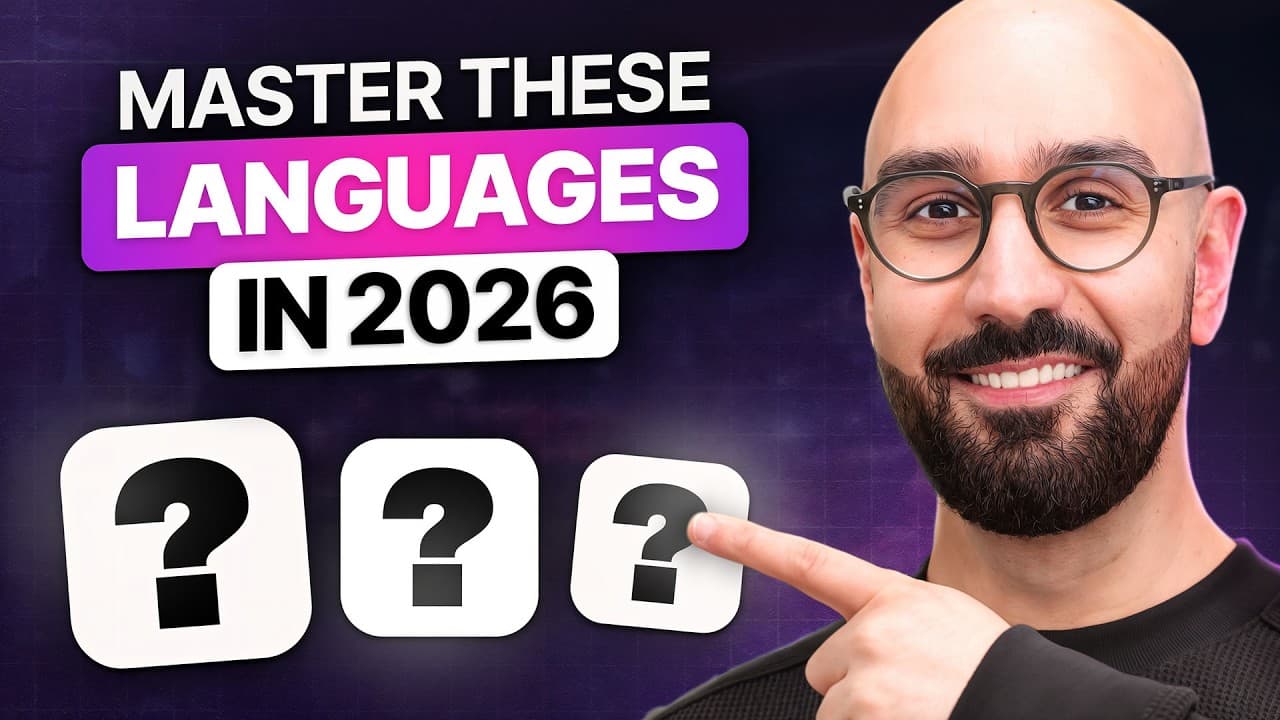
Top 5 Programming Languages to Learn in 2026 to Get Hired
TL;DR
Start with Python or JavaScript with TypeScript, then add SQL, and you'll already be ahead of most junior developers. Junior jobs aren't gone, but the bar is higher: companies assume you use AI tools and expect you to understand fundamentals like data structures, debugging, and databases, not just copy-paste code.
Transcript
Whether you're just starting to code or already have a bit of experience, one question keeps coming up. What programming languages should you learn in 2026? You've probably seen headlines saying AI is taking over, junior developers are being replaced, and companies only want seniors. Now, let's break down what's actually happening with real job mar... Read More
Key Insights
- Junior developer jobs are not gone, but the bar has gone up. Job listings for developers with 0 to 3 years of experience rose 47% since October 2023, according to a Litecast report, signaling a rebound after the 2022-2023 layoffs.
- Python is one of the smartest first moves for breaking into tech. About 58% of developers use it per the 2025 Stack Overflow survey, and it grew 7 percentage points in a single year, the largest increase of any major language.
- JavaScript is the most widely used language in the world, used by about 66% of developers, but most professional teams now use TypeScript because it adds types that catch bugs earlier and make large codebases easier to maintain.
- SQL is one of the highest return-on-investment skills a developer can learn. It appears in over 100,000 developer job listings in the US, often alongside Python, Java, JavaScript, or C#, because every serious application runs on data.
- Java and C# power a massive part of the software industry and offer steady, well-paid jobs less affected by short-term trends. The US has over 90,000 open Java positions, driven by enterprise systems that aren't rewritten every few years.
- Fundamentals matter more than ever because companies assume developers use AI tools. Employers want people who understand code, can fix problems, and make good decisions, not those who copy and paste without understanding what they build.
- Bonus languages are goal-driven choices. Go suits cloud and infrastructure, Rust suits systems and high-performance software, Swift is for iOS, and Kotlin is the modern standard for Android; learn them only if you know what you want to build.
- The safest starting path in 2026 is Python or JavaScript with TypeScript, then SQL, then specialization. Learning a language isn't the finish line: getting hired requires building things, solving problems, and showing you understand how software works.
Install to Summarize YouTube Videos and Get Transcripts
Explore YouTube Video Summarizer or Get YouTube Transcript Extractor
Questions & Answers
Q: Are junior developer jobs gone in 2026?
No, but the bar has gone up. After mass layoffs in 2022 and 2023 hit juniors hardest, the market showed real signs of rebound by the second half of 2025. Job listings for developers with 0 to 3 years of experience rose 47% since October 2023 per a Litecast report, and there are around 24,000 open entry-level software engineering positions on Indeed in the US alone, not counting internships or startups.
Q: What programming language should I learn first in 2026?
Start with Python or JavaScript with TypeScript. They are versatile, in demand, and open the most doors early on. Once you have one of those down, add SQL, and that combination alone puts you ahead of a huge number of junior developers. From there you can specialize in back end, front end, mobile, cloud, or enterprise development. There is no single best language, but there is a best language for the work you want to do.
Q: Why is Python a good language to learn?
Python is used for AI, machine learning, data analysis, backend development, automation, and scripting. About 58% of developers use it per the 2025 Stack Overflow survey, and it grew by 7 percentage points in a single year, the largest increase of any major language. There are over 100,000 open Python related jobs in the US alone. It is easy to learn, so you spend less time on syntax and more time building things, which is exactly what employers care about.
Q: What is the difference between JavaScript and TypeScript?
JavaScript is the most widely used language in the world, used by about 66% of developers, and is essential for building websites, dashboards, and full products. TypeScript builds on JavaScript by adding types, which helps catch bugs earlier, makes large codebases easier to maintain, and improves developer productivity. That is why it has become the default choice for serious production-grade web applications, is now used by the majority of modern web teams, and continues to grow faster than JavaScript itself.
Q: Why should developers learn SQL?
Every serious application runs on data, and that data lives in a database, including user accounts, orders, payments, logs, and analytics. All of it touches SQL, which is why SQL appears in over 100,000 developer job listings in the US, often alongside Python, Java, JavaScript, or C#. You don't need to be a database expert, but being able to read data, write queries, and understand how databases work instantly makes you more useful. It is one of the highest return-on-investment skills and pays off immediately.
Q: Is Java still worth learning in 2026?
Yes, especially if you aim for stability, backend roles, or larger organizations. Java has been around for decades and is still used by large companies, financial platforms, government systems, and high-scale enterprise applications. Because these systems don't get rewritten every two years, companies need developers to maintain and extend them long-term, keeping demand consistently high. There are over 90,000 open Java positions in the US on Indeed. It has a steeper learning curve than Python or JavaScript, but that is why companies value it.
Q: When should I learn languages like Go, Rust, Swift, or Kotlin?
These are goal-driven choices you should learn only in the right context. Go is exploding in cloud and infrastructure, used for microservices, DevOps, and backend systems where performance and simplicity matter. Rust is designed for performance, safety, and reliability, popular in systems programming, security, and high-performance software. Swift is the go-to for iOS development and Kotlin is the modern standard for Android. If you already know what you want to build, they make sense; otherwise, focus on the core languages first.
Q: What skills do companies expect from junior developers now?
Companies assume developers use AI tools, so they want people who understand code, can fix problems, and make good decisions even with AI in the loop, not those who copy and paste without understanding. Fundamentals matter more than ever: not just syntax, but understanding your language in depth, knowing core data structures like arrays, lists, dictionaries, stacks, and queues and when to use them, debugging, basic design patterns, version control, and databases. You don't need a computer science degree, but you need that level of understanding.
Summary & Key Takeaways
-
Junior developer roles rebounded by the second half of 2025, with listings for 0-3 years of experience up 47% since October 2023 and around 24,000 open US entry-level positions on Indeed. Europe faces a shortage, with 57% of companies unable to find enough qualified developers and the EU needing nearly 10 million more tech workers by 2030.
-
Python and JavaScript with TypeScript lead as the most versatile, in-demand languages. Python, used by 58% of developers, dominates AI, machine learning, and automation, with over 100,000 US job openings. JavaScript is used by 66% of developers, but professional teams now default to TypeScript for production-grade web applications because its types improve maintainability.
-
Java and C# offer stability in enterprise, financial, government, and game development, with over 90,000 open Java roles in the US, though they have steeper learning curves. SQL is essential everywhere, appearing in over 100,000 listings. The recommended path is Python or JavaScript with TypeScript, then SQL, then specialization by domain.
Read in Other Languages (beta)
Share This Summary 📚
Summarize YouTube Videos and Get Video Transcripts with 1-Click
Try YouTube Summary with ChatGPT & Claude or YouTube Transcript Generator
Explore More Summaries from Programming with Mosh 📚


Summarize YouTube Videos and Get Video Transcripts with 1-Click
Try YouTube Summary with ChatGPT & Claude or YouTube Transcript Generator