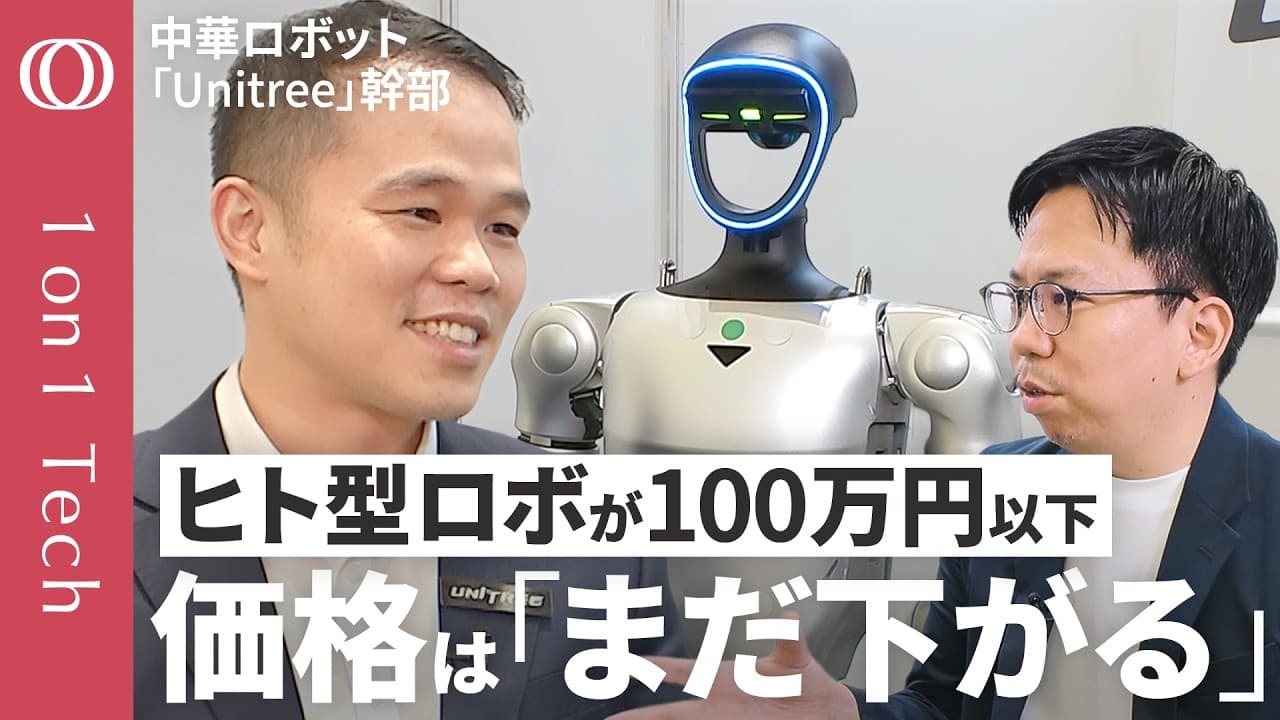
How Does Unitree Make Humanoid Robots Affordable?
TL;DR
Unitree makes humanoid robots more affordable through China’s expanding supply chain, in-house hardware and software development, and close control over components and manufacturing. Its near-term focus is not replacing people broadly, but reducing human exposure to dirty, dangerous, difficult, repetitive, hot, humid, noisy, or unpleasant workplaces while developers build practical applications.
Transcript
One city. Thank you for coming. We have Shawi Chen uh in Apex sales director. Thank you very much for coming. Thank you for having me. Yeah. So I think Unitry is known for like um the mass production of robots or and the southern robots like globally or even in Japan and many developers uh have been using Unry for robotic platform. So how does that... Read More
Key Insights
- Unitree’s early entry into robotics helped it build a strong market position while the commercial market was still small and largely centered on research and development. The company expects its share to face pressure as more manufacturers enter and demand becomes more diverse.
- Developer demand is becoming the main force behind Unitree’s robot sales. The company compares the emerging robotics ecosystem with smartphone applications, where many independent developers create specialized capabilities before products move into broad deployment and routine use.
- Unitree’s affordable pricing is supported by China’s increasingly mature manufacturing supply chain. A growing number of suppliers are entering embodied AI and robotics, which expands component availability, improves production stability, and creates conditions for lower costs.
- Internal development is central to Unitree’s product strategy. The company develops both hardware and software because third-party AI models may not match a robot’s physical design, creating compatibility problems between control systems, actuators, sensors, and the complete machine.
- Hardware strength depends on controlling details throughout the robot’s construction. Unitree says it works from individual screws and actuator materials upward, allowing compact robots to use strong motors while preserving greater oversight of quality, supplier relationships, and product design.
- Robot performances such as dancing and kung fu primarily generate attention and demonstrate physical capability. Unitree describes its approach as building athletic ability before work capability, reasoning that a strong and well-controlled robotic body can later support demanding practical tasks.
- Advanced movement results from several technologies working together rather than one breakthrough. Reinforcement learning teaches varied motions, while networking, language programming, vision-language-action systems, and world-action models contribute to perception, instruction following, control, and coordinated physical performance.
- Hazardous and uncomfortable workplaces are the clearest near-term application for humanoid robots. Unitree aims to reduce human exposure to dirty, dangerous, difficult, repetitive, hot, humid, noisy, or unpleasant conditions, rather than presenting robots simply as replacements for workers.
Install to Summarize YouTube Videos and Get Transcripts
Explore YouTube Video Summarizer or Get YouTube Transcript Extractor
Questions & Answers
Q: How does Unitree make humanoid robots affordable?
Unitree links affordability to China’s established manufacturing supply chain and its own control over product development. The company designs hardware and software internally, manages suppliers closely, and works on components from small screws to compact actuators. As the robotics market expands and suppliers become more capable and stable, Unitree expects production costs and selling prices to continue declining.
Q: Why has Unitree gained a large share of the robot market?
Unitree says it benefited from entering robotics early, when the market was small and demand came mainly from research and development. That timing provided experience, visibility, and relationships with customers and partners. The company also credits professional service and a sustained focus on research users, while acknowledging that its share may decrease as more competitors and applications enter the market.
Q: Who is currently buying Unitree robots?
Research organizations were the main customers during the market’s earlier stage, but Unitree says developers now represent the largest source of demand. These developers use the robots as platforms for creating new applications. The company expects this development phase to produce an ecosystem resembling smartphone applications, followed by broader deployment when useful software and operational solutions are ready.
Q: How does Unitree develop AI for its robots?
Unitree says it develops its own models, software, and hardware while also learning from developments elsewhere. The reason for internal development is compatibility: a model created for another platform may not align properly with a robot’s physical structure, sensors, or actuators. Coordinating the intelligence and the body allows the company to tailor movement and control to its machines.
Q: What technology lets Unitree robots dance and perform kung fu?
Unitree attributes these performances to a combination of technologies rather than a single system. Reinforcement learning supports the acquisition of varied movements, while networking, language programming, vision-language-action technology, and world-action models contribute additional capabilities. Continued advances across these areas allow the robots to coordinate their bodies and deliver more sophisticated physical demonstrations.
Q: Are robot dances and kung fu useful beyond publicity?
Dancing and kung fu are valuable for attracting attention and showing that a robot has strong balance, motion control, and physical coordination. Unitree nevertheless says practical applications are the eventual goal. Its philosophy is to establish athletic capability first, because a healthy and capable robotic body provides a foundation for performing work-related tasks in demanding environments later.
Q: Where will humanoid robots be most useful first?
Unitree expects the earliest practical value to appear in environments people find hazardous or uncomfortable. Examples given include dirty, dangerous, difficult, repetitive, hot, humid, noisy, or unpleasant workplaces. The stated objective is to reduce human exposure to these conditions, especially where people do not want to remain for extended periods, rather than merely replacing workers.
Q: Will humanoid robot prices continue to fall?
Unitree expects each product generation to become less expensive as the market grows and the supply chain becomes more solid, qualified, stable, and competitive. The company compares the future position of robots with a category between smartphones and cars in both price and production quantity. However, it also says the industry has not fully resolved the balance among affordability, capability, and safety.
Summary & Key Takeaways
-
Unitree attributes its market position to entering robotics early, concentrating on research and development customers, and serving partners professionally. As the industry matures, demand is shifting toward developers who are building applications, with wider deployment expected to follow once the software ecosystem and practical use cases become sufficiently developed.
-
Affordability comes from access to China’s maturing supply chain and Unitree’s decision to design and develop core hardware and software internally. Control extending down to small components and compact actuators gives the company greater influence over compatibility, production, supplier management, product performance, and pricing as manufacturing volumes expand.
-
Dancing, running, and kung fu demonstrations attract public attention, but Unitree views useful applications as the real objective. Reinforcement learning, vision-language-action systems, networking, and other technologies support increasingly capable movement. The company expects robots to prove most valuable first in hazardous, uncomfortable, repetitive, or otherwise undesirable working environments.
Read in Other Languages (beta)
Share This Summary 📚
Summarize YouTube Videos and Get Video Transcripts with 1-Click
Try YouTube Summary with ChatGPT & Claude or YouTube Transcript Generator
Explore More Summaries from TBS CROSS DIG with Bloomberg 📚






Summarize YouTube Videos and Get Video Transcripts with 1-Click
Try YouTube Summary with ChatGPT & Claude or YouTube Transcript Generator