Why Does the US Not Use the Metric System?
TL;DR
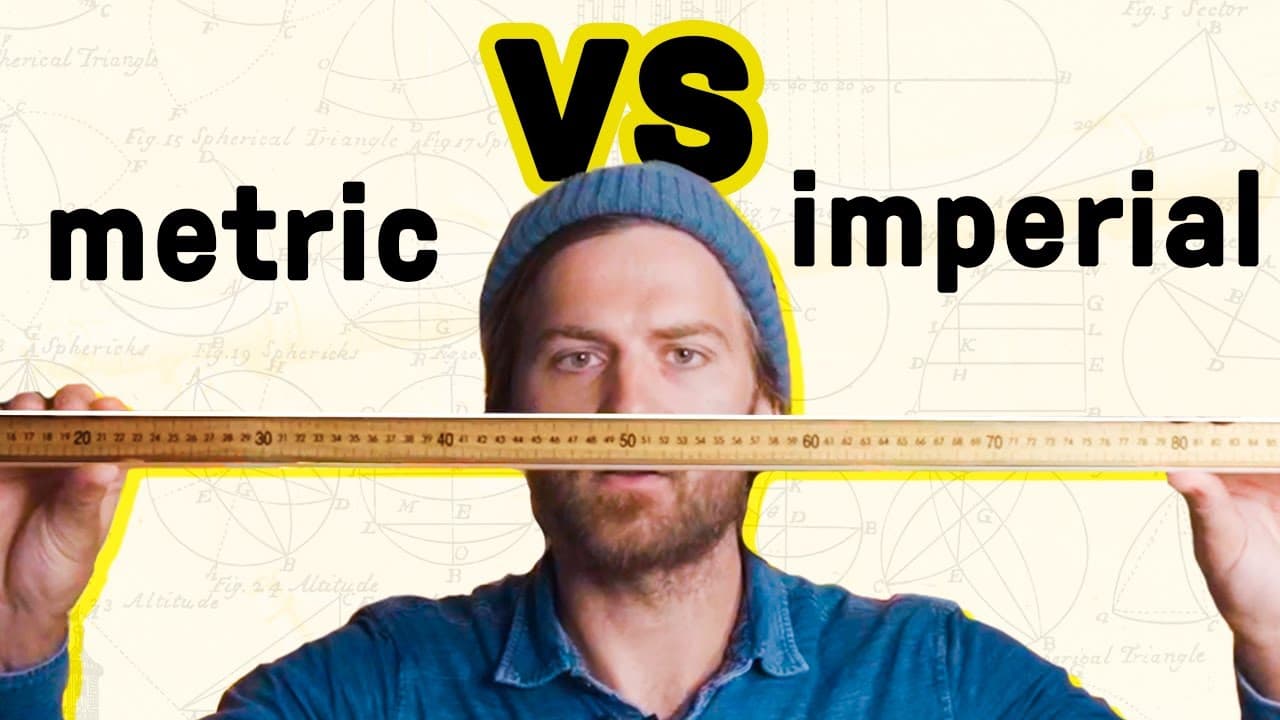
Only three countries have not adopted the metric system: the United States, Liberia, and Myanmar. The metric system came out of the French Enlightenment in the late 1700s, when astronomers spent seven years measuring the distance from the North Pole to the equator and divided it by 10 million to define the meter. Older units like the foot, inch, and mile were derived from body parts, barley corns, and farming activities.
Transcript
- [Interviewer] Do you know how many feet there are in a mile? - [Interviewee] 3,000-something. - [Johnny] This is the moment I realized I will never use the metric system. Okay, let's see how far you can jump. Ready? My six year old is constantly asking me to measure how far he can jump. - I have to get on that. - [Johnny] Okay, I'm gonna count it... Read More
Key Insights
- Only three countries do not use the metric system: the United States, Liberia, and Myanmar. Liberia is a small African nation the US effectively created to ship slaves back to, and Myanmar is a Southeast Asian country that used to be called Burma.
- The first thing humans measured was time, because the sun, moon, stars, and constellations are visible to everyone and repeat reliably every day and night. Measuring weight and length proved far harder, so for a long time the best available reference was the human body.
- The cubit is the earliest known unit of measurement and was based on the length of a forearm. It was imprecise because forearms vary in size, but it was accurate enough to build the pyramids in Cairo and Noah's ark, which was reportedly 300 cubits long.
- Many older units came from daily farm activities. The acre was the amount of land a farmer could plow in a day, the hundredweight was roughly how much a man could comfortably carry on his back, and the furlong was the distance a team of oxen could plow without resting.
- The inch was decreed in the 1300s as three grains of barley laid end to end, taken from the midst of the ear. The pound was defined as the weight of seven thousand grains, a definition so unwieldy that counting them out by hand is impractical.
- King Henry standardized the English yard using his own body, including the length from his nose to his thumb and the length of his arm. All yard-like measurements in England were derived from a literal human body for a period of time.
- The mile came from the distance covered by Roman soldiers walking one thousand paces, and was later found to be roughly eight furlongs. By the 1700s there were countless competing ways of measuring things, all of them tenuous and inconsistent.
- The meter was defined by measuring the distance from the North Pole to the equator, one-fourth of the earth's circumference, and dividing it into 10 million parts. Two French astronomers took seven years to complete the calculation, starting in 1792.
Install to Summarize YouTube Videos and Get Transcripts
Explore YouTube Video Summarizer or Get YouTube Transcript Extractor
Questions & Answers
Q: Which countries do not use the metric system?
Three countries do not use the metric system: the United States, Liberia, and Myanmar. The United States is described as the richest, most powerful country in the world. Liberia is a small African nation that the US effectively invented in order to ship slaves back to. Myanmar is a Southeast Asian country that used to be called Burma. On a world map showing metric adoption, the whole world appears as one color with these three countries peppered across the globe in a different color. Britain appears green on that map, meaning it is officially metric, but it still dabbles in pounds, pints, and miles.
Q: How was the meter originally defined?
The meter was defined by measuring the distance from the North Pole to the equator, which is one-fourth of the earth's circumference, and then chopping that line into 10 million equal parts. One of those parts is a meter. French thinkers wanted a unit pegged to an unchanging baseline rather than to forearms or barley corns, so they chose the planet itself. The name meter comes from the Greek word metron, meaning a measurement, which reflected the French Enlightenment's emphasis on precision and literalism.
Q: How did French astronomers measure the distance from the North Pole to the equator in 1792?
Two French astronomers went into the French countryside looking for high places such as hills and castle towers. Using a platinum map telescope, they measured the angles between two distant points, which let them take measurements without physically walking those distances. By repeating this, they created a series of little triangles across the countryside, then used basic middle-school-level math to calculate a hyper-accurate distance along a straight line. The process took them seven years to complete, but they succeeded, and from that line they derived the distance between the North Pole and the equator.
Q: Why is the earth's circumference not exactly 40,000 kilometers?
By the metric system's own logic the earth's circumference should be exactly 40,000 kilometers, since a quarter of it was divided into 10 million meters, or 10,000 kilometers. In reality there is an extra 75 kilometers. One of the two French astronomers made an error in his calculations, which made the final meter about 0.2 millimeters shorter than it should have been. He discovered the mistake partway through the project but did not tell anyone, because support for the new system was already tenuous and he did not want to invite more doubt or skepticism.
Q: What is a cubit and what was it used for?
The cubit is the earliest unit of measurement known, and it was basically the length of a forearm. Because everyone has differently sized forearms, it was not a precise unit, but it was good enough for major construction projects. It was used in building the giant pyramids in Cairo, and Noah's ark was reportedly 300 cubits long. The cubit is an example of how, for a long stretch of human history, the best measuring tools available were people's own bodies rather than any standardized reference.
Q: How were the foot, inch, and yard originally defined?
The foot was the average length of a man's foot, which made it a ruler you always had handy. The inch was decreed in the 1300s as three grains of barley laid end to end, taken from the midst of the ear, which would have required carrying a pouch of barley corns to measure anything. The yard was originally the average measurement around someone's chest, and later King Henry standardized the English yard using his own body, including the length from his nose to his thumb and the length of his arm.
Q: Where does the mile come from?
The mile is the distance covered by Roman soldiers walking one thousand paces, specifically a thousand two-step paces. Later it was somehow discovered that a mile was roughly about eight furlongs. A furlong itself was defined as the distance that a team of oxen could plow without resting, so the mile ended up anchored to another agricultural unit rather than to anything fixed. This chain of derivations illustrates how tenuous and inconsistent pre-metric measurements were by the time the 1700s arrived.
Q: How does the metric system connect length to volume?
Once the meter was established, an entire system could be built purely from it. For volume, you construct a hypothetical cube that is 10 centimeters on all sides, fill it with liquid, and the amount it holds is one liter. The system's other length units follow the same decimal logic: dividing a meter into a hundred smaller units gives a centimeter, and placing a thousand meters side by side gives a kilometer. The biggest advantage cited for the metric system is the time it saves in computation, since many calculations become merely a matter of moving the decimal point.
Summary & Key Takeaways
-
The entire world uses the same measuring system except for three countries: the United States, Liberia, and Myanmar. Liberia is a small African nation the US effectively invented to ship formerly enslaved people back to, and Myanmar is a Southeast Asian country formerly called Burma. Britain is green on the map but still dabbles in pounds, pints, and miles.
-
Before standardization, measurement was based on the human body and daily farm labor. The cubit was the length of a forearm, the foot was the average length of a man's foot, the inch was decreed in the 1300s as three grains of barley laid end to end, the yard was the average measurement around someone's chest, and the acre was the land a farmer could plow in a day.
-
In the late 1700s, amid the French Revolution and Enlightenment, French thinkers decided to peg measurement to the planet itself. Two astronomers used a platinum telescope to measure angles between distant high points, building triangles across the countryside so they could calculate distances without walking them, and after seven years derived the meter.
Read in Other Languages (beta)
Share This Summary 📚
Summarize YouTube Videos and Get Video Transcripts with 1-Click
Try YouTube Summary with ChatGPT & Claude or YouTube Transcript Generator
Explore More Summaries from Johnny Harris 📚






Summarize YouTube Videos and Get Video Transcripts with 1-Click
Try YouTube Summary with ChatGPT & Claude or YouTube Transcript Generator