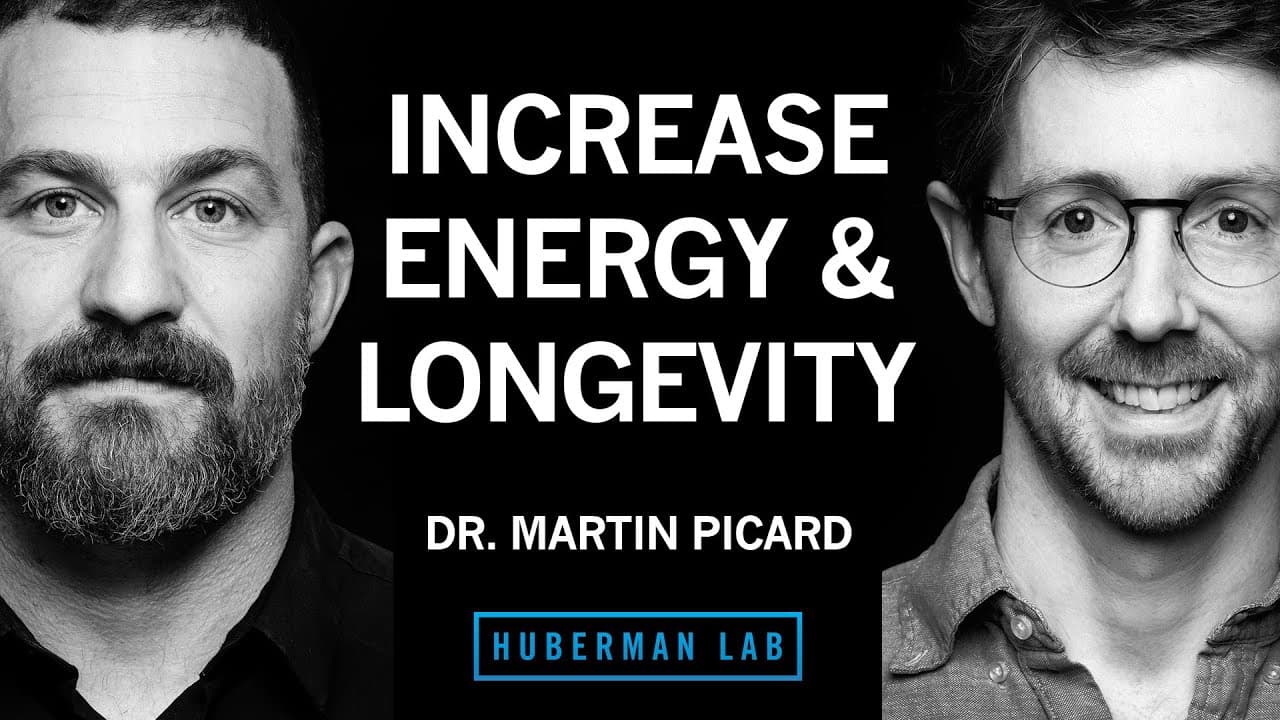
How Can You Improve Energy and Longevity by Optimizing Mitochondria? | Dr. Martin Picard
TL;DR
Improving mitochondrial function through exercise, nutrition, sleep, mindset, and stress management can support energy and healthy aging. Dr. Martin Picard explains that mitochondria produce cellular energy while linking psychological experiences to organ health and vigor, and that only around 7% of longevity may be genetically inherited. His research also indicates that stress-related hair graying can be temporarily reversible. Read on for the mechanisms and practical factors involved.
Transcript
What's the deal? Can people reverse the graying of their hair by reducing their stress? Can people accelerate the graying of their hair by stressing more? Likely both are true. Yes. Okay. And I think what we discovered is that hair graying, at least temporarily, is reversible. This was surprising because it goes against this notion that aging is a ... Read More
Key Insights
- Mitochondria are crucial for energy production and act as antennas linking psychological experiences to physical health.
- Only about 7% of longevity is genetically inherited; 90% is influenced by lifestyle and mindset.
- Mitochondria vary by organ and adapt to specific needs, influencing how different body systems age.
- Exercise, nutrition, and sleep are foundational, but mindset and stress management are also vital for mitochondrial health.
- Hair graying is linked to stress and can be reversible, challenging the notion of linear aging.
- Energy is experienced as a change in state; emotions may represent energy in motion.
- Sickness behavior conserves energy for immune function, highlighting the body's energy budget management.
- Purpose and well-being correlate with better mitochondrial function, suggesting psychological states impact cellular energy.
Install to Summarize YouTube Videos and Get Transcripts
Explore YouTube Video Summarizer or Get YouTube Transcript Extractor
Questions & Answers
Q: How can you improve energy and longevity by optimizing mitochondria?
Exercise, proper nutrition, adequate sleep, mindset, and stress management can all influence mitochondrial function. Dr. Martin Picard explains that these organelles affect cellular energy production, organ health, vigor, and the rate of biological aging.
Q: What do mitochondria do besides produce energy?
Mitochondria act like antennas that connect psychological experiences with organ health, aging, and mental and physical readiness. How well they work in different organs and brain areas reflects factors including exercise, thinking patterns, and stress management.
Q: How much of longevity is genetically inherited?
The discussion says no more than 10% of lifespan is genetically driven, with the best studies placing the estimate around 7%. It describes about 90% of longevity as not genetically inherited, emphasizing the importance of non-genetic influences.
Q: Can reducing stress reverse gray hair?
Dr. Martin Picard’s research found that hair graying can be temporarily reversible and is related to stress. The discussion suggests that reducing stress may reverse graying, while greater stress may accelerate it.
Q: Why does hair turn gray at different times on the same person?
Every hair has the same genome and is exposed to the same exercise, food, and stress conditions, yet individual hairs can gray decades apart. The episode presents this variation as a way to investigate why aging occurs at different rates.
Q: Is biological aging a steady, linear process?
The episode argues that aging is not simply a linear progression in which mitochondria decline steadily from youth to death. Mitochondrial health can drop sharply at particular ages and stages, while eating patterns, mindset, and exercise may help offset those changes.
Q: What is energy at the cellular and organism level?
The discussion defines energy as the potential for change. This broad definition encompasses forms such as thermal, electromagnetic, kinetic, and potential energy while connecting them to physical and mental vigor.
Q: Are mitochondria the same in every organ?
Mitochondria differ across organs and adapt to specific needs. Their function in particular organs and brain areas helps shape organ health, energy production, and how different body systems age.
Summary & Key Takeaways
-
Mitochondria are not merely cellular powerhouses; they translate lifestyle and psychological factors into energy levels and aging rates. Exercise, nutrition, and sleep are essential, but mindset and stress management also play significant roles in mitochondrial function. Understanding these connections can lead to better health and longevity.
-
Dr. Martin Picard emphasizes that only a small percentage of longevity is genetically predetermined. Most of it is influenced by lifestyle choices and mental states. By optimizing mitochondrial function through these avenues, individuals can enhance their physical and mental vitality and potentially reverse signs of aging.
-
Energy is not just about physical capacity but also involves psychological experiences. Emotions and purpose can influence mitochondrial health, affecting overall well-being. Understanding energy as a flow and transformation process can provide insights into improving health through lifestyle adjustments.
Read in Other Languages (beta)
Share This Summary 📚
Summarize YouTube Videos and Get Video Transcripts with 1-Click
Try YouTube Summary with ChatGPT & Claude or YouTube Transcript Generator
Explore More Summaries from Andrew Huberman 📚


Summarize YouTube Videos and Get Video Transcripts with 1-Click
Try YouTube Summary with ChatGPT & Claude or YouTube Transcript Generator