How Do Python Membership, Escape, and Formatting Operators Work?
TL;DR
Python's membership operators test containment: 'in' returns true when the first operand is contained within the second, and 'not in' does the opposite, both matching exact sequences rather than individual characters. Escape characters like backslash-quote insert non-allowed characters into strings, and the percent formatting operator injects external variable values into a string.
Transcript
foreign we will continue our discussion on string operators in Python so without any further delay let's get started the first topic of this presentation is membership operators the second topic is escape sequence operator and the third topic is string formatting operator we will understand these topics one by one let's start from the first topic t... Read More
Key Insights
- Membership operators in Python are binary operators that test containment. The 'in' operator returns true when the first operand is contained within the second operand and returns false otherwise, requiring two operands to evaluate.
- The 'in' operator matches an exact sequence, not individual characters. Typing 'PTA' in 'Just Breathe' returns false because that exact sequence is absent, even though each letter appears somewhere in the string.
- The 'not in' operator does the opposite of 'in', returning true only when the first operand is not contained within the second operand, so 'just' not in 'Just Breathe' returns false because the substring is present.
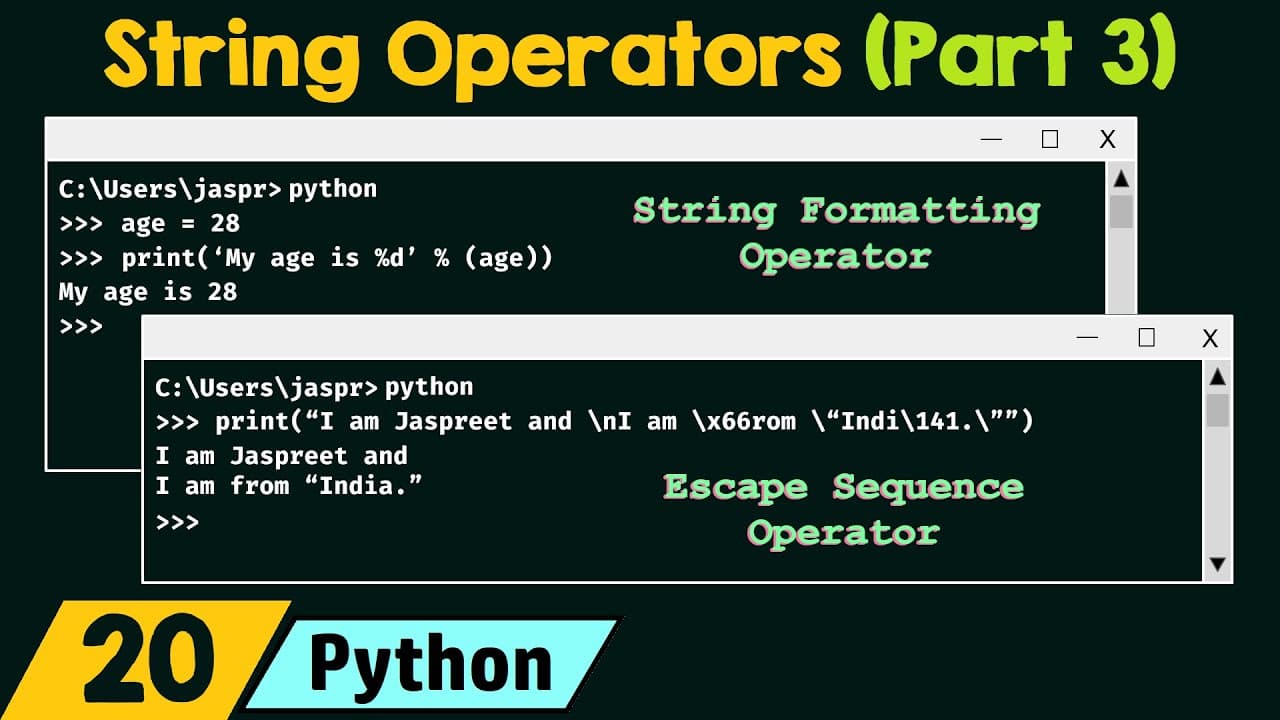
- An escape character is used to insert a non-allowed character into a string. It combines the escape operator, a backslash, followed by the non-allowed character you want to include in the string.
- Double quotes cannot appear directly inside a double-quoted string because they wrap the entire string. Placing a backslash in front of them escapes them so they are treated as part of the string content.
- Common escape sequences include backslash-n for a new line, backslash-b for a backspace, backslash-t for a tab, and a double backslash to insert an actual backslash into the string.
- Backslash-x followed by a two-digit hexadecimal value inserts the character for that code, and backslash followed by a three-digit octal value inserts the character for that octal code, each converted internally to a decimal ASCII value.
- The percent string formatting operator inserts external values into a string using format specifiers such as %d for integers, %c for characters, %s for strings, and %f for floating point values, also called format specifiers.
Install to Summarize YouTube Videos and Get Transcripts
Explore YouTube Video Summarizer or Get YouTube Transcript Extractor
Questions & Answers
Q: What are membership operators in Python?
Membership operators in Python are the 'in' operator and the 'not in' operator. Both are binary operators requiring two operands. The 'in' operator returns true if the first operand is contained within the second operand and false otherwise. The 'not in' operator returns true if the first operand is not contained within the second operand, performing the opposite check of the 'in' operator.
Q: Why does the 'in' operator return false when all the characters exist in the string?
The 'in' operator checks for an exact sequence, not for individual characters. In the video, typing 'PTA' in 'Just Breathe' returns false because that precise sequence does not appear in the string, even though the letters p, t, and a each exist somewhere within it. Membership is about the contiguous sequence matching, not the presence of separate characters scattered across the string.
Q: How does the 'not in' operator differ from the 'in' operator?
The 'not in' operator does the opposite of what the 'in' operator does. It returns true when the first operand is not contained within the second operand, and false when it is contained. For example, 'just' not in 'Just Breathe' returns false because 'just' is actually present, while 'PTA' not in 'Just Breathe' returns true because that exact sequence is absent from the string.
Q: What is an escape character in Python?
An escape character is used to insert a non-allowed character into a string. It consists of two parts: the escape operator, which is a backslash, followed by the non-allowed character you want to include. By adding a backslash in front of a character that would otherwise cause an error, Python treats it as part of the string rather than as syntax, allowing you to include characters like quotation marks.
Q: How do you include double quotes inside a Python string?
Double quotes cannot be placed directly inside a string wrapped in double quotes because they are used to mark the beginning and end of the entire string, which causes a syntax error. To include them, you convert them into escape characters by adding a backslash in front of each quote. Python then escapes the quotes and treats them as part of the string content instead of string delimiters.
Q: What are the common escape sequences in Python?
The video lists several common escape sequences. Backslash-n stands for a new line, backslash-b stands for a backspace, and backslash-t stands for a tab. A double backslash inserts an actual backslash into the string, which otherwise could not be included. Backslash-x with a hexadecimal value and a backslash with an octal value insert characters from those numbering systems, converted internally to decimal ASCII values.
Q: How do hexadecimal and octal escape sequences work in a string?
A backslash-x followed by a two-digit hexadecimal number inserts the character represented by that code, while a backslash followed by a three-digit octal number inserts the character for that octal code. Python converts each value to its decimal equivalent by multiplying each digit by its place value and summing the results, then uses that decimal number as the ASCII code to determine which character to print.
Q: What is the string formatting operator in Python and how is it used?
The string formatting operator is the percent sign, used to format a string by inserting external values into it. Common formatters, also called format specifiers, include %d for a decimal or integer, %c for a character, %s for a string, and %f for a floating point value. By assigning a value to a variable and referencing it with a specifier, you can change the value in one place without modifying the string itself.
Summary & Key Takeaways
-
The video covers three string operators in Python: membership operators, the escape sequence operator, and the string formatting operator. Membership operators are 'in' and 'not in', binary operators that test whether the first operand is contained within the second operand and return true or false accordingly.
-
The 'in' operator returns true only when an exact sequence appears within another sequence, not just its individual characters. The 'not in' operator returns the opposite result, giving true when a sequence is absent, demonstrated using strings like 'Just Breathe' in the interactive shell.
-
Escape characters combine a backslash with a non-allowed character to include quotes or special characters in strings. The percent formatting operator uses specifiers like %d, %c, %s, and %f to insert variable values into strings without hardcoding them directly.
Read in Other Languages (beta)
Share This Summary 📚
Summarize YouTube Videos and Get Video Transcripts with 1-Click
Try YouTube Summary with ChatGPT & Claude or YouTube Transcript Generator
Explore More Summaries from Neso Academy 📚



Summarize YouTube Videos and Get Video Transcripts with 1-Click
Try YouTube Summary with ChatGPT & Claude or YouTube Transcript Generator