What Are Stative Verbs in English Grammar?
TL;DR
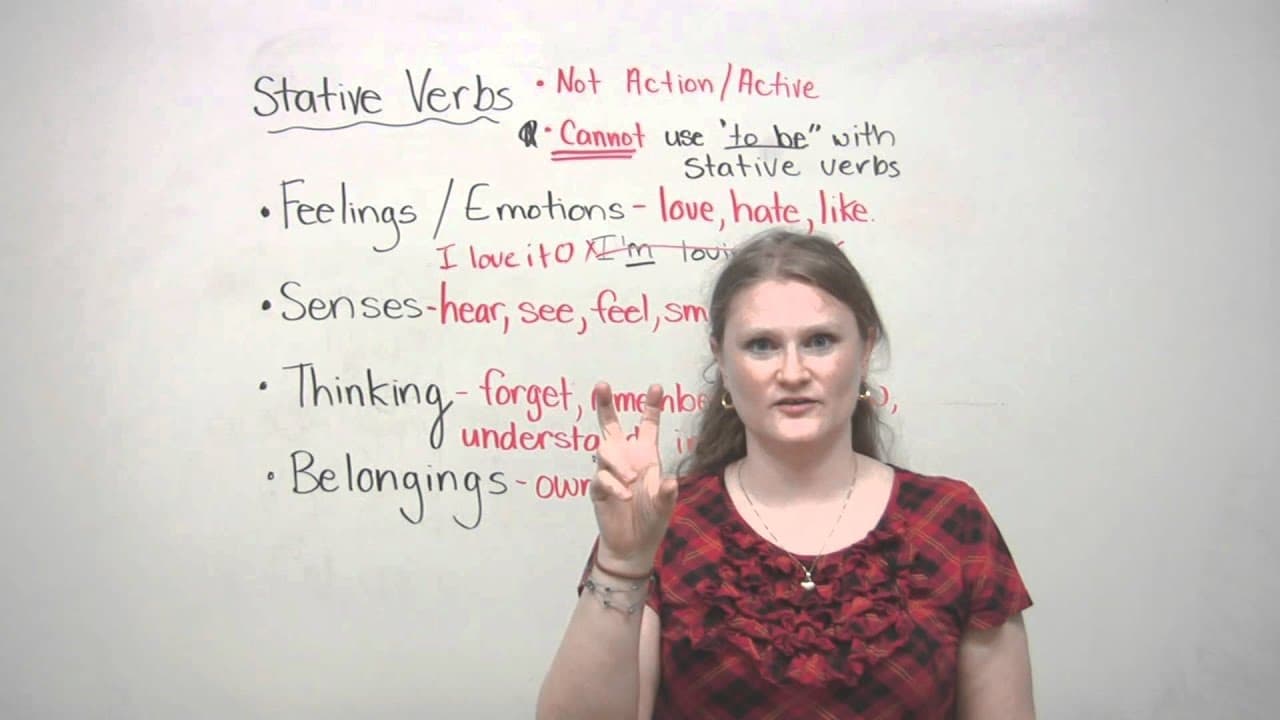
Stative verbs describe states or conditions rather than actions and can be categorized into feelings, senses, thinking, and belonging. Using 'to be' with stative verbs, like saying 'I'm loving it,' is grammatically incorrect; you should say 'I love it.' While strict in grammar, these verbs can be used more flexibly in casual conversation.
Transcript
Greetings and salutations. My name is Ronnie, and today I'm going to teach you, by request, some verbs that we like to call "stative verbs." "What are stative verbs?" you ask? Hmm. Stative verbs are verbs that are not action verbs. So verbs like "jump" or "run" or "wave" or "smile" all have actions to do with them. I like to call these "active verb... Read More
Key Insights
- 🤔 Stative verbs describe states or conditions, not actions, and fall into categories like feelings, senses, thinking, and belonging.
- 👔 Using "to be" with stative verbs is grammatically incorrect and should be avoided in formal English usage.
- 👻 While there are strict rules for stative verbs in grammar, conversational language often allows for more flexibility and informal usage.
- ❓ Understanding stative verbs is essential for accurate and effective communication in English language usage.
- 💁 Stative verbs highlight the importance of context and intended meaning in choosing the appropriate verb form for a given situation.
- ❓ Mastery of stative verbs can enhance overall language proficiency and communication skills in English.
- 🙊 Applying the correct usage of stative verbs can improve clarity and precision in written and spoken English language contexts.
Install to Summarize YouTube Videos and Get Transcripts
Explore YouTube Video Summarizer or Get YouTube Transcript Extractor
Questions & Answers
Q: What are stative verbs, and why are they important in grammar?
Stative verbs describe states or conditions, not actions, and are crucial in distinguishing between different types of verbs in English grammar.
Q: Why is it incorrect to use "to be" with stative verbs?
Using "to be" with stative verbs leads to grammatically incorrect constructions that do not accurately portray the intended meaning of the verb.
Q: How do stative verbs differ from active verbs?
Stative verbs focus on describing states or conditions, while active verbs highlight actions or behaviors, leading to distinct usage and grammar rules for each type.
Q: Can stative verbs be used differently in casual conversation compared to formal grammar?
Yes, while stative verbs have strict rules in formal grammar, in casual conversation or slang, people often use them with "to be" to express their thoughts, feelings, or sensations more informally.
Summary & Key Takeaways
-
Stative verbs are not action verbs and include categories like feelings, senses, thinking, and belonging.
-
Using "to be" with stative verbs is grammatically incorrect, such as saying "I'm loving it" instead of "I love it."
-
While stative verbs have specific rules in grammar, they can be used differently in casual conversation or slang.
Read in Other Languages (beta)
Share This Summary 📚
Summarize YouTube Videos and Get Video Transcripts with 1-Click
Try YouTube Summary with ChatGPT & Claude or YouTube Transcript Generator
Explore More Summaries from English with Ronnie · EnglishLessons4U with engVid 📚





Summarize YouTube Videos and Get Video Transcripts with 1-Click
Try YouTube Summary with ChatGPT & Claude or YouTube Transcript Generator