How Should Engineers Work With AI Coding Agents?
TL;DR
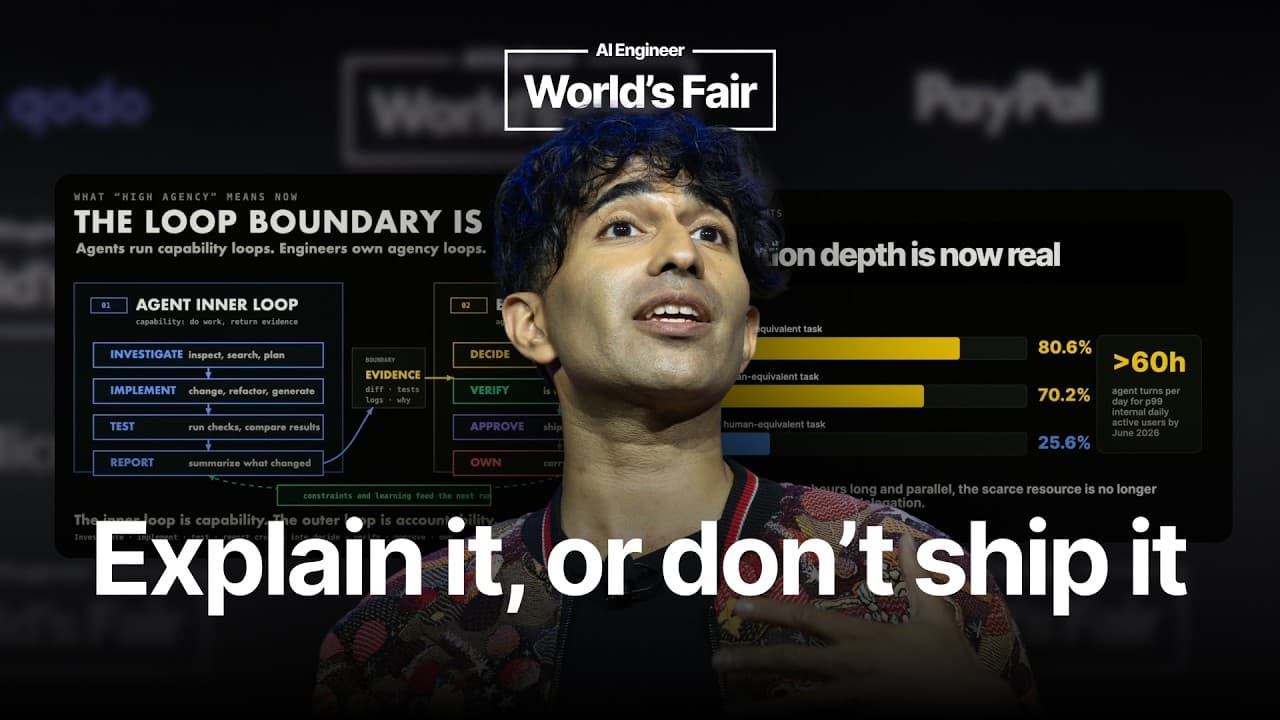
Engineers should delegate coding tasks to AI agents while retaining responsibility for evidence, system understanding, and production decisions. Humans must decide whether generated work ships, is blocked, is redirected, or proceeds with accepted risk. With 96% of engineers not fully trusting AI code but only about half always verifying it before committing, teams need cheaper, clearer verification that is harder to skip. Read on for practical principles covering agent harnesses, clean code, judgment, and accountability.
Transcript
[music] >> Howdy, folks. So, good afternoon or good whatever time it is when you're watching this on YouTube. I'm really excited to be here. And um today I want to talk to you about really uh what it takes to keep the human in the loop where engineering is concerned. I really want to start with a human side before we talk about the architecture her... Read More
Key Insights
- The engineer of the future is defined by choosing worthwhile work and owning the evidence, understanding, and verdict surrounding automated output. Engineering value shifts toward deciding whether software ships, is blocked, is redirected, or proceeds with accepted risk.
- Quality produces evidence, while a verdict assigns responsibility for a production decision. Answerability allows an engineer to stand behind that verdict, making accountability a practical engineering requirement once AI-generated and AI-assisted code becomes a normal part of software repositories.
- Harness engineering turns model intelligence into something delegable by surrounding the model with context, tools, a file system, and version control. Loop engineering extends that structure through repeated prompting, checking, remembering, and deciding what should happen next.
- Clean code improves both human maintainability and agent efficiency. The cited Sonar research found similar pass rates in clean and messy repositories, but clean code required fewer tokens and fewer revisits, connecting maintainability directly to software-factory efficiency.
- Verification is the bottleneck when agents generate more code than humans can review. The cited survey says 96% of engineers do not fully trust AI code, while only about half always verify it before committing, creating distrust without sufficient review bandwidth.
- Taste is the ability to make strong qualitative judgments before an objective metric or market verdict exists. It becomes valuable when generation is cheap, but it is not permanent protection because models can learn from examples, critiques, preferences, and previous decisions.
- An engineer is more than someone who can make a computer perform a task. Engineering requires reasoning about systems and constraints, defending trade-offs, managing risk, and remaining reachable and responsible when deployed software begins to fail.
- Cognitive debt is the widening gap between how much code exists and how much the team genuinely understands. Cognitive surrender occurs when a person adopts an AI answer before forming an independent judgment, replacing accountable delegation with blind acceptance.
Install to Summarize YouTube Videos and Get Transcripts
Explore YouTube Video Summarizer or Get YouTube Transcript Extractor
Questions & Answers
Q: How should software engineers work with AI coding agents?
Engineers should delegate work to agents while retaining judgment, system understanding, and responsibility for production outcomes. They should require evidence and independently decide whether the result ships, is blocked, is redirected, or proceeds with accepted risk.
Q: What skills will define the engineer of the future?
The engineer of the future will be defined by the ability to choose what is worth doing and determine which engineering mode and quality bar a product needs. Engineers must also own the evidence, understanding, and verdict surrounding increasingly automated work.
Q: What does answerability mean in AI-assisted software engineering?
Answerability is what allows an engineer to stand behind a production verdict and accept responsibility for it. It requires knowing what constraints guided the work, what evidence was produced, what risk was accepted, and who owns the result.
Q: What is the difference between harness engineering and loop engineering?
Harness engineering combines a model with context, tools, a file system, and Git, turning its intelligence into something engineers can delegate to. Loop engineering creates systems that repeatedly prompt, check, remember, and decide what happens next rather than relying on one run.
Q: What is a software factory in AI-assisted engineering?
A software factory emerges when models, harnesses, and engineering loops operate together. Agents work inside the inner loop and produce evidence, while humans remain responsible for the production decisions.
Q: Why does clean code matter when AI agents write software?
Clean code helps both the next human and the next agent working in a repository. Sonar research cited in the talk found roughly equal pass rates for clean and messy repositories, but clean code required fewer tokens and fewer revisits, improving factory efficiency.
Q: Why is verification a bottleneck for AI-generated code?
Agents can generate more code than humans have the capacity to review, so cheaper generation does not automatically produce cheaper review. The cited Sonar figures say 96% of people do not fully trust AI code, while only about half always verify it before committing, creating distrust without sufficient review bandwidth.
Q: Where does human judgment create leverage when agents generate code?
Human judgment creates leverage at the production checkpoint, where evidence must become an accountable decision. Engineers determine whether work should ship, be blocked, change direction, or proceed with acknowledged risk, especially when generation scales faster than human comprehension.
Summary & Key Takeaways
-
AI agents are changing engineering from direct code production toward supervising systems that generate, test, and revise software. Humans remain the highest-leverage checkpoint because production decisions require context, risk acceptance, and ownership. The engineer must decide whether work ships, gets blocked, changes direction, or proceeds with acknowledged risk.
-
Harness engineering combines a model with context, tools, files, and version control, while loop engineering adds repeated prompting, checking, memory, and decisions about what happens next. Together, these elements create software factories. Their effectiveness depends on evidence, maintainable code, verification systems, and accountable humans who can understand and judge their outputs.
-
Career advantages such as speed, recall, verification, taste, and judgment can weaken as models improve. Engineers should therefore keep moving their value to higher levels of responsibility. They must avoid cognitive debt and cognitive surrender, preserve their ability to explain systems, critique generated work, defend trade-offs, manage constraints, and respond when production fails.
Read in Other Languages (beta)
Share This Summary 📚
Summarize YouTube Videos and Get Video Transcripts with 1-Click
Try YouTube Summary with ChatGPT & Claude or YouTube Transcript Generator
Explore More Summaries from AI Engineer 📚



Summarize YouTube Videos and Get Video Transcripts with 1-Click
Try YouTube Summary with ChatGPT & Claude or YouTube Transcript Generator