What Is Homeostasis and How Is It Maintained?
TL;DR
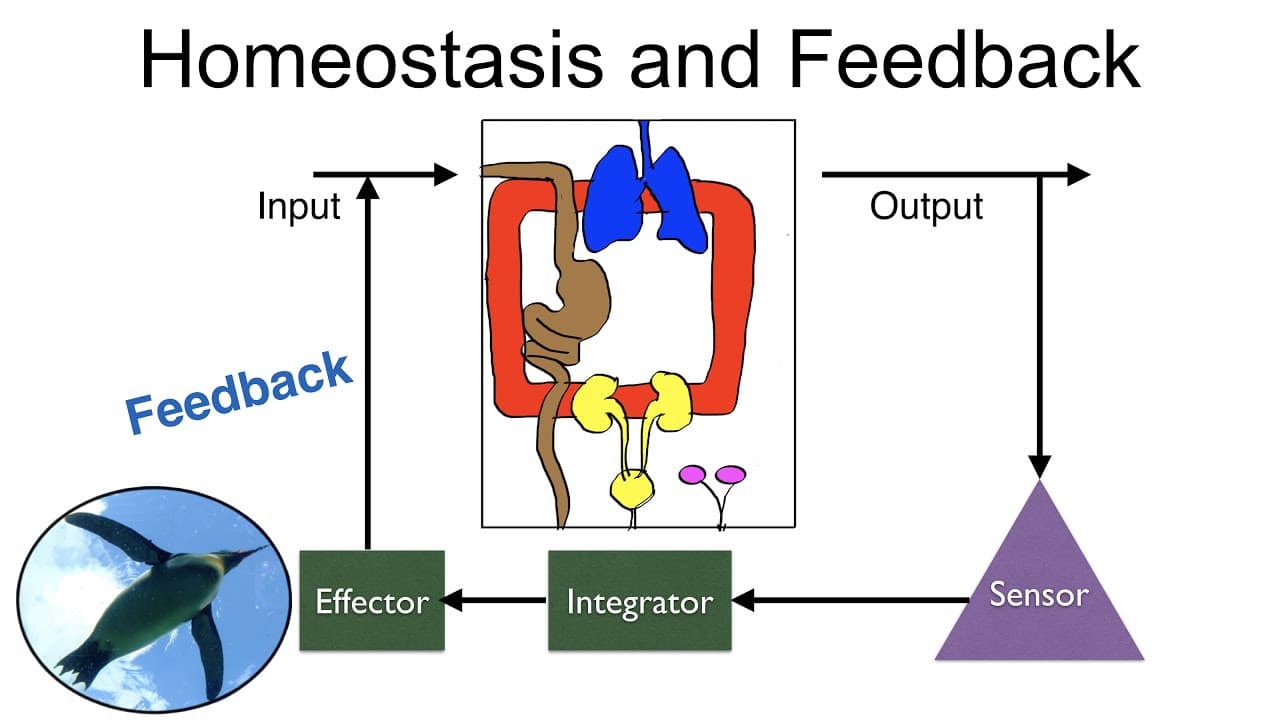
Homeostasis is the process that maintains a stable internal environment despite external changes, achieved through dynamic feedback mechanisms. Negative feedback loops oppose changes to keep variables within a narrow range, while positive feedback loops enhance changes for rapid responses during extreme events, like childbirth. Without homeostasis, the body risks disease.
Transcript
Hello and welcome to the PenguinProf channel. In today's episode, I'm going to talk about homeostasis and feedback. We're going to get into what homeostasis is, how it's maintained and the components of feedback loops. Before we get into it, you know the drill. I got to ask for your support. Please take a second and feed the Penguin. It feels so... Read More
Key Insights
- ❓ Homeostasis is crucial for maintaining stable conditions in the body and preventing disease.
- 🎁 The internal and external environment constantly present challenges to the body's ability to maintain homeostasis.
- 🔁 Negative feedback loops keep variables within a narrow range, while positive feedback loops enhance changes.
- ❓ Homeostasis is achieved through the coordination of sensors, integrators, and effectors.
- 😥 The body's variables oscillate around a set point value, ensuring dynamic constancy.
- 🔁 Negative feedback loops are stabilizing, while positive feedback loops are destabilizing.
- 🔁 Positive feedback loops are used for extreme processes that require a rapid response.
Install to Summarize YouTube Videos and Get Transcripts
Explore YouTube Video Summarizer or Get YouTube Transcript Extractor
Questions & Answers
Q: What is homeostasis, and why is it important?
Homeostasis is the dynamic constancy of the internal environment. It is essential for maintaining stable conditions in the body, as deviations from homeostasis can lead to disease.
Q: How does the body maintain homeostasis in a constantly changing environment?
The body uses negative feedback loops to oppose changes and keep variables within a narrow range. This involves sensors, integrators, and effectors working together to constantly monitor and regulate various physiological processes.
Q: What is the difference between negative and positive feedback loops?
In negative feedback, effectors push the variable back towards the set point, maintaining stability. In positive feedback, effectors enhance the change, leading to a destabilizing effect. Positive feedback is often used for extreme processes that require a rapid response.
Q: Can you provide examples of negative and positive feedback loops in the body?
An example of a negative feedback loop is thermoregulation, where the body regulates body temperature. An example of a positive feedback loop is childbirth, where contractions intensify as the baby pushes against the cervix.
Summary & Key Takeaways
-
Homeostasis is crucial for maintaining a relatively constant internal environment despite constant changes in the external environment.
-
Variables in the body are maintained within limits, oscillating around a set point value.
-
Homeostasis is maintained through negative feedback, where effectors oppose changes, and positive feedback, where effectors enhance changes.
Read in Other Languages (beta)
Share This Summary 📚
Summarize YouTube Videos and Get Video Transcripts with 1-Click
Try YouTube Summary with ChatGPT & Claude or YouTube Transcript Generator
Explore More Summaries from ThePenguinProf 📚





Summarize YouTube Videos and Get Video Transcripts with 1-Click
Try YouTube Summary with ChatGPT & Claude or YouTube Transcript Generator