What Is the Process of Action Potentials?
TL;DR
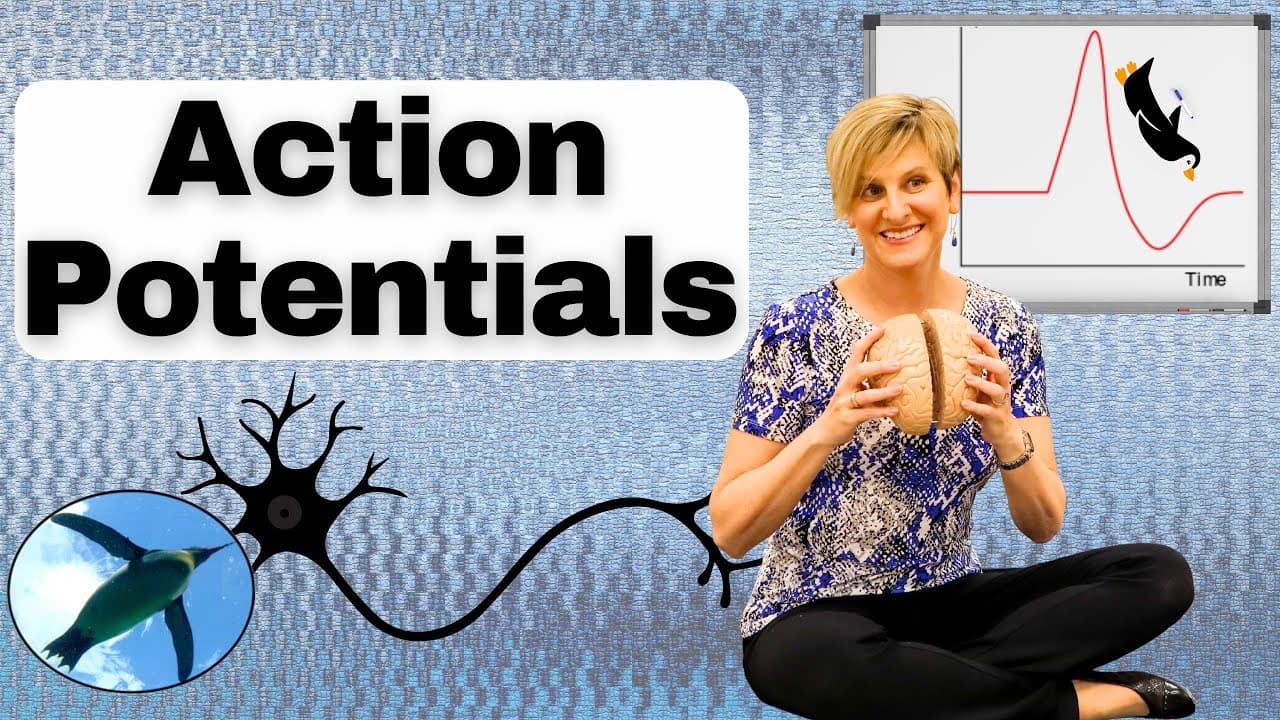
Action potentials are rapid electrochemical signals that propagate along neurons. They are driven by the movement of sodium and potassium ions through voltage-gated channels, leading to depolarization and repolarization of the cell membrane.
Transcript
Hello and welcome to the Penguin Prof Channel! Is this you studying the nervous system and the action potential? Yeah, it's, It's pretty severe. I know, but don't worry. We've got the action potential and those voltage gated channels today. So here we are, basic neuron function. We have the arrival of a stimulus. It says, GO! We reach threshold at ... Read More
Key Insights
- 😟 The action potential is a crucial mechanism for communication in the nervous system.
- ⛽ The membrane potential is maintained by the sodium-potassium pump and potassium leak channels.
- 🖐️ Voltage-gated channels play a vital role in initiating and regulating the action potential.
- 😑 Both sodium and potassium ions are involved in generating the action potential.
- 🔬 Rapid activation and slow inactivation gates control the movement of ions through voltage-gated channels.
- 🥺 Sodium influx leads to depolarization, while potassium efflux causes repolarization.
- 🍃 Hyperpolarization occurs when potassium continues to leave the cell.
Install to Summarize YouTube Videos and Get Transcripts
Explore YouTube Video Summarizer or Get YouTube Transcript Extractor
Questions & Answers
Q: What is the function of voltage-gated sodium channels in the action potential?
Voltage-gated sodium channels open when the membrane reaches threshold, allowing sodium ions to flow in and depolarize the cell, initiating the action potential.
Q: How do the rapid activation gates in the voltage-gated sodium channel work?
The rapid activation gates, made up of positively charged arginine residues, move in response to changes in membrane polarity, opening a channel for sodium ions to pass.
Q: What happens at the peak of the action potential?
At the peak, slow inactivation gates form a plug, stopping sodium influx. Voltage-gated potassium channels then open, allowing potassium ions to leave the cell, leading to repolarization.
Q: What causes hyperpolarization during the action potential?
Potassium continues to leave the cell, causing hyperpolarization, where the membrane potential goes below the resting level, reaching -80 millivolts.
Summary & Key Takeaways
-
The nervous system relies on the action potential, which is an electrochemical signal that spreads down the axon.
-
The cell membrane separates the extracellular and intracellular fluid, creating an electric potential difference of -70 millivolts.
-
Sodium and potassium ions play crucial roles in the action potential, with voltage-gated channels allowing their movement.
Read in Other Languages (beta)
Share This Summary 📚
Summarize YouTube Videos and Get Video Transcripts with 1-Click
Try YouTube Summary with ChatGPT & Claude or YouTube Transcript Generator
Explore More Summaries from ThePenguinProf 📚





Summarize YouTube Videos and Get Video Transcripts with 1-Click
Try YouTube Summary with ChatGPT & Claude or YouTube Transcript Generator