How to validate YouTube ideas for growth in 2026
TL;DR
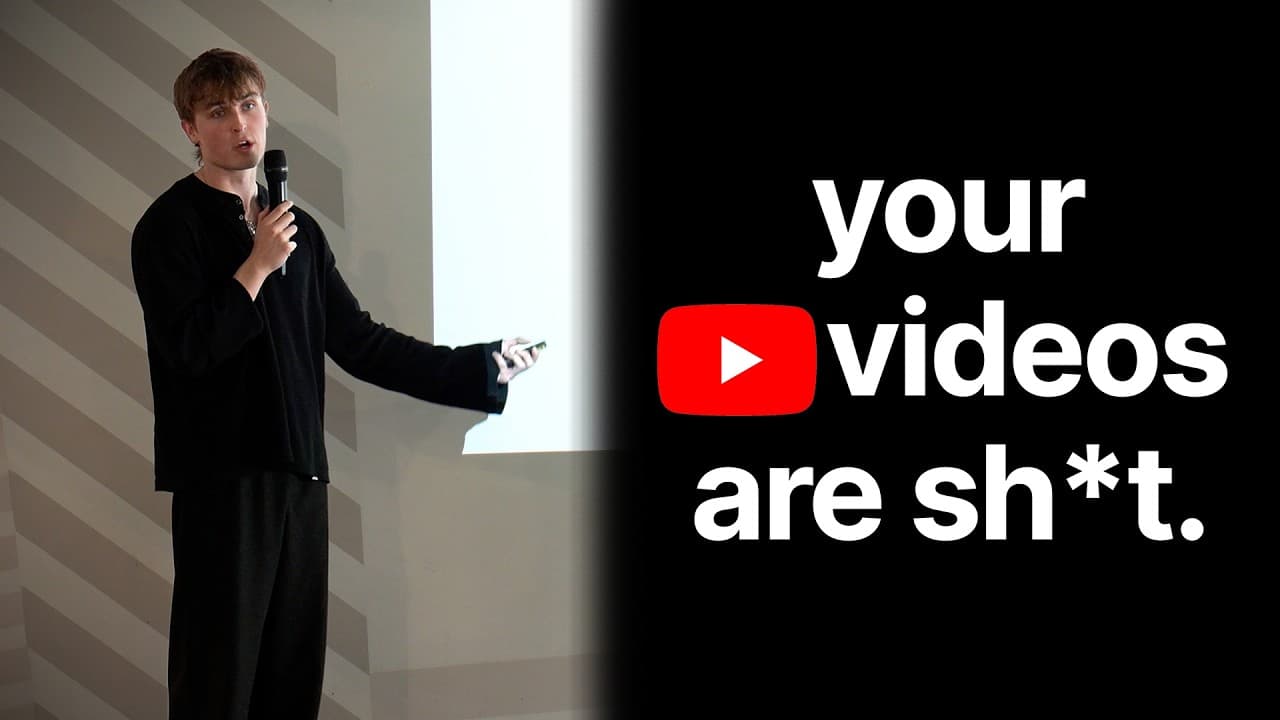
The key is to do thorough upfront research before filming. If you are confident your video idea is strong and the quality is high, you are more likely to succeed; test ideas with high diligence, not just hooks. Focus on understanding viewer psychology and use adjacent niches for inspiration to beat the market.
Transcript
What are the things to think about when moving mindset or doing like more long form aside from like the algorithms? >> Long form is quality over quantity first and foremost. So with short form, you can obviously test ideas which are basically the hooks and angles at a much higher frequency. But you can't properly test a YouTube video idea if you do... Read More
Key Insights
- You should perform the most due diligence before making a YouTube video to ensure the idea will work.
- High confidence in a video idea reduces the risk of underperforming content and helps diagnose issues later.
- Long form content benefits from quality over quantity, while short form is useful for testing ideas and hooks.
- Testing ideas with a higher frequency can reveal what hooks resonate, but only after strong video quality is established.
- Resonance can be found by studying viewer psychology and applying successful formats from adjacent niches.
- Research often uses cross-niche concepts to validate audience interest and potential success.
- A top priority is to generate enough views to create a data set that supports decision making.
- Bottlenecks in conversions should be diagnosed after ensuring traffic is sufficient and properly tracked.
Install to Summarize YouTube Videos and Get Transcripts
Explore YouTube Video Summarizer or Get YouTube Transcript Extractor
Questions & Answers
Q: How to start validating a YouTube idea before filming?
Begin with deep due diligence on the concept, ensuring the idea has strong potential to resonate with the target audience. Evaluate the niche, potential hooks, and the expected viewer psychology. Confidence should be high enough that you are excited to post, not hesitant, to avoid second guessing after release.
Q: What role does research play in choosing video topics?
Research helps identify the most promising ideas by testing elements such as titles and thumbnails from adjacent niches. The goal is to uncover what resonates with viewers who share similar psychology and intent, then adapt a proven format to your niche while maintaining relevance and accuracy.
Q: Why is testing hooks important in short form content?
Short form testing allows rapid iteration on hooks and angles, enabling you to identify which opening lines grab attention. This process should be balanced with ensuring the overall video quality remains high, so the audience continues watching beyond the hook and the video delivers value.
Q: How should you handle niche adjacency in idea generation?
Look at related niches where the audience has similar goals and psychology. Borrow successful formats from those areas and adapt them to your own niche, ensuring the core promise remains relevant to your viewers and that you maintain authenticity and credibility.
Q: When should you consider increasing posting frequency?
Increase frequency only when you have demonstrated the ability to diagnose underperformance efficiently. Start with a steady pace such as one video per week and move to higher frequency only after you are confident in your processes and data supports scaling.
Q: What is the importance of audience psychology in video design?
Understanding viewer psychology guides topic selection, framing, and delivery. By aligning content with what the audience wants to achieve and how they think, you improve engagement, watch time, and the likelihood of converting viewers into leads or customers.
Q: How does attribution tracking affect decision making?
With proper attribution tracking, you can identify whether traffic is driving conversions or if bottlenecks exist further down the funnel. This data helps you prioritize improvements to titles, thumbnails, or landing pages to maximize results from YouTube traffic.
Q: What should a video promise and proof strategy look like?
The promise should align with what viewers clicked for, and the proof should reinforce your credibility for that outcome. Matching the audience’s expectations with strong social proof and clear outcomes increases trust and the likelihood of action from viewers.
Summary & Key Takeaways
-
This summary explains that success on YouTube comes from deep pre-production research and testing ideas with high confidence before posting. It emphasizes quality over frequency for long form content, while allowing higher testing of hooks in short form. The approach includes using adjacent niches to validate concepts and tailoring content to the target audience.
-
The guidance discusses balancing research rigor with practical production pacing, such as posting one video per week initially and increasing only when the channel can sustain it. It also covers diagnosing bottlenecks with proper attribution and data once traffic grows.
-
Ultimately, the strategy aims to secure a confident, data-informed path to growing a YouTube channel by understanding viewer psychology, testing formats from other niches, and ensuring the video aligns with audience expectations.
Read in Other Languages (beta)
Share This Summary 📚
Summarize YouTube Videos and Get Video Transcripts with 1-Click
Try YouTube Summary with ChatGPT & Claude or YouTube Transcript Generator
Explore More Summaries from Jake Trinder 📚
Summarize YouTube Videos and Get Video Transcripts with 1-Click
Try YouTube Summary with ChatGPT & Claude or YouTube Transcript Generator