How Does a REST API Connect Clients and Servers?
TL;DR
A REST API lets a client and server communicate through standardized requests and responses. Clients use HTTP methods such as GET, POST, PUT, and DELETE on resource endpoints, while servers commonly return JSON data. REST APIs are described as simple, scalable, stateless, cache-supporting, and suitable for cloud applications that must read or modify resources.
Transcript
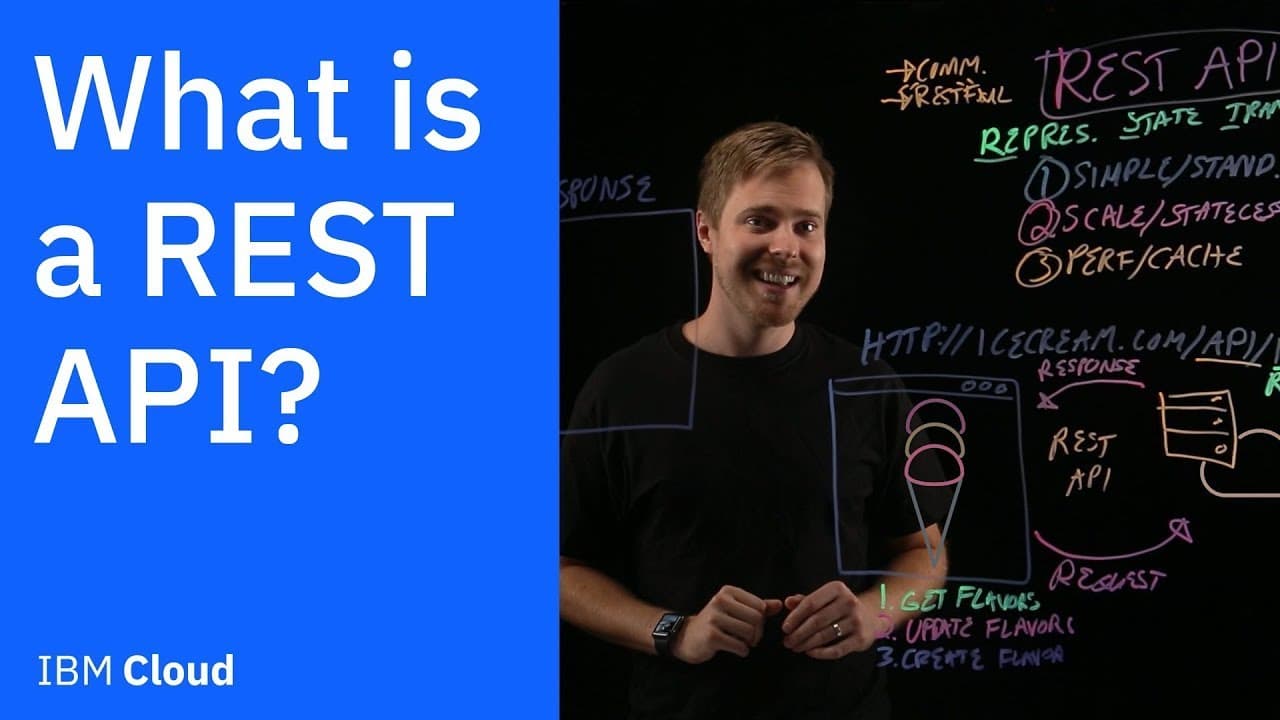
What is a REST API? What are the benefits - and how are they fundamental to your cloud application development? I'm Nathan Heckman from IBM Cloud, and I'm going to answer that for you today, but before i do please hit that subscribe button. Let's jump in with an example. Let's say that you work for an ice cream shop and you're trying to build a web... Read More
Key Insights
- REST is short for Representational State Transfer, a standardized software architecture style and a specific, widely used type of API. Its central purpose is communication between a client, such as a web application, and a server, such as a cloud-based service.
- A RESTful web service is a service that uses REST APIs to communicate. In the ice cream shop example, a web application communicates with a cloud-based server to display available flavors and allow workers to change the flavor data.
- REST APIs provide a simple and standardized approach to communication. Their established structure reduces the need to decide how requests and data should be formatted separately each time a client needs to communicate with a server.
- REST APIs are scalable and stateless, which helps services accommodate increasing complexity and modifications. Statelessness means the client and server do not need to track data state across their communications in the manner described by the presentation.
- REST APIs can maintain high performance partly because they support caching. This caching support is presented as a reason performance can remain high while a service becomes more complex.
- A REST API endpoint identifies the API and the resource being addressed. In icecream.com/api/flavors, the api segment marks the API portion, while flavors identifies the resource that the client wants to retrieve or modify.
- CRUD represents Create, Read, Update, and Delete. REST APIs associate these actions with HTTP methods: POST creates a resource, GET reads a resource, PUT updates or replaces a resource, and DELETE removes a resource.
- A REST API exchange consists primarily of a request and a response. A request may contain an operation, endpoint, parameters or body data, and headers, while the server typically responds with JSON data representing the result.
Install to Summarize YouTube Videos and Get Transcripts
Explore YouTube Video Summarizer or Get YouTube Transcript Extractor
Questions & Answers
Q: What is a REST API and what does REST mean?
REST means Representational State Transfer. A REST API is a standardized software architecture style and a particular type of API used for communication between clients and servers. A web application can send requests through the API to a cloud-based server, which processes them and returns responses. A service using REST APIs may also be described as a RESTful web service.
Q: How does a REST API connect a client and server?
A REST API connects a client and server through requests and responses. The client sends a request containing an HTTP operation, an endpoint, and, when needed, parameters or body data and headers. The server processes that request and sends a response back to the client. The response is typically JSON data representing the requested resource or the result of a change.
Q: What information can a REST API request contain?
A REST API request can contain an HTTP operation, a resource endpoint, parameters or a body, and headers. The operation specifies the desired action, while the endpoint identifies the resource involved. Parameters or body data provide information needed for the action. Headers are a special request component that may contain an API key or other authentication data.
Q: How do CRUD actions map to REST API methods?
CRUD stands for Create, Read, Update, and Delete, which are common actions performed during client-server communication. In the REST API mapping presented, POST corresponds to creating a resource, GET corresponds to reading or retrieving one, PUT corresponds to updating or replacing one, and DELETE corresponds directly to deleting one. These HTTP methods state what should happen to the selected resource.
Q: How does GET retrieve resources from a REST API?
GET retrieves resource data from a REST API. In the ice cream shop example, the client sends a GET request to /api/flavors to obtain the flavors currently in stock. The server responds with an array of flavor resources, including strawberry and mint chocolate. The application can then use that returned data to display the shop's available flavors.
Q: How does PUT update a resource in a REST API?
PUT updates or replaces a selected resource. When mint chocolate runs out, the example sends a PUT request to /api/flavors/1, where 1 identifies the flavor being replaced. The request body specifies chocolate as the new flavor. The server responds by acknowledging that the resource with ID 1 now has the flavor value chocolate.
Q: How does POST create a resource in a REST API?
POST creates a new resource using data supplied by the client. In the ice cream shop example, the client sends a POST request to /api/flavors and includes restful raspberry in the request body. The server creates the flavor and returns a response showing the new resource with ID 2 and the flavor value restful raspberry.
Q: Why are REST APIs useful for cloud applications?
REST APIs are useful for cloud applications because they provide simple, standardized communication between clients and cloud-based servers. They are described as scalable and stateless, making modifications easier as a service becomes more complex without tracking state across client and server. They also support caching, which contributes to high performance as the service grows in complexity.
Summary & Key Takeaways
-
REST stands for Representational State Transfer, a standardized software architecture style used for communication between clients and servers. A service that communicates through REST APIs may be called a RESTful web service. REST APIs give cloud applications a consistent way to request, receive, create, update, or delete resource data.
-
A REST API request can include an HTTP operation, a resource endpoint, parameters or a body, and headers. Headers may carry an API key or other authentication data. After processing the request, the server returns a response, which is typically represented as JSON data for the client to use.
-
The ice cream shop example uses the resource endpoint /api/flavors. GET retrieves flavors currently in stock, PUT replaces the flavor identified by a particular ID, and POST creates a new flavor from data in the request body. Each response returns data showing the retrieved, updated, or created resource.
Read in Other Languages (beta)
Share This Summary 📚
Summarize YouTube Videos and Get Video Transcripts with 1-Click
Try YouTube Summary with ChatGPT & Claude or YouTube Transcript Generator
Explore More Summaries from IBM Technology 📚






Summarize YouTube Videos and Get Video Transcripts with 1-Click
Try YouTube Summary with ChatGPT & Claude or YouTube Transcript Generator